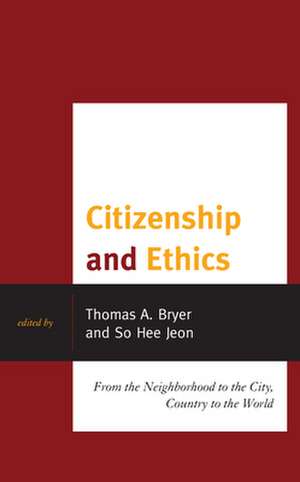
Citizenship and Ethics: From the Neighborhood to the City, Country to the World: Democratic Dilemmas and Policy Responsiveness
Editat de Thomas A. Bryer, So Hee Jeon Contribuţii de Seongho An, Mahabat Baimyrzaeva, Jennifer M. Brinkerhoff, Stephanie Britt, Chao Guo, Alfred Tat-Kei Ho, Pradeep Chandra Kathi, Pamela S. Medina, Jack W. Meek, Mehnaaz Momen, Vishnu Muraleedharan, Cristian Pliscoff, Daniel Seigler, Wanzhu Shi, Ruechagorn Trairatananusorn, Feng Wang, Weijie Wang, Michael Yusheng Wu, Wai-Hang Yeeen Limba Engleză Hardback – 3 apr 2021

Preț: 660.68 lei
Preț vechi: 1054.43 lei
-37%
Puncte Express: 991
Carte tipărită la comandă
Livrare economică 19 noiembrie-03 decembrie
Livrare prin curier în România Termenul estimat este afișat lângă disponibilitate.
Transport gratuit pentru acest produs Plată online sau ramburs, în funcție de opțiunile comenzii.
Retur gratuit în 14 zile Comandă securizată și suport în română.
Specificații
ISBN-13: 9781793613943
ISBN-10: 179361394X
Pagini: 330
Ilustrații: 11 b/w illustrations;17 tables;
Dimensiuni: 152 x 229 x 27 mm
Greutate: 0.61 kg
Editura: Bloomsbury Publishing
Colecția Lexington Books
Seria Democratic Dilemmas and Policy Responsiveness
Locul publicării:New York, United States
ISBN-10: 179361394X
Pagini: 330
Ilustrații: 11 b/w illustrations;17 tables;
Dimensiuni: 152 x 229 x 27 mm
Greutate: 0.61 kg
Editura: Bloomsbury Publishing
Colecția Lexington Books
Seria Democratic Dilemmas and Policy Responsiveness
Locul publicării:New York, United States
Cuprins
Preface: Reflections from Terry L. Cooper
PART I: Introduction
Chapter 1: Citizenship and Ethics: Significance of the Questions
Thomas Bryer
PART II: Citizenship and Neighborhood Governance
Chapter 2: How and When can Citizens Most Meaningfully Represent Themselves in Public Policy and Service Delivery Processes
Jennifer Brinkerhoff
Chapter 3: Analyzing Citizen-Centered Collaborative Management--the "Who" and the "How"
Alfred T. Ho and Michael Wu
Chapter 4: Citizen-Centered Capacity Building for Sustainability
Jack W. Meek and Stephanie Britt
Chapter 5: The Boundary Setting of Collaborative Governance: Why are Civic Organizations Often Excluded?
Weijie Wang
Chapter 6: The Impact of Social Media Adoption on Citizen Trust
Daniel Seigler and Sarah Stoeckel
Chapter 7: Citizen Participation 2.0? Examining Social Media Use by Los Angeles Neighborhood Councils
Seongho An and Chao Guo
PART III: Public Service Ethics and Citizenship
Chapter 8: The Role of Ethical Citizenship in Advancing Immigrant In
PART I: Introduction
Chapter 1: Citizenship and Ethics: Significance of the Questions
Thomas Bryer
PART II: Citizenship and Neighborhood Governance
Chapter 2: How and When can Citizens Most Meaningfully Represent Themselves in Public Policy and Service Delivery Processes
Jennifer Brinkerhoff
Chapter 3: Analyzing Citizen-Centered Collaborative Management--the "Who" and the "How"
Alfred T. Ho and Michael Wu
Chapter 4: Citizen-Centered Capacity Building for Sustainability
Jack W. Meek and Stephanie Britt
Chapter 5: The Boundary Setting of Collaborative Governance: Why are Civic Organizations Often Excluded?
Weijie Wang
Chapter 6: The Impact of Social Media Adoption on Citizen Trust
Daniel Seigler and Sarah Stoeckel
Chapter 7: Citizen Participation 2.0? Examining Social Media Use by Los Angeles Neighborhood Councils
Seongho An and Chao Guo
PART III: Public Service Ethics and Citizenship
Chapter 8: The Role of Ethical Citizenship in Advancing Immigrant In
Recenzii
Citizenship and Ethics underscores the importance of public ethics and civic engagement for public administration theory and practice. By revisiting, reflecting, and advancing Professor Cooper's landmark research, the contributors have demonstrated with great depth the various pathways to ethical decision making and citizen-centered collaborative public management in diverse policy domains and institutional contexts.
This volume of multi-generational scholarship in honor of Terry Cooper's work addresses two major governance challenges: how to restore ethical, competent public administration, based on a commitment to the public good; and how active partnerships between citizens and government lead to effective public policy. Amidst political efforts to disenfranchise voters and attack the administrative state, this is a much-needed scholarly and practical contribution to rebuilding trust in our public institutions and democratic governance.
A recent analysis of the public sector values identified in recent sample of 125 NASPAA self-study reports, suggests that at least 66% of them include Ethical Awareness and more than 50% in the subjects of Equity-Social Justice in their mission statements (Svara & Baizhanov, 2018). Certainly these programs, and others aspiring to reach that status, will find this edited volume a valuable resources in their assigned readings. Presenting perspectives from a variety of settings, and from various levels of government, with a particular focus on the importance of sub-national governments, these readings will enhance the attainment of new knowledge and competences. Clearly Prof. Cooper has stimulated a wide range of intellectual inquiry and awareness through his teaching and writings.
This volume of multi-generational scholarship in honor of Terry Cooper's work addresses two major governance challenges: how to restore ethical, competent public administration, based on a commitment to the public good; and how active partnerships between citizens and government lead to effective public policy. Amidst political efforts to disenfranchise voters and attack the administrative state, this is a much-needed scholarly and practical contribution to rebuilding trust in our public institutions and democratic governance.
A recent analysis of the public sector values identified in recent sample of 125 NASPAA self-study reports, suggests that at least 66% of them include Ethical Awareness and more than 50% in the subjects of Equity-Social Justice in their mission statements (Svara & Baizhanov, 2018). Certainly these programs, and others aspiring to reach that status, will find this edited volume a valuable resources in their assigned readings. Presenting perspectives from a variety of settings, and from various levels of government, with a particular focus on the importance of sub-national governments, these readings will enhance the attainment of new knowledge and competences. Clearly Prof. Cooper has stimulated a wide range of intellectual inquiry and awareness through his teaching and writings.