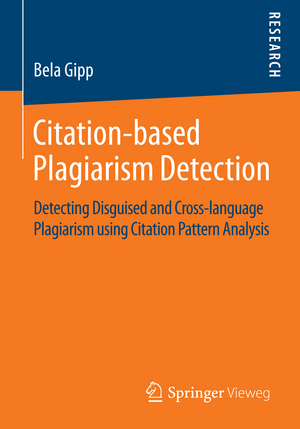
Citation-based Plagiarism Detection
Autor Bela Gippen Limba Engleză Paperback – 14 iul 2014
Preț: 336.05 lei
Preț vechi: 420.07 lei
-20%
Puncte Express: 504
Carte tipărită la comandă
Livrare economică 03-17 decembrie
Livrare prin curier în România Termenul estimat este afișat lângă disponibilitate.
Transport gratuit de la 400.00 lei Plată online sau ramburs, în funcție de opțiunile comenzii.
Retur gratuit în 14 zile Comandă securizată și suport în română.
Specificații
ISBN-13: 9783658063931
ISBN-10: 3658063939
Pagini: 376
Ilustrații: XXVI, 350 p. 70 illus.
Dimensiuni: 148 x 210 x 21 mm
Greutate: 0.49 kg
Ediția:2014
Editura: SPRINGER VIEWEG
Locul publicării:Wiesbaden, Germany
ISBN-10: 3658063939
Pagini: 376
Ilustrații: XXVI, 350 p. 70 illus.
Dimensiuni: 148 x 210 x 21 mm
Greutate: 0.49 kg
Ediția:2014
Editura: SPRINGER VIEWEG
Locul publicării:Wiesbaden, Germany
V-ar putea interesa
-
 Head First HTML and CSS 2eElisabeth Robson-20%Preț: 299.12 lei373.90 lei
 -
 KanbanDavid J. Anderson-20%Preț: 264.20 lei330.25 lei
 -
 Preț: 299.96 lei
 -
 Continuous Delivery with Visual Studio ALM 2015Mathias Olausson-20%Preț: 299.70 lei374.63 lei
 -
 Mastering ServiceNow - Second EditionMartin Wood-20%Preț: 368.74 lei460.93 lei
 -
 Databases and Information SystemsGuntis Arnicans-20%Preț: 329.38 lei411.72 lei
 -
 Optical SuperComputingShlomi Dolev-20%Preț: 396.47 lei495.58 lei
 -
 Data Management in Grid and Peer-to-Peer SystemsAbdelkader Hameurlain-20%Preț: 315.00 lei393.75 lei
 -
 -20%Preț: 321.03 lei401.30 lei
 -
 -20%Preț: 395.14 lei493.92 lei
 -
 -20%Preț: 317.85 lei397.31 lei
 -
 -20%Preț: 622.27 lei777.83 lei
Public țintă
ResearchCuprins
Current state of plagiarism detection approaches and systems.- Citation-based Plagiarism Detection.
Textul de pe ultima copertă
Plagiarism is a problem with far-reaching consequences for the sciences. However, even today’s best software-based systems can only reliably identify copy&paste plagiarism. Disguised plagiarism forms, including paraphrased text, cross-language plagiarism, as well as structural and idea plagiarism often remain undetected. This weakness of current systems results in a large percentage of scientific plagiarism going undetected. Bela Gipp provides an overview of the state-of-the art in plagiarism detection and an analysis of why these approaches fail to detect disguised plagiarism forms. The author proposes Citation-based Plagiarism Detection to address this shortcoming. Unlike character-based approaches, this approach does not rely on text comparisons alone, but analyzes citation patterns within documents to form a language-independent "semantic fingerprint" for similarity assessment. The practicability of Citation-based Plagiarism Detection was proven by its capability to identify so-far non-machine detectable plagiarism in scientific publications.
Contents
Bela Gipp is a postdoctoral researcher at the University of California, Berkeley.
Contents
- Current state of plagiarism detection approaches and systems
- Citation-based Plagiarism Detection
- Readers interested in the problem of plagiarism in the sciences
- Faculty and students from all disciplines, but especially computer science
Bela Gipp is a postdoctoral researcher at the University of California, Berkeley.
Caracteristici
Publication in the field of technical sciences Includes supplementary material: sn.pub/extras