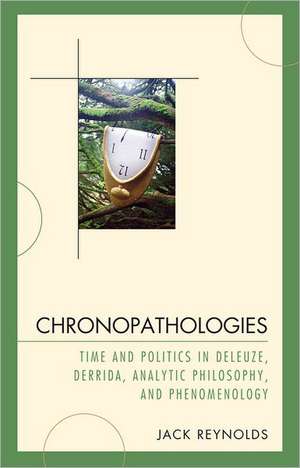
Chronopathologies: Time and Politics in Deleuze, Derrida, Analytic Philosophy, and Phenomenology
Autor Jack Reynoldsen Limba Engleză Hardback – 8 dec 2011
Preț: 704.45 lei
Preț vechi: 1054.17 lei
-33%
Puncte Express: 1057
Carte tipărită la comandă
Livrare economică 18 noiembrie-02 decembrie
Livrare prin curier în România Termenul estimat este afișat lângă disponibilitate.
Transport gratuit pentru acest produs Plată online sau ramburs, în funcție de opțiunile comenzii.
Retur gratuit în 14 zile Comandă securizată și suport în română.
Specificații
ISBN-13: 9780739132814
ISBN-10: 0739132814
Pagini: 292
Dimensiuni: 162 x 241 x 26 mm
Greutate: 0.6 kg
Ediția:New.
Editura: Bloomsbury Publishing
Colecția Lexington Books
Locul publicării:New York, United States
ISBN-10: 0739132814
Pagini: 292
Dimensiuni: 162 x 241 x 26 mm
Greutate: 0.6 kg
Ediția:New.
Editura: Bloomsbury Publishing
Colecția Lexington Books
Locul publicării:New York, United States
Cuprins
Introduction: Chronopathologies: The Politics of Time
Part I. Analytic Philosophy, Atemporality, and Presentism: Some Encounters Across the Chunnel
Chapter 1: Analytic and Continental Philosophy: A Contretemps?
Chapter 2: Common Sense and Philosophical Methodology: Some Metaphilosophical Reflections on Analytic Philosophy via Deleuze
Chapter 3: Negotiating the Non-negotiable: Rawls, Derrida, and the Intertwining of Political Calculation and Ultra-politics
Part II. Poststructuralism, Time Out of Joint, and Future Politics
Chapter 4: The Politics of Futurity in Derrida and Deleuze
Chapter 5: Wounds and Scars: Deleuze on the Time and the Ethic of the Event
Chapter 6: Deleuze's Perverse-structure: Beyond the Other-structure and the Struggle for Recognition
Chapter 7: Derrida, Friendship, and the Transcendental Priority of the "Untimely"
Part III. Phenomenology, Embodiment, and Pragmatic Temporality: An Anachronistic Dialogue
Chapter 8: Time Out of Joint: Between Phenomenology and Post-structuralism
Chapter 9: Dreyfus, Merleau-Ponty, and Deleuze on l'Habitude, Coping, and Trauma in Morality and Skill Acquisition
Chapter 10: Touched by Time: Some Critical Reflections on Derrida's Reading of Merleau-Ponty in Le Toucher.
Chapter 11: Heidegger and Derrida on Being-towards-death and Philosophy's Untimely Future
Conclusion: Beyond Chronopathologies
Part I. Analytic Philosophy, Atemporality, and Presentism: Some Encounters Across the Chunnel
Chapter 1: Analytic and Continental Philosophy: A Contretemps?
Chapter 2: Common Sense and Philosophical Methodology: Some Metaphilosophical Reflections on Analytic Philosophy via Deleuze
Chapter 3: Negotiating the Non-negotiable: Rawls, Derrida, and the Intertwining of Political Calculation and Ultra-politics
Part II. Poststructuralism, Time Out of Joint, and Future Politics
Chapter 4: The Politics of Futurity in Derrida and Deleuze
Chapter 5: Wounds and Scars: Deleuze on the Time and the Ethic of the Event
Chapter 6: Deleuze's Perverse-structure: Beyond the Other-structure and the Struggle for Recognition
Chapter 7: Derrida, Friendship, and the Transcendental Priority of the "Untimely"
Part III. Phenomenology, Embodiment, and Pragmatic Temporality: An Anachronistic Dialogue
Chapter 8: Time Out of Joint: Between Phenomenology and Post-structuralism
Chapter 9: Dreyfus, Merleau-Ponty, and Deleuze on l'Habitude, Coping, and Trauma in Morality and Skill Acquisition
Chapter 10: Touched by Time: Some Critical Reflections on Derrida's Reading of Merleau-Ponty in Le Toucher.
Chapter 11: Heidegger and Derrida on Being-towards-death and Philosophy's Untimely Future
Conclusion: Beyond Chronopathologies
Recenzii
Reynolds is at the forefront of a return: the rebirth of phenomenology after successive burials by analytic philosophy, post-structuralism and naturalism. It returns, critically and controversially, through a philosophy of time setting lived time alongside contemporary scientific theories and ideas taken from Derrida and Deleuze. Reynolds has made believable phantoms of Heidegger, Levinas and, above all, Merleau-Ponty. It matters not whether you wish to dispel them or make them flesh, his book is an essential discussion of debates around time at the cross-over of different philosophical traditions.
Jack Reynolds has undertaken the monumental task of defining philosophy as it stands today. Unlike any other book of which I know, Reynolds has approached all the major strains of contemporary philosophy with an even hand and a depth of insight, from analytic philosophy to post-structuralism, to phenomenology. Reynolds shows us that the primary philosophical problem remains that of time but now it is time connected to ethics and politics. The value of Chronopathologies cannot be underestimated.
Jack Reynolds' insightful essays demonstrate the importance as well as the difficulty of thinking across the metaphilosophical borders that separate phenomenology, poststructuralism and analytic philosophy. They develop a compelling case for the deficiencies of each, from the perspective of the others, in relation to their respective approaches to time and suggest ways in which each can learn from the others. This book both calls for and exemplifies genuine conversation between analytic and continental philosophy.
In Chronopathologies, the Australian philosopher Jack Reynolds gives an exciting analysis of the intimate connection between time and politics in three trajectories of contemporary philosophy: analytic philosophy, poststructuralism and phenomenology. Reynolds makes an important contribution to the philosophical study of time. He convincingly shows that the analytic and continental branches of philosophy need each other to become aware of the temporal and normative biases that bedevil them.
Jack Reynolds has undertaken the monumental task of defining philosophy as it stands today. Unlike any other book of which I know, Reynolds has approached all the major strains of contemporary philosophy with an even hand and a depth of insight, from analytic philosophy to post-structuralism, to phenomenology. Reynolds shows us that the primary philosophical problem remains that of time but now it is time connected to ethics and politics. The value of Chronopathologies cannot be underestimated.
Jack Reynolds' insightful essays demonstrate the importance as well as the difficulty of thinking across the metaphilosophical borders that separate phenomenology, poststructuralism and analytic philosophy. They develop a compelling case for the deficiencies of each, from the perspective of the others, in relation to their respective approaches to time and suggest ways in which each can learn from the others. This book both calls for and exemplifies genuine conversation between analytic and continental philosophy.
In Chronopathologies, the Australian philosopher Jack Reynolds gives an exciting analysis of the intimate connection between time and politics in three trajectories of contemporary philosophy: analytic philosophy, poststructuralism and phenomenology. Reynolds makes an important contribution to the philosophical study of time. He convincingly shows that the analytic and continental branches of philosophy need each other to become aware of the temporal and normative biases that bedevil them.