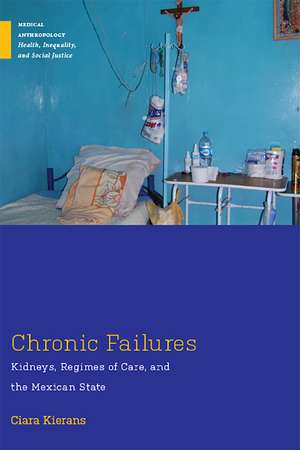
Chronic Failures: Kidneys, Regimes of Care, and the Mexican State: Medical Anthropology
Autor Ciara Kieransen Limba Engleză Paperback – 15 noi 2019 – vârsta ani
Din seria Medical Anthropology
- 5%
 Preț: 1056.07 lei
 -
 Preț: 204.89 lei
 -
 Preț: 209.61 lei
 -
 Preț: 253.01 lei
 -
 Preț: 211.58 lei
 - 5%
 Preț: 226.42 lei
 -
 Preț: 386.93 lei
 -
 Preț: 387.96 lei
 -
 Preț: 391.31 lei
 -
 Preț: 393.77 lei
 - 5%
 Preț: 1280.76 lei
 -
 Preț: 387.96 lei
 - 5%
 Preț: 1301.62 lei
 - 13%
 Preț: 1002.26 lei
 - 13%
 Preț: 982.41 lei
 -
 Preț: 387.96 lei
 - nou
 Preț: 984.05 lei
 -
 Preț: 355.95 lei
 - nou
 Preț: 686.60 lei
 - nou
 Preț: 220.08 lei
Preț: 367.28 lei
Preț vechi: 386.60 lei
-5%
Puncte Express: 551
Carte indisponibilă temporar
Doresc să fiu notificat când acest titlu va fi disponibil:
Se trimite...
Specificații
ISBN-13: 9780813596648
ISBN-10: 0813596645
Pagini: 200
Ilustrații: 8 b-w photographs
Dimensiuni: 152 x 229 x 15 mm
Greutate: 0 kg
Ediția:None
Editura: Rutgers University Press
Colecția Rutgers University Press
Seria Medical Anthropology
ISBN-10: 0813596645
Pagini: 200
Ilustrații: 8 b-w photographs
Dimensiuni: 152 x 229 x 15 mm
Greutate: 0 kg
Ediția:None
Editura: Rutgers University Press
Colecția Rutgers University Press
Seria Medical Anthropology
Notă biografică
CIARA KIERANS is a reader in social anthropology in the Department of Public Health and Policy at the University of Liverpool in the United Kingdom. She is the coauthor of Social and Cultural Perspectives on Health, Technology and Medicine: Old Concepts, New Problems.
Recenzii
“Chronic Failures unfolds a chilling account of the pathological regimes of renal care in Jalisco, Mexico, written in taut prose that is at once theoretically incisive and full of telling ethnographic texture. Moving deftly across the specific and entangled relations of bodies, markets, and state, this book brilliantly weaves together clinical paper-work and polluted lake water, pharmaceutical tianguis and charitable billionaires, media scandals and a mysterious new form of chronic kidney failure into a compelling indictment of the mirage of biomedical salvation. Kierans lays bare how sickness itself is made into a form of consuming labor – one that more often produces hardship and harm rather than health.”
“Kierans offers an extraordinary portrait of the challenges underlying efforts to survive kidney failure in Mexico. 'Regimes of care' extend far beyond clinical interventions, incorporating (and insisting upon) the ongoing labors of kin, including the transport challenges of ongoing dialysis treatments, the oppressive cost of immunosuppressant drugs post-transplant, the limits of universal insurance and its bureaucratic burdens, and even the necessity of having a microwave at home. This beautifully written, thought-provoking work stands out as an important contribution to social scientists’ writings on the sociomedical dimensions of organ failure, healthcare disparities, and on the entanglement of suffering and hope.”
"the book is sensitive to multiple theoretical lenses that unpack the rich ethnographic details in the local complex settings. It is a must-read for those interested in medical anthropology, clinical nephrology, science and technology studies, global health, and biomedical ethics as it shows how organ transplantation, a 'miracle' medicine of the twentieth century, actually exploits the poor."
Descriere
Chronic Failures: Kidneys, Regimes of Care and the Mexican State is about Chronic Kidney Disease (CKD) and the relentless search for care within a context of poverty, inequality and uneven welfare arrangements. Documenting the routes taken to access care, the practices of patients without entitlement offer critical perspectives on state-market-healthcare relations.