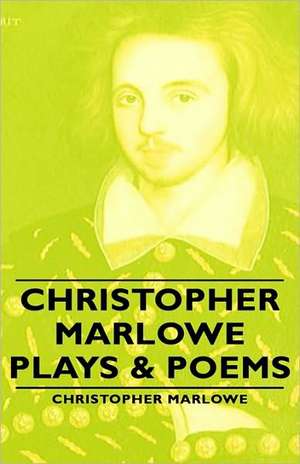
Christopher Marlowe - Plays & Poems
Autor Christopher Marloween Limba Engleză Hardback – 4 noi 2008
Preț: 347.36 lei
Puncte Express: 521
Carte tipărită la comandă
Livrare economică 30 mai-13 iunie
Specificații
ISBN-13: 9781443733700
ISBN-10: 1443733709
Pagini: 508
Dimensiuni: 145 x 222 x 33 mm
Greutate: 0.84 kg
Editura: Pomona Press
ISBN-10: 1443733709
Pagini: 508
Dimensiuni: 145 x 222 x 33 mm
Greutate: 0.84 kg
Editura: Pomona Press
V-ar putea interesa
-
 The Essential Rumi - ReissueColeman BarksPreț: 109.78 lei
 -
 Critical Studies: The Great GatsbyKathleen ParkinsonPreț: 32.57 lei
 -
 Poetry by HeartJulie Blake-28%Preț: 74.90 lei104.61 lei
 -
 Adonis: Selected PoemsAdonisPreț: 113.55 lei
 -
 Norse MythologyNeil GaimanPreț: 131.86 lei
 -
 Arthur Miller's Death of a SalesmanProfessor Peter L. HaysPreț: 127.84 lei
 -
 Preț: 241.47 lei
 -
 English Critical Essays (Sixteenth, Seventeenth and Eighteenth Centuries)Edmund D. D. JonesPreț: 264.76 lei
 -
 Lectures on the English Comic Writers - (1819)William HazlittPreț: 260.85 lei
 -
 Old England at Play - Old Plays Adapted for Young PlayersLynette FeaseyPreț: 192.80 lei
 -
 Preț: 249.86 lei
 -
 Milk and HoneyRupi Kaur-21%Preț: 69.99 lei88.41 lei
 -
 Dirty Pretty ThingsMichael Faudet-23%Preț: 63.11 lei82.45 lei
 -
 BentMartin Sherman-27%Preț: 87.73 lei120.47 lei
 -
 The Tragical History of Dr. FaustusChristopher MarlowePreț: 85.03 lei
 -
 Preț: 104.08 lei
 -
 Preț: 103.56 lei
Notă biografică
Dramatist, son of a shoemaker at Canterbury, where he was born, was educated at the King's School there, and in 1581 went to Benet's (now Corpus Christi) College, Cambridge, where he graduated B.A. 1583, and M.A. in 1587.
Marlowe shunned a life as a clergyman which university wits like himself were expected to follow, and moved to London to pursue the insecure craft of a playwright. Among his early plays were 'Tamburlaine the Great' and 'The Famous Tragedy of the Rich Jew of Malta', all well-received by Elizabethan audiences and displaying an impressive poetic talent that was bold enough to use high-quality blank verse for the first time in English theatre. He collaborated with friend and literary colleague, William Shakespeare, on 'Henry VI' and 'Titus Andronicus' and his influence on Shakespeare is seen in the latter's restrained use of rhyme in 'Richard III'. Traditional rhyme was eschewed by Marlowe in preference for blank verse, over which he acquired a constantly increasing mastery.
Marlowe shunned a life as a clergyman which university wits like himself were expected to follow, and moved to London to pursue the insecure craft of a playwright. Among his early plays were 'Tamburlaine the Great' and 'The Famous Tragedy of the Rich Jew of Malta', all well-received by Elizabethan audiences and displaying an impressive poetic talent that was bold enough to use high-quality blank verse for the first time in English theatre. He collaborated with friend and literary colleague, William Shakespeare, on 'Henry VI' and 'Titus Andronicus' and his influence on Shakespeare is seen in the latter's restrained use of rhyme in 'Richard III'. Traditional rhyme was eschewed by Marlowe in preference for blank verse, over which he acquired a constantly increasing mastery.