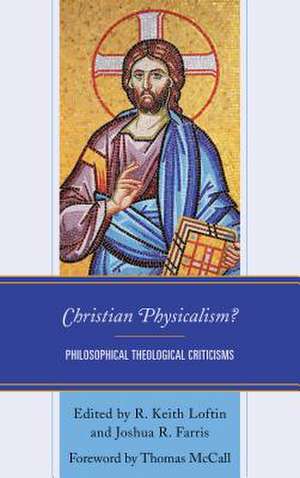
Christian Physicalism?: Philosophical Theological Criticisms
Editat de R. Keith Loftin, Joshua R. Farris Cuvânt înainte de Thomas McCall Contribuţii de Thomas Atkinson, John W. Cooper, Marc Cortez, C. Stephen Evans, Paul L. Gavrilyuk, Bruce L. Gordon, Matthew J. Hart, Jonathan J. Loose, Jason McMartin, Angus Menuge, J.P. Moreland, R.T. Mullins, Gerald O’Collins, Brandon Rickabaugh, Howard Robinson, R. Scott Smith, Charles Taliaferro, James T. Turner, Jren Limba Engleză Hardback – 26 dec 2017
Preț: 798.69 lei
Preț vechi: 1247.11 lei
-36%
Puncte Express: 1198
Carte tipărită la comandă
Livrare economică 04-18 decembrie
Livrare prin curier în România Termenul estimat este afișat lângă disponibilitate.
Transport gratuit pentru acest produs Plată online sau ramburs, în funcție de opțiunile comenzii.
Retur gratuit în 14 zile Comandă securizată și suport în română.
Specificații
ISBN-13: 9781498549233
ISBN-10: 1498549233
Pagini: 494
Ilustrații: 1 graphs;
Dimensiuni: 154 x 230 x 32 mm
Greutate: 0.89 kg
Editura: Bloomsbury Publishing
Colecția Lexington Books
Locul publicării:New York, United States
ISBN-10: 1498549233
Pagini: 494
Ilustrații: 1 graphs;
Dimensiuni: 154 x 230 x 32 mm
Greutate: 0.89 kg
Editura: Bloomsbury Publishing
Colecția Lexington Books
Locul publicării:New York, United States
Cuprins
Foreword
Thomas McCall
Christian Physicalism? An Introduction
Joshua R. Farris & R. Keith Loftin
1. The Incorporeality of the Soul in Patristic Thought
Paul L. Gavrilyuk
2. Christian Physicalism: Against the Medieval Divines
Thomas Atkinson
3. Substance Dualism and the Diachronic/Synchronic Unity of Consciousness
J.P. Moreland
4. Christian Physicalism and Our Knowledge of God
Angus Menuge
5. Physicalism, Divine Eternality, and Life Everlasting
R. Keith Loftin and R.T. Mullins
6. Holy Saturday and Christian Theological Anthropology
Jason McMartin
7. Physicalism, the Incarnation, and Holy Saturday: A Conversation with Karl Barth
Marc Cortez
8. Physicalist Christology and the Two Sons Worry
R.T. Mullins
9. Physicalism and the Death of Christ
Charles Taliaferro
10. Christian Materialism Entails Pelagianism
Matthew J. Hart
11. Sanctification and Physicalism
R. Scott Smith
12. Neuroscience, Spiritual Formation, and Bodily Souls: A Critique of Christian Physicalism
Brandon Rickabaugh & C
Thomas McCall
Christian Physicalism? An Introduction
Joshua R. Farris & R. Keith Loftin
1. The Incorporeality of the Soul in Patristic Thought
Paul L. Gavrilyuk
2. Christian Physicalism: Against the Medieval Divines
Thomas Atkinson
3. Substance Dualism and the Diachronic/Synchronic Unity of Consciousness
J.P. Moreland
4. Christian Physicalism and Our Knowledge of God
Angus Menuge
5. Physicalism, Divine Eternality, and Life Everlasting
R. Keith Loftin and R.T. Mullins
6. Holy Saturday and Christian Theological Anthropology
Jason McMartin
7. Physicalism, the Incarnation, and Holy Saturday: A Conversation with Karl Barth
Marc Cortez
8. Physicalist Christology and the Two Sons Worry
R.T. Mullins
9. Physicalism and the Death of Christ
Charles Taliaferro
10. Christian Materialism Entails Pelagianism
Matthew J. Hart
11. Sanctification and Physicalism
R. Scott Smith
12. Neuroscience, Spiritual Formation, and Bodily Souls: A Critique of Christian Physicalism
Brandon Rickabaugh & C
Recenzii
The authors of this book contend that Christian intellectuals have made an egregiously bad deal in selling their souls in order to make peace with physicalist philosophy and naturalist science. They provide a powerful challenge to the physicalist conglomerate in contemporary thought, and give us a wide range of reasons why we need to recover the full riches of the robust view of human nature assumed in Nicene catholic Christian faith.
Throughout church history some of the most innovative Christian philosophy has been occasioned by the need to refute wayward doctrine. Christian Physicalism?: Philosophical Theological Criticisms constitutes another excellent case in point. This book is a tour de force critique of Christian physicalism, featuring an array of interesting and powerful arguments-historical, philosophical, biblical, theological, and even scientific-against the materialist view of human nature. These essays will not be the final round in the debate over Christian physicalism, but they ought to be.
Throughout church history some of the most innovative Christian philosophy has been occasioned by the need to refute wayward doctrine. Christian Physicalism?: Philosophical Theological Criticisms constitutes another excellent case in point. This book is a tour de force critique of Christian physicalism, featuring an array of interesting and powerful arguments-historical, philosophical, biblical, theological, and even scientific-against the materialist view of human nature. These essays will not be the final round in the debate over Christian physicalism, but they ought to be.