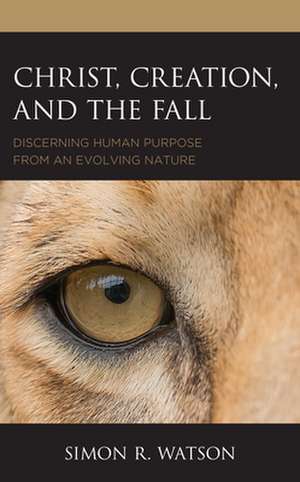
Christ, Creation, and the Fall: Discerning Human Purpose from an Evolving Nature
Autor Simon R. Watsonen Limba Engleză Hardback – 3 mai 2021
Preț: 524.82 lei
Preț vechi: 815.71 lei
-36%
Puncte Express: 787
Carte tipărită la comandă
Livrare economică 08-22 decembrie
Livrare prin curier în România Termenul estimat este afișat lângă disponibilitate.
Transport gratuit pentru acest produs Plată online sau ramburs, în funcție de opțiunile comenzii.
Retur gratuit în 14 zile Comandă securizată și suport în română.
Specificații
ISBN-13: 9781978710924
ISBN-10: 1978710925
Pagini: 190
Dimensiuni: 158 x 232 x 18 mm
Greutate: 0.44 kg
Editura: Bloomsbury Publishing
Colecția Fortress Academic
Locul publicării:New York, United States
ISBN-10: 1978710925
Pagini: 190
Dimensiuni: 158 x 232 x 18 mm
Greutate: 0.44 kg
Editura: Bloomsbury Publishing
Colecția Fortress Academic
Locul publicării:New York, United States
Cuprins
Introduction
Chapter 1 William Paley and Douglas John Hall: The Watchmaker God and the Crucified Christ
Chapter 2 Charles Darwin, Asa Gray, and Aubrey Moore: A Natural History of the Golden Rule
Chapter 3 Philip Hefner's Risky Teleology: Natural Selection as the Sacrificial Means of a Free Creation
Chapter 4 Denis Edwards and Elizabeth Johnson: A Liberative Sophia
Conclusion: Discerning Christ in Creation
Chapter 1 William Paley and Douglas John Hall: The Watchmaker God and the Crucified Christ
Chapter 2 Charles Darwin, Asa Gray, and Aubrey Moore: A Natural History of the Golden Rule
Chapter 3 Philip Hefner's Risky Teleology: Natural Selection as the Sacrificial Means of a Free Creation
Chapter 4 Denis Edwards and Elizabeth Johnson: A Liberative Sophia
Conclusion: Discerning Christ in Creation
Recenzii
That Charles Darwin's theory of evolution through natural selection challenged Christianity is a truism. Too often, the response has been denial - biblical literalists - or untroubled acceptance - the majority of theologians and philosophers writing today. Simon R. Watson belongs to that small but all-important third group, who see that after Darwin, nothing can be the same, but that this is a tremendously exciting opportunity to rethink and reaffirm Christian faith, one that centers on a God of love who, through Christ, creates but extends human nature. We are no longer passive subjects, but actively involved in the unfurling universe. You may not agree. I am not sure I do. But you will come from Watson's book with your mind buzzing with the new directions in which he points. A very exciting book.
To the list of significant reflections on the relationship of Darwinian evolution to Christian ideas about God we may now add those of Simon Watson. In this challenging and informed study, the author gives a refined assessment of the theological value of important previous attempts to rethink the idea of God after Darwin. I think expert readers, especially those interested in the question of science and theology, will appreciate the accuracy and insightfulness of this study.
Simon Watson and I are very different. He is a theologian, I am a biologist. He is a Christian, I am an atheist. Nevertheless, over many conversations, over many years, I have developed a profound appreciation of his perspective on the intersection between science and religion. In this book he beautifully demonstrates why. He presents a comprehensive account of how theologians wrestle with the facts emerging from evolutionary biology and leaves both theologians and scientists with many insights to grapple with.
This is the right book on the right topic at the right time. Watson identifies the historical roots of evolutionary theodicy within the framework of natural theology, then proceeds forward to critically engage Phil Hefner's formulation of imago Dei as created co-creator. But he does not stop there. I read this book with growing excitement as his constructive theology turns to Sophia by engaging Denis Edwards and Elizabeth Johnson. He has provided us not only with a significant contribution to the field of theology and science, but also with a valuable monograph on the problem of suffering.
To the list of significant reflections on the relationship of Darwinian evolution to Christian ideas about God we may now add those of Simon Watson. In this challenging and informed study, the author gives a refined assessment of the theological value of important previous attempts to rethink the idea of God after Darwin. I think expert readers, especially those interested in the question of science and theology, will appreciate the accuracy and insightfulness of this study.
Simon Watson and I are very different. He is a theologian, I am a biologist. He is a Christian, I am an atheist. Nevertheless, over many conversations, over many years, I have developed a profound appreciation of his perspective on the intersection between science and religion. In this book he beautifully demonstrates why. He presents a comprehensive account of how theologians wrestle with the facts emerging from evolutionary biology and leaves both theologians and scientists with many insights to grapple with.
This is the right book on the right topic at the right time. Watson identifies the historical roots of evolutionary theodicy within the framework of natural theology, then proceeds forward to critically engage Phil Hefner's formulation of imago Dei as created co-creator. But he does not stop there. I read this book with growing excitement as his constructive theology turns to Sophia by engaging Denis Edwards and Elizabeth Johnson. He has provided us not only with a significant contribution to the field of theology and science, but also with a valuable monograph on the problem of suffering.