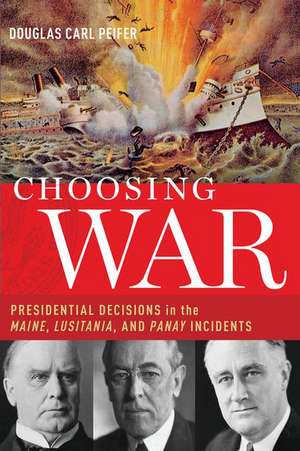
Choosing War: Presidential Decisions in the Maine, Lusitania, and Panay Incidents
Autor Douglas Carl Peiferen Limba Engleză Paperback – 22 noi 2018
Preț: 210.52 lei
Puncte Express: 316
Carte disponibilă
Livrare economică 12-18 noiembrie
Livrare prin curier în România Termenul estimat este afișat lângă disponibilitate.
Transport gratuit de la 400.00 lei Plată online sau ramburs, în funcție de opțiunile comenzii.
Retur gratuit în 14 zile Comandă securizată și suport în română.
Specificații
ISBN-13: 9780190939601
ISBN-10: 0190939605
Pagini: 344
Ilustrații: 24 illus.
Dimensiuni: 231 x 155 x 18 mm
Greutate: 0.52 kg
Editura: Oxford University Press
Colecția OUP USA
Locul publicării:New York, United States
ISBN-10: 0190939605
Pagini: 344
Ilustrații: 24 illus.
Dimensiuni: 231 x 155 x 18 mm
Greutate: 0.52 kg
Editura: Oxford University Press
Colecția OUP USA
Locul publicării:New York, United States
Recenzii
This work is very valuable to aspiring historians in its discussion of the uses of history....With at-sea incidents between U.S. and Iranian and Chinese ships on the rise, this book should be required reading for policymakers and national security professionals alike.
[A]n excellent example of how historically informed comparative analysis can create a framework for our understanding of the uses of force and war-making....The gripping prose style and narrative detail in each episode are impressive....[O]ne can only hope
[T]his book could appeal to someone who knows little about the three naval incidents and wants to get a relatively quick lesson on the historical background and the military and political considerations of each. It should also appeal to the enthusiast who really wants to get into the weeds of diplomacy with Peifer.
Peifer's insightful analysis in Choosing War is as useful as it is timely....Peifer makes a unique contribution to our understanding of how an American administration makes that most important of decisions
Choosing War is an excellent dissection of the decisions made by American presidents in the wake of the Maine, Lusitania, and Panay incidents. Choosing War, in great detail, shows that naval incidents are very often a precursor to greater conflicts on land, on sea, and in the air....It is a unique book that is written clearly enough to serve as popular history, yet Choosing War will also serve as a great reference to American military figures, geopolitical strategists, and their publicly elected leaders.
Well-reasoned and convincing, Choosing War makes an important contribution to the fields of presidential studies and decision making. It also provides excellent examinations of three naval events and their link to foreign relations. Thus it will be of interest and value to both diplomatic and naval historians. There exists no similar study.
Americans can choose their wars, or blunder into them. Douglas Peifer's insights into three moments of crisis and decision from the high seas
Presidents from Dwight Eisenhower to poor Barack Obama today have luxuriated in the certainty that we could project American force anywhere to solve any conflict that collided with our national interests. Mr. Peifer argues naval and air power no longer are adequate shortcuts to diplomacy.
A compelling illustration of the sort of insights that political scientists and practitioners routinely miss...Peifer's wonderfully clear prose makes the volume a page-turner.
[An] exemplary feat of historical interpretation.
This is a valuable work...[Choosing War] is worth a place on the reader's list and is highly recommended.
In Choosing War, historian Douglas Carl Peifer has written a book that can help tomorrow's policymakers anticipate the kinds of predicaments that may confront them...Anyone interested in improving critical thinking during future maritime emergencies will find Choosing War to be provocative [and] rewarding.
Articulate, well organized, and highly readable... Peifer makes a unique contribution to our understanding of how an American administration makes that most important of decisions-whether or not to go to war... Choosing War hits the mark.
Choosing War, in great detail, shows that naval incidents are very often a precursor to greater conflicts on land, on sea, and in the air. Douglas Carl Peifer also reaffirms a need for the historical perspective, short and long term, in regard to contemporary matters. These contemporary matters are often thought to be the exclusive domain of political scientists and policy analysts, but Choosing War shows that historians can add just as much, if not more, to current policy debates.
[A]n excellent example of how historically informed comparative analysis can create a framework for our understanding of the uses of force and war-making....The gripping prose style and narrative detail in each episode are impressive....[O]ne can only hope
[T]his book could appeal to someone who knows little about the three naval incidents and wants to get a relatively quick lesson on the historical background and the military and political considerations of each. It should also appeal to the enthusiast who really wants to get into the weeds of diplomacy with Peifer.
Peifer's insightful analysis in Choosing War is as useful as it is timely....Peifer makes a unique contribution to our understanding of how an American administration makes that most important of decisions
Choosing War is an excellent dissection of the decisions made by American presidents in the wake of the Maine, Lusitania, and Panay incidents. Choosing War, in great detail, shows that naval incidents are very often a precursor to greater conflicts on land, on sea, and in the air....It is a unique book that is written clearly enough to serve as popular history, yet Choosing War will also serve as a great reference to American military figures, geopolitical strategists, and their publicly elected leaders.
Well-reasoned and convincing, Choosing War makes an important contribution to the fields of presidential studies and decision making. It also provides excellent examinations of three naval events and their link to foreign relations. Thus it will be of interest and value to both diplomatic and naval historians. There exists no similar study.
Americans can choose their wars, or blunder into them. Douglas Peifer's insights into three moments of crisis and decision from the high seas
Presidents from Dwight Eisenhower to poor Barack Obama today have luxuriated in the certainty that we could project American force anywhere to solve any conflict that collided with our national interests. Mr. Peifer argues naval and air power no longer are adequate shortcuts to diplomacy.
A compelling illustration of the sort of insights that political scientists and practitioners routinely miss...Peifer's wonderfully clear prose makes the volume a page-turner.
[An] exemplary feat of historical interpretation.
This is a valuable work...[Choosing War] is worth a place on the reader's list and is highly recommended.
In Choosing War, historian Douglas Carl Peifer has written a book that can help tomorrow's policymakers anticipate the kinds of predicaments that may confront them...Anyone interested in improving critical thinking during future maritime emergencies will find Choosing War to be provocative [and] rewarding.
Articulate, well organized, and highly readable... Peifer makes a unique contribution to our understanding of how an American administration makes that most important of decisions-whether or not to go to war... Choosing War hits the mark.
Choosing War, in great detail, shows that naval incidents are very often a precursor to greater conflicts on land, on sea, and in the air. Douglas Carl Peifer also reaffirms a need for the historical perspective, short and long term, in regard to contemporary matters. These contemporary matters are often thought to be the exclusive domain of political scientists and policy analysts, but Choosing War shows that historians can add just as much, if not more, to current policy debates.
Notă biografică
Douglas Carl Peifer is a Professor of History and Strategy at the US Air War College in Montgomery, Alabama.