
Tagore, R: Chitra - A Play in One Act
en Limba Engleză Paperback – 17 noi 2006
Preț: 151.24 lei
Puncte Express: 227
Cartea nu mai face parte din oferta noastră
Livrare prin curier în România Termenul estimat este afișat lângă disponibilitate.
Transport gratuit de la 400.00 lei Plată online sau ramburs, în funcție de opțiunile comenzii.
Retur gratuit în 14 zile Comandă securizată și suport în română.
Specificații
ISBN-13: 9781406730821
ISBN-10: 1406730823
Pagini: 48
Dimensiuni: 140 x 216 x 3 mm
Greutate: 0.08 kg
Editura: Read Books
Locul publicării:United Kingdom
ISBN-10: 1406730823
Pagini: 48
Dimensiuni: 140 x 216 x 3 mm
Greutate: 0.08 kg
Editura: Read Books
Locul publicării:United Kingdom
V-ar putea interesa
-
 Amy's ViewDavid HarePreț: 78.08 lei
 -
 My Zinc BedDavid HarePreț: 79.64 lei
 -
 Attempts on Her LifeMartin CrimpPreț: 76.29 lei
 -
 The Permanent WayDavid HarePreț: 88.29 lei
 -
 The Judas KissDavid HarePreț: 83.53 lei
 -
 Goodnight Desdemona (Good Morning Juliet)Ann-Marie MacdonaldPreț: 81.80 lei
 -
 Murdered to DeathPeter GordonPreț: 82.15 lei
 -
 Not Now DarlingJohn ChapmanPreț: 82.81 lei
 -
 Heartbreak HouseBernard ShawPreț: 191.28 lei
 -
 Preț: 182.55 lei
 -
 Saint JoanBernard ShawPreț: 180.23 lei
 -
 In April OnceWilliam Alexander PercyPreț: 234.50 lei
 -
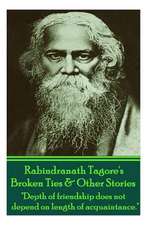 Rabindranath Tagore's Broken Ties & Other StoriesRabindranath TagorePreț: 52.27 lei
 -
 The Bogus WomanKay Adshead-17%Preț: 86.58 lei103.81 lei
 -
 The FarmNell Leyshon-26%Preț: 70.26 lei94.38 lei
 -
 Die Nacht der ErfüllungRabindranath TagorePreț: 150.88 lei
 -
 Der GärtnerRabindranath TagorePreț: 156.29 lei
 -
 Der König der dunklen KammerRabindranath TagorePreț: 139.58 lei
 -
 Stories from Tagore (World Classics, Unabridged)Rabindranath TagorePreț: 106.46 lei
Notă biografică
¿ Rabindranath Tagore, was a polymath, poet, musician, and artist from the Indian subcontinent. He reshaped Bengali literature and music, as well as Indian art with Contextual Modernism in the late 19th and early 20th centuries. Author of the "profoundly sensitive, fresh and beautiful verse" of Gitanjali, he became in 1913 the first non-European to win the Nobel Prize in Literature.[7] Tagore's poetic songs were viewed as spiritual and mercurial; however, his "elegant prose and magical poetry" remain largely unknown outside Bengal.[8] He is sometimes referred to as "the Bard of Bengal".[9]
¿ A Brahmo Hindu from Calcutta with ancestral gentry roots in Burdwan District[10] and Jessore, Tagore wrote poetry as an eight-year-old.[11] At the age of sixteen, he released his first substantial poems under the pseudonym Bhanusi¿ha ("Sun Lion"), which were seized upon by literary authorities as long-lost classics. By 1877 he graduated to his first short stories and dramas, published under his real name. As a humanist, universalist, internationalist, and ardent anti-nationalist, he denounced the British Raj and advocated independence from Britain. As an exponent of the Bengal Renaissance, he advanced a vast canon that comprised paintings, sketches and doodles, hundreds of texts, and some two thousand songs; his legacy also endures in the institution he founded, Visva-Bharati University.
¿ Tagore modernised Bengali art by spurning rigid classical forms and resisting linguistic strictures. His novels, stories, songs, dance-dramas, and essays spoke to topics political and personal. Gitanjali (Song Offerings), Gora (Fair-Faced) and Ghare-Baire (The Home and the World) are his best-known works, and his verse, short stories, and novels were acclaimed-or panned-for their lyricism, colloquialism, naturalism, and unnatural contemplation. His compositions were chosen by two nations as national anthems: India's Jana Gana Mana and Bangladesh's Amar Shonar Bangla. The Sri Lankan national anthem was inspired by his work
¿ A Brahmo Hindu from Calcutta with ancestral gentry roots in Burdwan District[10] and Jessore, Tagore wrote poetry as an eight-year-old.[11] At the age of sixteen, he released his first substantial poems under the pseudonym Bhanusi¿ha ("Sun Lion"), which were seized upon by literary authorities as long-lost classics. By 1877 he graduated to his first short stories and dramas, published under his real name. As a humanist, universalist, internationalist, and ardent anti-nationalist, he denounced the British Raj and advocated independence from Britain. As an exponent of the Bengal Renaissance, he advanced a vast canon that comprised paintings, sketches and doodles, hundreds of texts, and some two thousand songs; his legacy also endures in the institution he founded, Visva-Bharati University.
¿ Tagore modernised Bengali art by spurning rigid classical forms and resisting linguistic strictures. His novels, stories, songs, dance-dramas, and essays spoke to topics political and personal. Gitanjali (Song Offerings), Gora (Fair-Faced) and Ghare-Baire (The Home and the World) are his best-known works, and his verse, short stories, and novels were acclaimed-or panned-for their lyricism, colloquialism, naturalism, and unnatural contemplation. His compositions were chosen by two nations as national anthems: India's Jana Gana Mana and Bangladesh's Amar Shonar Bangla. The Sri Lankan national anthem was inspired by his work