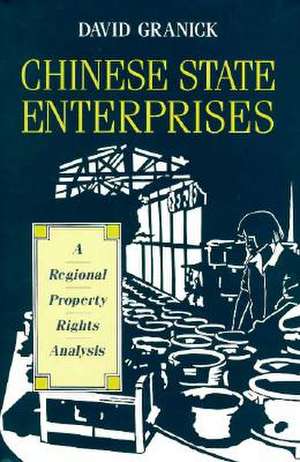
Chinese State Enterprises: A Regional Property Rights Analysis
Autor David Granicken Limba Engleză Hardback – 22 mar 1990
"We are indebted to David Granick for his thoughtful, careful, empirically documented study of the Chinese state industrial enterprise that not only provides a rarely attained comparative analysis but also possesses an explanatory power in suggesting how this system might evolve in the future."—Jeanne L. Wilson, Business Horizons
Preț: 600.77 lei
Preț vechi: 653.00 lei
-8%
Puncte Express: 901
Carte disponibilă
Livrare economică 08-22 octombrie
Livrare express 23-29 septembrie pentru 40.89 lei
Livrare prin curier în România Termenul estimat este afișat lângă disponibilitate.
Transport gratuit pentru acest produs Plată online sau ramburs, în funcție de opțiunile comenzii.
Retur gratuit în 14 zile Comandă securizată și suport în română.
Specificații
ISBN-13: 9780226305882
ISBN-10: 0226305880
Pagini: 358
Dimensiuni: 152 x 229 x 25 mm
Greutate: 0.65 kg
Ediția:1
Editura: University of Chicago Press
Colecția University of Chicago Press
ISBN-10: 0226305880
Pagini: 358
Dimensiuni: 152 x 229 x 25 mm
Greutate: 0.65 kg
Ediția:1
Editura: University of Chicago Press
Colecția University of Chicago Press
V-ar putea interesa
-
 Preț: 107.07 lei
 -
 Preț: 140.36 lei
 -
 Book Was There: Reading in Electronic TimesAndrew PiperPreț: 139.25 lei
 -
 Human Factors in Multi-Crew Flight OperationsHarry W. Orlady-15%Preț: 546.16 lei642.55 lei
 -
 -27%Preț: 67.20 lei91.77 lei
 -
 Transport PlanningDavid Banister-15%Preț: 439.93 lei517.56 lei
 -
 The Airline BusinessRigas Doganis-15%Preț: 654.30 lei769.76 lei
 -
 Museums and Education: Purpose, Pedagogy, PerformanceEilean Hooper-GreenhillPreț: 382.45 lei
 -
 Toy MonsterJerry OppenheimerPreț: 90.44 lei
 -
 -19%Preț: 51.94 lei63.90 lei
 -
 Flight Of The TitansKenny KempPreț: 109.99 lei
Cuprins
Tables
Acknowledgments
1. Introduction
The Set of Case Studies
Coverage of the Book and Organization
The Targeted Readership
2. Multiple Principals in Principal-Agent Analysis
Analytic Framework
Facts To Be Explained
The Property Rights Model and the Basic Hypothesis
History of Property Rights Over State-owned Enterprises
Principal-Agent Analysis Applied to Supervision Over Enterprises
Property Rights in General in the People's Republic of China
Hierarchy Among Principals
Appendix: Case Studies of Supervisory Authority Over Enterprises
3. Planning As Coordination
The Macroeconomic Setting
Plan Fulfillment by the Individual Enterprise
The Ratchet Effect Syndrome
Hypothesis As To Planning
Analysis of Sample Data
Conclusion
Appendix: Planning Materials on Individual Enterprises
4. Multiple Prices and Equilibrium Price
Stage Analysis of Industrial Procurement
Procurement Data From the Sample
Multiple Prices and Equilibrium Analysis
Kornai's "Soft Budget Constraint"
5. The Incentives Facing the Enterprises
Incentives Specific to Upper Managers
Incentives Common to the Labor Force As a Whole
Conclusion
Appendix: Regressions for Incentives Common to the Labor Force As a Whole
6. Elements of Price
Sales Tax and Profits
Materials Purchases and Wages
Conclusions
7. Internal Organization of the Enterprise
Party Committee versus Director Control Within the Enterprise
Trade Unions, Workers' Congresses, and Democratic Management
Foremen and Political Cadres
8. Conclusion, Including Evaluations of Efficiency
Thematic Summary
Allocation of Labor and Determination of Wages
The Pre-reform and Reform Years: Differences and Continuities
Efficiency Evaluations
Appendix: The Chinese Incentive System in State Industry
Notes
References
Index
Acknowledgments
1. Introduction
The Set of Case Studies
Coverage of the Book and Organization
The Targeted Readership
2. Multiple Principals in Principal-Agent Analysis
Analytic Framework
Facts To Be Explained
The Property Rights Model and the Basic Hypothesis
History of Property Rights Over State-owned Enterprises
Principal-Agent Analysis Applied to Supervision Over Enterprises
Property Rights in General in the People's Republic of China
Hierarchy Among Principals
Appendix: Case Studies of Supervisory Authority Over Enterprises
3. Planning As Coordination
The Macroeconomic Setting
Plan Fulfillment by the Individual Enterprise
The Ratchet Effect Syndrome
Hypothesis As To Planning
Analysis of Sample Data
Conclusion
Appendix: Planning Materials on Individual Enterprises
4. Multiple Prices and Equilibrium Price
Stage Analysis of Industrial Procurement
Procurement Data From the Sample
Multiple Prices and Equilibrium Analysis
Kornai's "Soft Budget Constraint"
5. The Incentives Facing the Enterprises
Incentives Specific to Upper Managers
Incentives Common to the Labor Force As a Whole
Conclusion
Appendix: Regressions for Incentives Common to the Labor Force As a Whole
6. Elements of Price
Sales Tax and Profits
Materials Purchases and Wages
Conclusions
7. Internal Organization of the Enterprise
Party Committee versus Director Control Within the Enterprise
Trade Unions, Workers' Congresses, and Democratic Management
Foremen and Political Cadres
8. Conclusion, Including Evaluations of Efficiency
Thematic Summary
Allocation of Labor and Determination of Wages
The Pre-reform and Reform Years: Differences and Continuities
Efficiency Evaluations
Appendix: The Chinese Incentive System in State Industry
Notes
References
Index