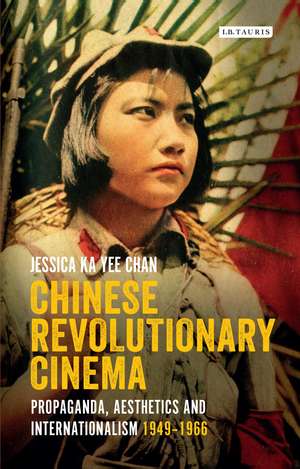
Chinese Revolutionary Cinema: Propaganda, Aesthetics and Internationalism 1949–1966
Autor Jessica Ka Yee Chanen Limba Engleză Hardback – 24 ian 2019
Based on extensive archival research, this book's focus on the distinctive rhetoric of post-war socialist China will be of value to East Asian Cinema scholars, Chinese Studies academics and those interested in the history of twentieth-century socialist culture.
Preț: 546.11 lei
Preț vechi: 829.36 lei
-34%
Puncte Express: 819
Carte disponibilă
Livrare economică 09-23 noiembrie
Livrare prin curier în România Termenul estimat este afișat lângă disponibilitate.
Transport gratuit pentru acest produs Plată online sau ramburs, în funcție de opțiunile comenzii.
Retur gratuit în 14 zile Comandă securizată și suport în română.
Specificații
ISBN-13: 9781788311908
ISBN-10: 1788311906
Pagini: 288
Ilustrații: 25 b&w
Dimensiuni: 144 x 218 x 22 mm
Greutate: 0.48 kg
Editura: Bloomsbury Publishing
Colecția I.B.Tauris
Locul publicării:London, United Kingdom
ISBN-10: 1788311906
Pagini: 288
Ilustrații: 25 b&w
Dimensiuni: 144 x 218 x 22 mm
Greutate: 0.48 kg
Editura: Bloomsbury Publishing
Colecția I.B.Tauris
Locul publicării:London, United Kingdom
Cuprins
Introduction 1
1 Propaganda and Film Aesthetics 23
2 Literature on Screen: Recasting Classical Hollywood Narration in Family Melodrama 54
3 Translating Soviet Montage 87
4 Socialist Glamour: The Socialist Star Craze, Stanislavski's System and Cinematic Iconography of the Gaze 119
5 Visions of Internationalism in Chinese Film Journals 147
Conclusion 173
Notes 180
Glossary 215
Filmography 222
Bibliography 225
Index 237
1 Propaganda and Film Aesthetics 23
2 Literature on Screen: Recasting Classical Hollywood Narration in Family Melodrama 54
3 Translating Soviet Montage 87
4 Socialist Glamour: The Socialist Star Craze, Stanislavski's System and Cinematic Iconography of the Gaze 119
5 Visions of Internationalism in Chinese Film Journals 147
Conclusion 173
Notes 180
Glossary 215
Filmography 222
Bibliography 225
Index 237
Recenzii
Overall, Chan's unique history provides something more than an overview of an understudied period; by examining propaganda as a complex mode that necessitated the comingling of writers, artists, performers, bureaucrats and capital ... she is able to contribute to a broader understanding of film production under socialism ... [The book] will be of interest to scholars of East Asian Cinema, Chinese Studies, as well as those with an interest in the history of socialist culture.
A long-awaited book that sheds new light on revolutionary Chinese cinema. Eloquently written, it opens our eyes not only to these films' politics, but also to their forms and artistry.
Chinese Revolutionary Cinema is based on meticulous research and insightful analysis. Avoiding Cold War rhetoric, Chan brilliantly shows how Maoist cinema interacted with Hollywood and Soviet paradigms, as it adapted melodramatic structures, montage theory, and star promotion to the revolutionary cause.
A long-awaited book that sheds new light on revolutionary Chinese cinema. Eloquently written, it opens our eyes not only to these films' politics, but also to their forms and artistry.
Chinese Revolutionary Cinema is based on meticulous research and insightful analysis. Avoiding Cold War rhetoric, Chan brilliantly shows how Maoist cinema interacted with Hollywood and Soviet paradigms, as it adapted melodramatic structures, montage theory, and star promotion to the revolutionary cause.