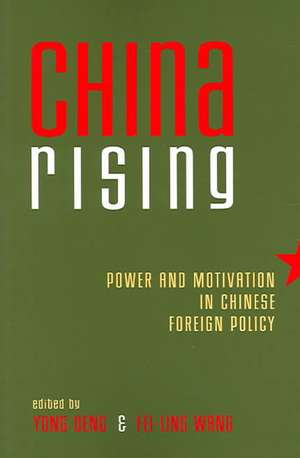
China Rising: Power and Motivation in Chinese Foreign Policy: Asia in World Politics
Editat de Yong Deng, Fei-Ling Wang Contribuţii de Yun-han Chu, John W. Garver, Peter Hays Gries, Thomas G. Moore, Andrew Scobell, Ming Wan, Hongying Wang, Jianwei Wangen Limba Engleză Paperback – 26 noi 2004
Din seria Asia in World Politics
- 22%
 Preț: 349.68 lei
 - 19%
 Preț: 321.94 lei
 - 33%
 Preț: 357.13 lei
 -
 Preț: 371.43 lei
 - 20%
 Preț: 317.02 lei
 - 25%
 Preț: 347.76 lei
 - 31%
 Preț: 352.59 lei
 - 24%
 Preț: 205.02 lei
 - 23%
 Preț: 279.24 lei
 - 18%
 Preț: 327.89 lei
 - 17%
 Preț: 335.41 lei
 - 23%
 Preț: 255.93 lei
 - 22%
 Preț: 351.93 lei
 - 24%
 Preț: 223.22 lei
 - 19%
 Preț: 224.32 lei
Preț: 352.92 lei
Preț vechi: 448.62 lei
-21%
Puncte Express: 529
Carte tipărită la comandă
Livrare economică 07-21 decembrie
Livrare prin curier în România Termenul estimat este afișat lângă disponibilitate.
Transport gratuit de la 400.00 lei Plată online sau ramburs, în funcție de opțiunile comenzii.
Retur gratuit în 14 zile Comandă securizată și suport în română.
Specificații
ISBN-13: 9780742528925
ISBN-10: 0742528928
Pagini: 352
Dimensiuni: 148 x 226 x 24 mm
Greutate: 0.46 kg
Ediția:New.
Editura: Bloomsbury Publishing
Colecția Rowman & Littlefield
Seria Asia in World Politics
Locul publicării:New York, United States
ISBN-10: 0742528928
Pagini: 352
Dimensiuni: 148 x 226 x 24 mm
Greutate: 0.46 kg
Ediția:New.
Editura: Bloomsbury Publishing
Colecția Rowman & Littlefield
Seria Asia in World Politics
Locul publicării:New York, United States
V-ar putea interesa
-
 KrakatoaSimon Winchester-18%Preț: 77.47 lei94.29 lei
 -
 Stones of Empire: The Buildings of the RajJan Morris-18%Preț: 257.63 lei316.11 lei
 -
 Gandhi: A Very Short IntroductionBhikhu Parekh-20%Preț: 57.15 lei71.12 lei
 -
 -9%Preț: 399.38 lei441.19 lei
 -
 Politics and Culture in Wartime JapanBen-Ami Shillony-32%Preț: 681.15 lei997.81 lei
 -
 Contemporary TaiwanDavid Shambaugh-17%Preț: 255.70 lei308.10 lei
 -
 1421. The Year China Discovered the WorldGavin MenziesPreț: 72.49 lei
 -
 Zen at WarBrian Daizen Victoria-20%Preț: 319.18 lei396.68 lei
 -
 BushidoTsunetomo YamamotoPreț: 60.77 lei
 -
 Chinese LessonsJohn PomfretPreț: 131.25 lei
 -
 The Great Hedge of IndiaRoy Moxham-27%Preț: 67.74 lei92.76 lei
 -
 The Ottoman Empire: 1300-1600Halil Inalcik-25%Preț: 81.85 lei108.94 lei
 -
 Jungle Soldier: The true story of Freddy Spencer ChapmanBrian Moynahan-24%Preț: 71.74 lei94.69 lei
Cuprins
Chapter 1 Introduction
Chapter 2 Beijing's Incentive Structure: The Pursuit of Preservation, Prosperity, and Power
Chapter 3 Better Than Power: "International Status" in Chinese Foreign Policy
Chapter 4 National Image Building and Chinese Foreign Policy
Chapter 5 Nationalism and Chinese Foreign Policy
Chapter 6 Chinese Foreign Policy in the Age of Globalization
Chapter 7 China's Multilateral Diplomacy in the New Millennium
Chapter 8 China's U.S. Policies
Chapter 9 The Evolution of Beijing's Policy toward Taiwan during the Reform Era
Chapter 10 Democracy and Human Rights in Chinese Foreign Policy: Motivation and Behavior
Chapter 11 Terrorism and Chinese Foreign Policy
Chapter 2 Beijing's Incentive Structure: The Pursuit of Preservation, Prosperity, and Power
Chapter 3 Better Than Power: "International Status" in Chinese Foreign Policy
Chapter 4 National Image Building and Chinese Foreign Policy
Chapter 5 Nationalism and Chinese Foreign Policy
Chapter 6 Chinese Foreign Policy in the Age of Globalization
Chapter 7 China's Multilateral Diplomacy in the New Millennium
Chapter 8 China's U.S. Policies
Chapter 9 The Evolution of Beijing's Policy toward Taiwan during the Reform Era
Chapter 10 Democracy and Human Rights in Chinese Foreign Policy: Motivation and Behavior
Chapter 11 Terrorism and Chinese Foreign Policy
Recenzii
The authors provide an incisive and informative update on Chinese foreign policy in the aftermath of 9/11, which furthered reforms already under way in Beijing's approach to world affairs in general and the U.S. in particular.
Analyzing the complex patterns in Chinese foreign policy, this collection tries to look into the motivational structure behind China's foreign policy choices, which includes Beijing's concerns for its international status, domestic stability and growth, and antiterrorism. The two able editors, Deng and Wang, assembled a group of talented authors who explored issues raising from China's national image and Chinese nationalism to China's multilateral diplomacy, and from China's U.S. policy to its policy towards Taiwan..Highly recommended. Upper division undergraduates and above.
About half of the contributors to the Yong Deng and Fei-Ling Wang volume were Chinese citizens before becoming professors at American universities and thus are sensitive to what motivates Chinese foreign policy. . . . There are insightful contributions about how features of Chinese nationalism affect foreign policy and how China has moved beyond its traditional distrust of multilateral diplomacy.
The collection of papers is well worth reading, for the book brings together a number of leading scholars and their contributions do much to make sense of Beijing's motives. Moreover, they base much of their work on a careful reading of Chinese sources, opening a much-needed window into the though processes of Chinese leaders and academics for those who cannot read such material in its original language....The authors do an admirable job in cutting to the heart of key issues.
China Rising is a welcome addition to the already large body of literature on the topic. ... the authors do an admirable job in cutting to the heart of the key issue.
The two able editors, Deng and Wang, assembled a group of talented authors who explored issues ranging from China's national image and Chinese nationalism to China's multilateral diplomacy, and from China's U.S. policy to its policy toward Taiwan. The book also includes chapters examining the motivation driving China's human rights diplomacy, China's antiterrorism policy, and its general foreign policy orientation in the age of globalization. Highly recommended.
A basic and comprehensive review of contemporary Chinese foreign policy-I found it very helpful to my undergraduate students.
Analyzing the complex patterns in Chinese foreign policy, this collection tries to look into the motivational structure behind China's foreign policy choices, which includes Beijing's concerns for its international status, domestic stability and growth, and antiterrorism. The two able editors, Deng and Wang, assembled a group of talented authors who explored issues raising from China's national image and Chinese nationalism to China's multilateral diplomacy, and from China's U.S. policy to its policy towards Taiwan..Highly recommended. Upper division undergraduates and above.
About half of the contributors to the Yong Deng and Fei-Ling Wang volume were Chinese citizens before becoming professors at American universities and thus are sensitive to what motivates Chinese foreign policy. . . . There are insightful contributions about how features of Chinese nationalism affect foreign policy and how China has moved beyond its traditional distrust of multilateral diplomacy.
The collection of papers is well worth reading, for the book brings together a number of leading scholars and their contributions do much to make sense of Beijing's motives. Moreover, they base much of their work on a careful reading of Chinese sources, opening a much-needed window into the though processes of Chinese leaders and academics for those who cannot read such material in its original language....The authors do an admirable job in cutting to the heart of key issues.
China Rising is a welcome addition to the already large body of literature on the topic. ... the authors do an admirable job in cutting to the heart of the key issue.
The two able editors, Deng and Wang, assembled a group of talented authors who explored issues ranging from China's national image and Chinese nationalism to China's multilateral diplomacy, and from China's U.S. policy to its policy toward Taiwan. The book also includes chapters examining the motivation driving China's human rights diplomacy, China's antiterrorism policy, and its general foreign policy orientation in the age of globalization. Highly recommended.
A basic and comprehensive review of contemporary Chinese foreign policy-I found it very helpful to my undergraduate students.