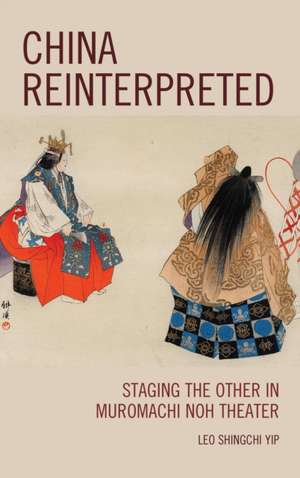
China Reinterpreted: Staging the Other in Muromachi Noh Theater
Autor Leo Shingchi Yipen Limba Engleză Hardback – 4 apr 2016
Preț: 566.66 lei
Preț vechi: 861.62 lei
-34%
Puncte Express: 850
Carte tipărită la comandă
Livrare economică 09-23 noiembrie
Livrare prin curier în România Termenul estimat este afișat lângă disponibilitate.
Transport gratuit pentru acest produs Plată online sau ramburs, în funcție de opțiunile comenzii.
Retur gratuit în 14 zile Comandă securizată și suport în română.
Specificații
ISBN-13: 9781498520584
ISBN-10: 1498520588
Pagini: 230
Ilustrații: 6 b/w photos
Dimensiuni: 160 x 230 x 20 mm
Greutate: 0.32 kg
Editura: Bloomsbury Publishing
Colecția Lexington Books
Locul publicării:New York, United States
ISBN-10: 1498520588
Pagini: 230
Ilustrații: 6 b/w photos
Dimensiuni: 160 x 230 x 20 mm
Greutate: 0.32 kg
Editura: Bloomsbury Publishing
Colecția Lexington Books
Locul publicării:New York, United States
Cuprins
Introduction - Locating China in Noh: The Evolving Dynamics of the Other and the Self
Chapter 1 - The "Auspicious Other": Celebrating with Chinese Deities in Seiobo, Tobosaku, and Tsurukame
Chapter 2 - The "Sympathized Other" and the "Distanced Self": Recasting Legendary Chinese Beauties in Shokun and Yokihi
Chapter 3 - The "Exotic Other": The Spectacular China in Shakkyo andRyoko
Chapter 4 - The "Destructive Other": Threats from China in Haku Rakuten and Zegai
Chapter 5 - The "Harmonious Other" and the "United Self": The Socially and Religiously Unified Chinese in Sansho and Tosen
Conclusion - Reinterpreting China, Reinventing China
Chapter 1 - The "Auspicious Other": Celebrating with Chinese Deities in Seiobo, Tobosaku, and Tsurukame
Chapter 2 - The "Sympathized Other" and the "Distanced Self": Recasting Legendary Chinese Beauties in Shokun and Yokihi
Chapter 3 - The "Exotic Other": The Spectacular China in Shakkyo andRyoko
Chapter 4 - The "Destructive Other": Threats from China in Haku Rakuten and Zegai
Chapter 5 - The "Harmonious Other" and the "United Self": The Socially and Religiously Unified Chinese in Sansho and Tosen
Conclusion - Reinterpreting China, Reinventing China
Recenzii
This book is an excellent introduction to premodern Chinese and Japanese cultural exchanges and communication. Comparative readings of the Noh plays present the unique trajectory by which each Chinese character arrives at the Japanese Noh stage. The translation of the Noh play Yokihi provides a good example of a Chinese play. For scholars, teachers and students who are interested in Sino-Japanese cultural transmission, as well as the development of Noh theater in the medieval period, this book will be a good reference.
China Reinterpreted is the first comprehensive scholarship on how Japanese no theatre responded, incorporated, used, re-interpreted, and represented Chinese themes and characters during the late medieval Muromachi period. . . . China Reinterpretedis carefully reasoned and extensively researched. It is essential reading for anyone interested in the study of medieval Japanese no theatre, and especially Chinese plays in crosscultural contexts. Furthermore, the potential applications of Yip's theoretical framework are far-reaching, and as such may greatly contribute to a broader range of scholarship from transnational and intra-Asia studies, to art history, music, theatre and dance.
This is an extremely well-informed and scholarly work, full of valuable information about important plays that in many cases have not been considered in depth in English hitherto. China Reinterpreted is a welcome and valuable contribution to contemporary scholarship about No.
By looking closely at eleven noh plays that feature Chinese stories and characters, Professor Yip has written a carefully-documented book about the multiple ways in which Japanese playwrights portrayed China, Japan's primary Muromachi Period 'other'-these 'others' are divided into 'sympathized other,' 'distanced other,' 'exotic other,' 'destructive other,' and 'harmonious other,' representing the ambivalence that educated Japanese felt toward China in the late medieval period of Japan's history.??
In China Reinterpreted: Staging the Other in Muromachi Noh Theater, the author does a wonderful job in analyzing the images of China manifested in the Chinese plays of noh using various theories of Self and Other. This is a very informative scholarly book not only for the study of noh theater but also of Asian theater and culture in general.
China Reinterpreted is the first comprehensive scholarship on how Japanese no theatre responded, incorporated, used, re-interpreted, and represented Chinese themes and characters during the late medieval Muromachi period. . . . China Reinterpretedis carefully reasoned and extensively researched. It is essential reading for anyone interested in the study of medieval Japanese no theatre, and especially Chinese plays in crosscultural contexts. Furthermore, the potential applications of Yip's theoretical framework are far-reaching, and as such may greatly contribute to a broader range of scholarship from transnational and intra-Asia studies, to art history, music, theatre and dance.
This is an extremely well-informed and scholarly work, full of valuable information about important plays that in many cases have not been considered in depth in English hitherto. China Reinterpreted is a welcome and valuable contribution to contemporary scholarship about No.
By looking closely at eleven noh plays that feature Chinese stories and characters, Professor Yip has written a carefully-documented book about the multiple ways in which Japanese playwrights portrayed China, Japan's primary Muromachi Period 'other'-these 'others' are divided into 'sympathized other,' 'distanced other,' 'exotic other,' 'destructive other,' and 'harmonious other,' representing the ambivalence that educated Japanese felt toward China in the late medieval period of Japan's history.??
In China Reinterpreted: Staging the Other in Muromachi Noh Theater, the author does a wonderful job in analyzing the images of China manifested in the Chinese plays of noh using various theories of Self and Other. This is a very informative scholarly book not only for the study of noh theater but also of Asian theater and culture in general.