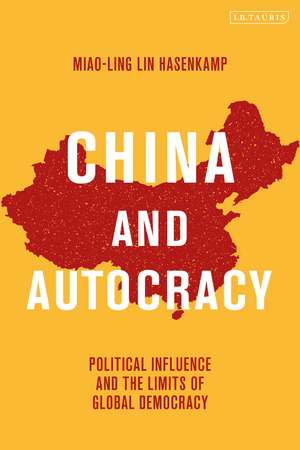
China and Autocracy: Political Influence and the Limits of Global Democracy
Editat de Miao-ling Lin Hasenkampen Limba Engleză Paperback – 18 noi 2021
China's success economically, this collection argues, is undermining the post-war consensus that 'liberal democracy is best'. In a multi-polar, Chinese-dominated world, Trump, Putin, Erdogan, and other global leaders no longer criticize China. In fact, they frequently invoke the usefulness of 'strong' and 'united' leadership. At the same time, China seeks to wear the mantle of a great power, and in doing so talks about human rights, climate change, freedom and economic liberalism.
This collection examines how China views itself and where reality meets rhetoric on trade, international relations, diplomacy, economics and social policy. The contributors expertly dissect China's autocracy, and show how a ripple effect is altering the political-model consensus around the world.
Preț: 213.66 lei
Preț vechi: 288.03 lei
-26%
Puncte Express: 320
Carte tipărită la comandă
Livrare economică 23 noiembrie-07 decembrie
Livrare prin curier în România Termenul estimat este afișat lângă disponibilitate.
Transport gratuit de la 400.00 lei Plată online sau ramburs, în funcție de opțiunile comenzii.
Retur gratuit în 14 zile Comandă securizată și suport în română.
Specificații
ISBN-13: 9780755637263
ISBN-10: 0755637267
Pagini: 240
Dimensiuni: 156 x 234 mm
Greutate: 0.34 kg
Editura: Bloomsbury Publishing
Colecția I.B.Tauris
Locul publicării:London, United Kingdom
ISBN-10: 0755637267
Pagini: 240
Dimensiuni: 156 x 234 mm
Greutate: 0.34 kg
Editura: Bloomsbury Publishing
Colecția I.B.Tauris
Locul publicării:London, United Kingdom
Cuprins
Acknowledgments
1. China's Authoritarianism Goes Global? Domestic and International Dimensions
2. The Prospect of Democracy in China: One-Man Leadership and Institutional Change
3. China's Provincial Leaders of Communist Propaganda
4. Politics of Representation and the Changing Meanings of Rule of Law in Contemporary China
5. Eliminating and Raising Tigers and Flies: The Paradox of China's Anti-Corruption Campaign
6. Is It Possible to Harmonize Universalism with Localism? Deliberating Human RightsDiscourse in China
7. Realising the Chinese Dream beyond China: A Prospect Connecting the Domestic Dimension with the International One
8. China and the 'Adversary' Dynamic in U.S. Foreign Policy Discourses in the 21st Century
9. India and China: Overcoming the great wall of mistrust
10. China in Latin America
11. China in sub-Saharan Africa: Implications for democracy promotion
12. China's Autocracy, Global Democracy and their Limits in an Age of Uncertainty
Bibliography
About the authors
Index
1. China's Authoritarianism Goes Global? Domestic and International Dimensions
2. The Prospect of Democracy in China: One-Man Leadership and Institutional Change
3. China's Provincial Leaders of Communist Propaganda
4. Politics of Representation and the Changing Meanings of Rule of Law in Contemporary China
5. Eliminating and Raising Tigers and Flies: The Paradox of China's Anti-Corruption Campaign
6. Is It Possible to Harmonize Universalism with Localism? Deliberating Human RightsDiscourse in China
7. Realising the Chinese Dream beyond China: A Prospect Connecting the Domestic Dimension with the International One
8. China and the 'Adversary' Dynamic in U.S. Foreign Policy Discourses in the 21st Century
9. India and China: Overcoming the great wall of mistrust
10. China in Latin America
11. China in sub-Saharan Africa: Implications for democracy promotion
12. China's Autocracy, Global Democracy and their Limits in an Age of Uncertainty
Bibliography
About the authors
Index
Recenzii
At a time when conditions in China appear ever more circumscribed and China's global engagement is ever more intense, this ground-breaking multi-disciplinary study on Chinese authoritarianism in all its different forms helps make sense of what the PRC's political system means for domestic governance and the Chinese people, and what it means for Chinese foreign relations and the rest of the world.
A wide ranging discussion, from a diverse group of authors, of one of the most pressing issues in geopolitics today - what the Chinese model of governance might be, and how it might offer competition to liberal democracies. Taking case studies from domestic issues like anti-corruption management to provincial leadership and propaganda, and international ones such as China's engagement with Africa, this study shows that there are no straight forward answers, and that a variety of theoretical approaches need to be used to understand not only what a Chinese model might be, but whether it really has potency and relevance beyond the borders of China itself.
A wide ranging discussion, from a diverse group of authors, of one of the most pressing issues in geopolitics today - what the Chinese model of governance might be, and how it might offer competition to liberal democracies. Taking case studies from domestic issues like anti-corruption management to provincial leadership and propaganda, and international ones such as China's engagement with Africa, this study shows that there are no straight forward answers, and that a variety of theoretical approaches need to be used to understand not only what a Chinese model might be, but whether it really has potency and relevance beyond the borders of China itself.