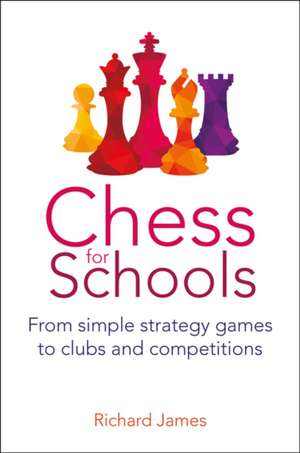
Chess for Schools: From simple strategy games to clubs and competitions
Autor Richard Jamesen Limba Engleză Paperback – 26 aug 2022
Ne-a atras atenția modul în care Chess for Schools transformă predarea șahului dintr-o activitate pur tehnică într-un instrument pedagogic versatil, aplicabil direct în sala de clasă. Richard James pleacă de la premisa că, deși beneficiile cognitive ale șahului sunt recunoscute, complexitatea jocului standard poate fi intimidantă pentru elevii de vârstă mică. Soluția propusă în acest volum este utilizarea unor jocuri de strategie simplificate care permit o progresie naturală și sustenabilă. Remarcăm structura pragmatică a manualului, care nu se rezumă doar la reguli, ci oferă profesorilor metode concrete de a identifica momentul optim pentru introducerea conceptelor avansate. Spre deosebire de Chess for Kids, o lucrare anterioară a autorului axată pe lecții scurte pentru uz individual, Chess for Schools este un manifest pentru crearea unei culturi a șahului la nivel de instituție. Autorul își folosește expertiza acumulată din anii '70 pentru a oferi soluții de incluziune, abordând specific nevoile copiilor cu cerințe educaționale speciale și rolul crucial al părinților în acest proces. Cititorii familiarizați cu Chess for Educators de Karel van Delft vor aprecia modul în care volumul de față completează cercetarea științifică cu un set de exerciții și puzzle-uri gata de utilizat în orele de curs. Tonul este unul echilibrat, evitând promisiunile nerealiste și punând accent pe beneficiile sociale și de comunicare ale jocului. Este o resursă esențială pentru profesorii care doresc să înființeze cluburi școlare, oferind un cadru logistic pentru organizarea competițiilor și colaborarea între școlile primare și secundare. Richard James reușește să demonstreze că șahul nu este doar un sport de elită, ci un limbaj educațional accesibil tuturor.
Preț: 121.19 lei
Carte disponibilă
Livrare economică 26 octombrie-09 noiembrie
Livrare express 10-16 octombrie pentru 31.14 lei
Specificații
ISBN-10: 1785835971
Pagini: 224
Dimensiuni: 152 x 234 x 20 mm
Greutate: 0.46 kg
Editura: Crown House Publishing
V-ar putea interesa
-
 Kartenset Umwelt- und Klimaspiele für den UnterrichtLeona Sprotte-HuberPreț: 205.01 lei
 -
 Animal Social NetworksJens Krause-33%Preț: 998.71 lei1482.64 lei
 -
 MiddleRichard JamesPreț: 67.24 lei
 -
 The NeighboursRichard JamesPreț: 209.41 lei
 -
 AnabolicRichard JamesPreț: 82.03 lei
 -
 Preț: 429.44 lei
 -
 Instructional Models in ReadingSteven A. Stahl-18%Preț: 849.46 lei1035.93 lei
 -
 Teaching Communication: Theory, Research, and MethodsAnita L. Vangelisti-18%Preț: 1312.00 lei1600.00 lei
 -
 Preț: 391.74 lei
 -
 Black Immigrant LiteraciesPatriann SmithPreț: 299.56 lei
 -
 Democratic Habits in the Art ClassroomElizabeth SuttonPreț: 300.54 lei
 -
 Preț: 317.46 lei
 -
 Visualization in Science EducationJohn K. Gilbert-15%Preț: 640.41 lei753.42 lei
 -
 Microstructure and Phase TransitionDavid Kinderlehrer-15%Preț: 641.01 lei754.13 lei
 -
 BehaviourJen Foster-15%Preț: 606.73 lei713.80 lei
 -
 Make Your Own RainbowLeonie BriggsPreț: 142.22 lei
 -
 HorslipsRichard JamesPreț: 112.72 lei
 -
 Bacteriocins, Microcins and LantibioticsRichard James-18%Preț: 965.44 lei1177.37 lei
 -
 Glauben korrelativ kommunizierenBurkard PorzeltPreț: 153.30 lei
 -
 Ich werde Kopfrechen-Profi - Klasse 3-6Bernd WehrenPreț: 85.21 lei
 -
 Gewaltfreie Kommunikation in der SekundarstufeEvelyn SchöllmannPreț: 179.85 lei
De ce să citești această carte
Recomandăm această carte educatorilor și învățătorilor care vor să integreze șahul în curriculum într-un mod atractiv și adaptat nivelului de dezvoltare al copiilor. Cititorul câștigă acces la o metodologie testată timp de decenii, care pune accent pe jocuri de strategie intermediare, facilitând astfel tranziția către șahul de performanță fără a descuraja elevii prin complexitate timpurie.
Despre autor
Richard James este un expert recunoscut internațional în pedagogia șahului pentru copii, activând în acest domeniu încă din 1970. Este pionierul instruirii online prin platforma chessKIDS.com, unde a dezvoltat metode interactive de învățare. Deși interesele sale culturale sunt diverse, incluzând scrieri despre muzica rock și sociologie culturală, activitatea sa principală rămâne dedicată înțelegerii modului în care mintea celor mici procesează strategiile abstracte. Experiența sa vastă se reflectă în abordarea sa didactică, fiind considerat unul dintre cei mai importanți specialiști britanici în șahul școlar.
Descriere scurtă
Chess is a game of extraordinary excitement and beauty and all children should have the opportunity to experience it. Indeed, many claim that playing abstract strategy games such as chess provides a wide range of cognitive and social benefits-such as improvements in problem-solving ability and communication skills.
However, Richard James argues that, because of the complexity of chess, most younger children would gain more benefit from simpler chess-based strategy games and incremental learning. In this practical handbook, Richard provides a wide range of games and puzzles based on these principles which are appropriate for primary schools and explains how teachers can identify children who would benefit from starting young.
Richard also sets out how this approach can engage the whole community, including working with children with special needs, getting parents involved in learning and playing, and developing partnerships between primary and secondary schools.
Chess for Schools shares the latest research into how children process information, combined with insights into international best practice in teaching chess to young children. The book demonstrates the transformative effect chess can have on older children, and how this can be promoted in secondary schools. Richard James offers valuable insights into the greater context of chess-playing, expressing how and why chess is a joy to so many worldwide andshares a series of resources and minigames for teachers to use with their learners.
An ideal resource for primary and secondary school teachers wanting to introduce their pupils to chess.
; An approach to teaching chess in schools through a series of mini games which will enable all children to better understand and enjoy this magnificent game.
; Richard James has created an essential tool for teaching chess in schools. Rooted in deep personal understanding and decades of experience, this approachable, practical guide breaks down the learning of chess and maps out an effective and robust teaching plan. Tackling both social and educational benefits, this book will help you establish a chess culture that seeps through your school.
Ellie Dix
; When I began to read Chess for Schools, I was aware of two salient facts: that Richard James has tremendous experience teaching chess to children - in a classroom setting and as founder of the famously successful Richmond Junior Chess Club; and that he has been a consistent critic of much current chess teaching practice - particularly in primary schools, where he believes the teaching of chess is frequently pitched at an unrealistic level in relation to the cognitive development of the pupils. I was consequently well-prepared for a text that might ruffle some feathers.I was not disappointed. There are undeniably passages in the book which will make uncomfortable reading for some chess teachers and parents. Yet far from the feeling that Richard James is gratuitously courting controversy, I came to regard his unwillingness to pull punches with many in his target audience as a mark of the book's uncommon integrity. His views are the product not only of great experience but also of a persistent quest to improve the outcomes for his pupils, both those with lofty chess ambitions and those who will enjoy a variety of relationships with the game. He has read widely and thought deeply, and the result is a coherent, very readable and well-structured argument which he makes with obvious passion. I didn't agree with all his contentions, but I always found myself hungry to read on. The book will certainly prompt fresh thoughts and is also a treasure trove of practical advice and resources for chess instruction. I would strongly