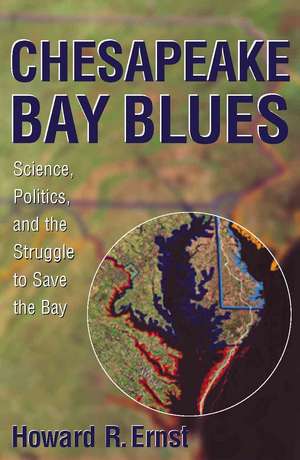
Chesapeake Bay Blues: Science, Politics, and the Struggle to Save the Bay: American Political Challenges
Autor Howard R. Ernsten Limba Engleză Paperback – 25 mar 2003



Preț: 263.81 lei
Preț vechi: 343.94 lei
-23%
Puncte Express: 396
Carte tipărită la comandă
Livrare economică 23 noiembrie-07 decembrie
Livrare prin curier în România Termenul estimat este afișat lângă disponibilitate.
Transport gratuit de la 400.00 lei Plată online sau ramburs, în funcție de opțiunile comenzii.
Retur gratuit în 14 zile Comandă securizată și suport în română.
Specificații
ISBN-13: 9780742523517
ISBN-10: 0742523519
Pagini: 224
Dimensiuni: 150 x 227 x 14 mm
Greutate: 0.35 kg
Ediția:0224
Editura: Bloomsbury Publishing
Colecția Rowman & Littlefield
Seria American Political Challenges
Locul publicării:New York, United States
ISBN-10: 0742523519
Pagini: 224
Dimensiuni: 150 x 227 x 14 mm
Greutate: 0.35 kg
Ediția:0224
Editura: Bloomsbury Publishing
Colecția Rowman & Littlefield
Seria American Political Challenges
Locul publicării:New York, United States
V-ar putea interesa
-
 -20%Preț: 296.65 lei371.99 lei
 -
 -31%Preț: 740.41 lei1076.16 lei
 -
 Social Policy: An IntroductionKen Blakemore-27%Preț: 230.56 lei317.19 lei
 -
 -15%Preț: 473.93 lei557.55 lei
 -
 What's Wrong with Climate Politics and How to Fix ItPaul G HarrisPreț: 235.58 lei
 -
 The Five Stages of CollapseDmitry OrlovPreț: 167.55 lei
 -
 Preț: 394.22 lei
 -
 Modern SlaveryJulia O'Connell Davidson-15%Preț: 658.47 lei774.68 lei
 -
 China's Foreign PolicyG. Rozman-15%Preț: 675.35 lei794.53 lei
 -
 Trust in FoodU. KjaernesPreț: 379.12 lei
 -
 -27%Preț: 162.10 lei221.53 lei
 -
 Alternative Economies and Spaces: New Perspectives for a Sustainable EconomyHans-Martin Zademach-25%Preț: 156.15 lei206.96 lei
Cuprins
Part 1 I The Chesapeake Bay and Environmental Politics
Chapter 2 The Chesapeake Bay: Management of North America's Largest Estuary; Managing the Chesapeake Bay; The State of the Bay: A Limited Inventory of Living Resources; Conclusion
Chapter 3 The Chesapeake Bay as a Political Dilemma: Understanding the Political Barriers to Environmental Policy; "It's the Economy, Stupid": How Economic Primacy Influences Environmental Politics; Divided Government and the Race to the Bottom: How America's Fragm
Part 4 II Nutrient Management and Bay Politics
Chapter 5 Swimming against the Tide: Nutrient Reduction Efforts in the Bay Watershed; The Difficulty of Achieving Nutrient Reductions; The Scorecard: Measuring Nutrient; Reduction "Success"; Conclusion
Chapter 6 The Political Fight of Nutrient Management Policy: The Case of Agricultural Regulation; Agricultural Nutrient Loading; Political Background: The Fight for Enforceable Agricultural Regulations in Maryland and Pennsylvania; Environmental Theory: Toward a De
Part 7 III The Blue Crab and Bay Politics
Chapter 8 All You Can Eat? The Difficult Task of Protecting the Blue Crab; The Blue Crab (Callinectes sapidus); The Decline of the Blue Crab; Factors Complicating Blue Crab Management for the Chesapeake Bay; The Struggle for a Sensible Management Strategy; Co
Chapter 9 Battling Over the Blue Crab: The Politics of Crab Management in Virginia and Maryland; Blue Crab Management in Virginia; Blue Crab Management in Maryland; Environmental Theory: Toward a Deeper understanding of Blue Crab Management; Economic Primacy and Bl
Part 10 IV Learning from the Past
Chapter 11 Toward a Brighter Future for the Chesapeake Bay; Ten Measures to Improve Politics for the Bay; Concludsion
Chapter 12 Appendix: Nutrient Management and the Bay
Chapter 2 The Chesapeake Bay: Management of North America's Largest Estuary; Managing the Chesapeake Bay; The State of the Bay: A Limited Inventory of Living Resources; Conclusion
Chapter 3 The Chesapeake Bay as a Political Dilemma: Understanding the Political Barriers to Environmental Policy; "It's the Economy, Stupid": How Economic Primacy Influences Environmental Politics; Divided Government and the Race to the Bottom: How America's Fragm
Part 4 II Nutrient Management and Bay Politics
Chapter 5 Swimming against the Tide: Nutrient Reduction Efforts in the Bay Watershed; The Difficulty of Achieving Nutrient Reductions; The Scorecard: Measuring Nutrient; Reduction "Success"; Conclusion
Chapter 6 The Political Fight of Nutrient Management Policy: The Case of Agricultural Regulation; Agricultural Nutrient Loading; Political Background: The Fight for Enforceable Agricultural Regulations in Maryland and Pennsylvania; Environmental Theory: Toward a De
Part 7 III The Blue Crab and Bay Politics
Chapter 8 All You Can Eat? The Difficult Task of Protecting the Blue Crab; The Blue Crab (Callinectes sapidus); The Decline of the Blue Crab; Factors Complicating Blue Crab Management for the Chesapeake Bay; The Struggle for a Sensible Management Strategy; Co
Chapter 9 Battling Over the Blue Crab: The Politics of Crab Management in Virginia and Maryland; Blue Crab Management in Virginia; Blue Crab Management in Maryland; Environmental Theory: Toward a Deeper understanding of Blue Crab Management; Economic Primacy and Bl
Part 10 IV Learning from the Past
Chapter 11 Toward a Brighter Future for the Chesapeake Bay; Ten Measures to Improve Politics for the Bay; Concludsion
Chapter 12 Appendix: Nutrient Management and the Bay
Recenzii
Chesapeake Bay Blues cuts through the rhetorical muck, which, like the algae that blooms in the bay, tends to shut out the light.
Ernst has written a book that is packed with information on the politics and science behind the past, present, and future management of the Chesapeake Bay. He digs deep into the exterior and interior layers of policy and procedure that surround Chesapeake Bay protection measures. Ernst presents complex ideas and concepts in detail while still making them accessible to beginning students or interested lay readers-no small task. Backed by a plethora of cited references, Ernst goes further than most authors and provides a detailed "Notes" section on interesting and necessary background and "See also" information for each chapter. A wise choice for all academic libraries as well as for all public libraries.
Chesapeake Bay Blues should motivate a wake-up call for all Bay lovers. A reading must for all concerned.
Howard Ernst paints a stunning portrait of the Chesapeake Bay with a broad brush, yet fills the canvas with documented details of challenges to water quality, living resources and management programs. The text is written with energy and conviction without being melodramatic. A most valuable contribution to a growing library on the Bay.
Howard Ernst's book is an original and needed view of the long struggle to restore the Chesapeake Bay to health. It's readable and thoughtful. I'd recommend it to anyone interested in the Bay, or in environmental restoration in general.
Chesapeake Bay Blues is an exceptionally rich and insightful analysis of how the nation's largest estuary fell victim to human greed, economic expansion, and pollution. Ernst skillfully surveys the multiple causes of the Bay's deterioration, with appropriate attention both to environmental science and public policy issues. The book offers a highly readable and well-informed account of threats to the Bay's health and what might be done to restore both the ecosystem and the enormous economic values it brings to the region.
Howard Ernst, author of Chesapeake Bay Blues, has made quite a splash in the environmental community.
I hope Chesapeake Bay Blues is widely read and debated, because business as usual-even tweaked a bit-isn't going to cut it for restoring the Chesapeake.
Ernst has made some bold conclusions and in doing so, he's bucking the conventional wisdom esposed by the conglomeration of interests involved in the Bay restoration effort.
Ernst has provided an excellent history of natural resource preservation. He does a marvelous job of accurately defining the Chesapeake Bay and its physical, chemical, and biological inputs and outputs. Ernst has done a good service for all of us interested in the Chesapeake Bay by telling its fascinating story.
This splendidly written, carefully documented account of the ecological and economic devastation of one of the nation's great resources is a sad commentary on the human race.
A very important book. The book is an eye-opening exploration into the 'inability of the political process to adequately address environmental problems.'
Very well writtern and provides an easily understandable description of the political challenges faced by those proposing new or more stringent enviornmental regulations or programs.
Anyone who claims to care about the Chesapeake Bay should read Chesapeake Bay Blues by Howard R. Ernst, a Naval Academy political science professor. [Chesapeake Bay Blues] is the first serious look at the Chesapeake that targets with precision what Ernst considers the real problem: politics, and the unwillingness of the public, business, industry, science, environmentalists or the government at any level to acknowledge the complexity and severity of the issues and deal with them realistically.
Ernst has written a book that is packed with information on the politics and science behind the past, present, and future management of the Chesapeake Bay. He digs deep into the exterior and interior layers of policy and procedure that surround Chesapeake Bay protection measures. Ernst presents complex ideas and concepts in detail while still making them accessible to beginning students or interested lay readers-no small task. Backed by a plethora of cited references, Ernst goes further than most authors and provides a detailed "Notes" section on interesting and necessary background and "See also" information for each chapter. A wise choice for all academic libraries as well as for all public libraries.
Chesapeake Bay Blues should motivate a wake-up call for all Bay lovers. A reading must for all concerned.
Howard Ernst paints a stunning portrait of the Chesapeake Bay with a broad brush, yet fills the canvas with documented details of challenges to water quality, living resources and management programs. The text is written with energy and conviction without being melodramatic. A most valuable contribution to a growing library on the Bay.
Howard Ernst's book is an original and needed view of the long struggle to restore the Chesapeake Bay to health. It's readable and thoughtful. I'd recommend it to anyone interested in the Bay, or in environmental restoration in general.
Chesapeake Bay Blues is an exceptionally rich and insightful analysis of how the nation's largest estuary fell victim to human greed, economic expansion, and pollution. Ernst skillfully surveys the multiple causes of the Bay's deterioration, with appropriate attention both to environmental science and public policy issues. The book offers a highly readable and well-informed account of threats to the Bay's health and what might be done to restore both the ecosystem and the enormous economic values it brings to the region.
Howard Ernst, author of Chesapeake Bay Blues, has made quite a splash in the environmental community.
I hope Chesapeake Bay Blues is widely read and debated, because business as usual-even tweaked a bit-isn't going to cut it for restoring the Chesapeake.
Ernst has made some bold conclusions and in doing so, he's bucking the conventional wisdom esposed by the conglomeration of interests involved in the Bay restoration effort.
Ernst has provided an excellent history of natural resource preservation. He does a marvelous job of accurately defining the Chesapeake Bay and its physical, chemical, and biological inputs and outputs. Ernst has done a good service for all of us interested in the Chesapeake Bay by telling its fascinating story.
This splendidly written, carefully documented account of the ecological and economic devastation of one of the nation's great resources is a sad commentary on the human race.
A very important book. The book is an eye-opening exploration into the 'inability of the political process to adequately address environmental problems.'
Very well writtern and provides an easily understandable description of the political challenges faced by those proposing new or more stringent enviornmental regulations or programs.
Anyone who claims to care about the Chesapeake Bay should read Chesapeake Bay Blues by Howard R. Ernst, a Naval Academy political science professor. [Chesapeake Bay Blues] is the first serious look at the Chesapeake that targets with precision what Ernst considers the real problem: politics, and the unwillingness of the public, business, industry, science, environmentalists or the government at any level to acknowledge the complexity and severity of the issues and deal with them realistically.