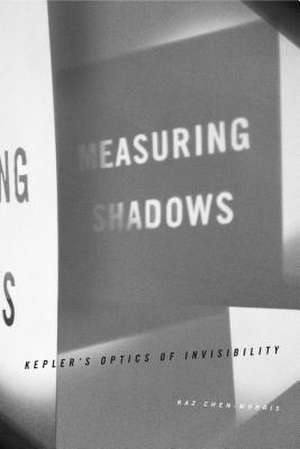
Chen-Morris, R: Measuring Shadows
en Paperback – 15 noi 2017
Breaking from medieval and Renaissance traditions that insisted upon direct sensory perception, Kepler advocated for instruments as mediators between the eye and physical reality, and for mathematical language to describe motion. It was only through this kind of knowledge, he argued, that observation could produce certainty about the heavens. Not only was this conception of visibility crucial to advancing the early modern understanding of vision and the retina, but it affected how people during that period approached and understood the world around them.
Preț: 243.16 lei
Puncte Express: 365
Carte disponibilă
Livrare economică 16-30 noiembrie
Livrare prin curier în România Termenul estimat este afișat lângă disponibilitate.
Transport gratuit de la 400.00 lei Plată online sau ramburs, în funcție de opțiunile comenzii.
Retur gratuit în 14 zile Comandă securizată și suport în română.
Specificații
ISBN-13: 9780271070995
ISBN-10: 0271070994
Pagini: 264
Dimensiuni: 152 x 226 x 18 mm
Greutate: 0.36 kg
Editura: Penn State University Press
ISBN-10: 0271070994
Pagini: 264
Dimensiuni: 152 x 226 x 18 mm
Greutate: 0.36 kg
Editura: Penn State University Press
V-ar putea interesa
-
 Preț: 315.92 lei
 -
 -23%Preț: 574.29 lei745.83 lei
 -
 -15%Preț: 572.76 lei673.84 lei
 -
 -15%Preț: 626.52 lei737.07 lei
 -
 Preț: 299.16 lei
 -
 Preț: 516.85 lei
 -
 Between Two WorldsCemal KafadarPreț: 258.52 lei
 -
 Preț: 266.09 lei
 -
 Preț: 361.89 lei
 -
 The Arians of the Fourth CenturyJohn Henry NewmanPreț: 280.19 lei
 -
 Holmdel and Pleasant ValleyGerald V. CeresPreț: 214.65 lei
 -
 The Last Voyage of the LusitaniaA. A. HoehingPreț: 108.16 lei
 -
 Medizinisches Ethos und theologische EthikUwe Gerrens-9%Preț: 696.89 lei765.81 lei
 -
 Science in the Age of BaroqueOfer Gal-18%Preț: 929.66 lei1133.73 lei
Notă biografică
Raz Chen-Morris is Senior Lecturer in History at the Hebrew University of Jerusalem.
Descriere
Focusing on the astronomer Johannes Kepler's 1604 treatise on optics, explores Kepler's radical break from scientific and epistemological traditions and shows how he posited new ways to view scientific truth and knowledge in the early modern period.