Cantitate/Preț
Produs

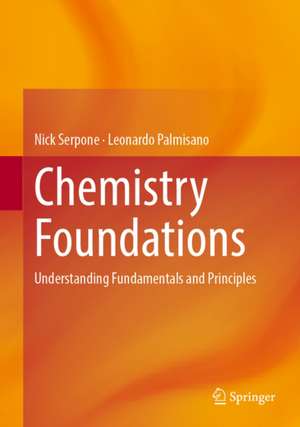
Chemistry Foundations

Autor Leonardo Palmisano, Nick Serpone
en Limba Engleză Hardback – 28 oct 2026

Preț: 71831 lei

Preț vechi: 89789 lei
-20% Precomandă

Puncte Express: 1077

Carte nepublicată încă

Livrare prin curier în România Precomanda se expediază când titlul devine disponibil.
Transport gratuit pentru acest produs Plată online sau ramburs, în funcție de opțiunile comenzii.
Retur gratuit în 14 zile Comandă securizată și suport în română.
Doresc să fiu notificat când acest titlu va fi disponibil:

Specificații

ISBN-13: 9783032236951
ISBN-10: 3032236959
Pagini: 834
Dimensiuni: 178 x 254 mm
Editura: Springer Nature Switzerland AG

Notă biografică

Prof. Nick Serpone is a distinguished physical inorganic chemist and internationally recognized pioneer in photocatalysis, photochemistry, and environmental remediation, with a career spanning more than five decades. He earned his Ph.D. from Cornell University in 1968 and has since held major academic positions, including years as Professor (1968-1998), University Research Professor (1998-2004), and Professor Emeritus (since 2000) at Concordia University, Professore a contratto at the University of Pavia in the program “Rientro dei Cervelli” (2002-2005), Visiting Professor at several leading institutions worldwide, and Program Director at the U.S. National Science Foundation (1998–2001). Elected a Fellow of the European Academy of Sciences (2010) and Head of its Materials Science Division (2014-2020), he has co-authored over 525 scientific papers and co-authored/co edited numerous books (18). His research has significantly advanced the understanding of Heterogeneous Photocatalysis, semiconductor photophysics, photochemistry of transition metal complexes and sunscreen products, and in the last 2 decades microwave assisted chemical processes. He has collaborated extensively with international research groups, served on high level national and international scientific committees and panels, contributed to IUPAC terminology, and co holds patents related to photocatalyst sensitization, establishing him as a central figure in modern photochemical sciences.
 
Prof. Leonardo Palmisano is a distinguished chemist known internationally for his contributions to photocatalysis, catalysis, and inorganic chemistry. After earning a Chemistry degree with highest honours from the University of Palermo in 1973, he advanced through research roles before becoming a Full Professor of Chemistry at the same university in 2000. His career includes extensive international collaborations, visiting professorships in the UK, Germany, and Japan, and leadership of numerous national and international research projects, including European Union–funded work at the Plataforma Solar de Almería. A fellow of the Royal Society of Chemistry and member of the Italian and American Chemical Societies, he has published over 400 scientific papers, contributed to textbooks such as Fondamenti di Chimica, edited a book on wastewater treatment, and holds five patents. His most cited works focus on titanium dioxide photocatalysts, photocatalytic materials for environmental remediation, and the role of photocatalysis in organic chemistry, establishing him as a leading figure in heterogeneous photocatalysis and related areas.

Cuprins

Chapter 1: Atomic Nature of Matter: Historical Perspective

Chapter 2: Structure of the Atom

Chapter 3: The Periodic System

Chapter 4: Chemical Bonding, Part I

Chapter 5: Chemical Bonding, Part II

Chapter 6: Oxidation Numbers, Nomenclature and Chemical Reactions

Chapter 7: The Gaseous State

Chapter 8: Chemical Thermodynamics: First Law and Thermochemistry

Chapter 9: Chemical Thermodynamics: Entropy and Free Energy

Chapter 10: The Solid-State

Chapter 11: The Liquid State: Changes in Single-Component Systems

Chapter 12: Systems with Two or More Components, Part I

Chapter 13: Systems with Two or More Components, Part II

Chapter 14: Chemical Kinetics

Chapter 15: Chemical Equilibrium, Part I

Chapter 16: Chemical Equilibrium, Part II

Chapter 17: Electrochemistry

Chapter 18: Elements of Nuclear Chemistry

Chapter 19: Elements of Inorganic Chemistry, Part I -- Main Group Elements

Chapter 20: Elements of Inorganic Chemistry, Part II -- Transition Metals

Chapter 21: Elements of Organic Chemistry

Chapter 22: Elements of Biochemistry

Chapter 23: Chemistry and our Environment

Chapter 24: Molecular Symmetry and Group Theory

Appendix A1: Physical Quantities and Units of Measurement

Appendix A2: International System of Units

Appendix A3: Dimensions of Physical Quantities

Appendix A4: Sensitivity of Measuring Instruments, Precision and Accuracy of Measurements

Appendix A5: Significant Figures and Exponential Notation

Appendix A6: Tables