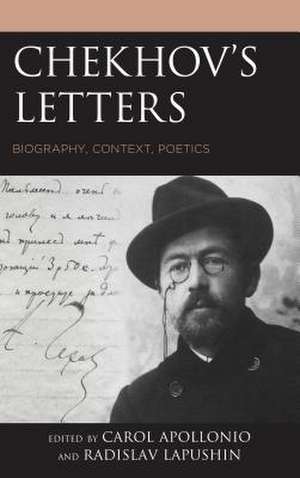
Chekhov's Letters: Biography, Context, Poetics: Crosscurrents: Russia's Literature in Context
Editat de Carol Apollonio, Radislav Lapushin Contribuţii de Rosamund Bartlett, Liya Bushkanets, Sharon M. Carnicke, Alexander Chudakov, John Douglas Clayton, Caryl Emerson, Svetlana Evdokimova, Michael Finke, Elizabeth Geballe, Irina Gitovich, Elena Gorokhova, Serge Gregory, Robert Louis Jackson, Vladimir Kataev, Alevtina Kuzicheva, Vladimir Lakshin, Matthew Mangold, Robin Feuer Miller, Katherine T. O'Connor, Zinovy Paperny, Emma Polotskaya, Cathy Popkin, Dina Rubina, Galina Rylkova, Igor Sukhikhen Limba Engleză Hardback – 15 oct 2018
| Toate formatele și edițiile | Preț | Express |
|---|---|---|
| Paperback (1) | 268.90 lei 6-8 săpt. | |
| Bloomsbury Publishing – 28 apr 2021 | 268.90 lei 6-8 săpt. | |
| Hardback (1) | 771.73 lei 6-8 săpt. | |
| Bloomsbury Publishing – 15 oct 2018 | 771.73 lei 6-8 săpt. |




Preț: 771.73 lei
Preț vechi: 941.14 lei
-18%
Puncte Express: 1158
Preț estimativ în valută:
136.58€ • 159.62$ • 118.58£
136.58€ • 159.62$ • 118.58£
Carte tipărită la comandă
Livrare economică 19 februarie-05 martie
Preluare comenzi: 021 569.72.76
Specificații
ISBN-13: 9781498570442
ISBN-10: 1498570445
Pagini: 358
Ilustrații: 20 b/w photos;
Dimensiuni: 159 x 229 x 34 mm
Greutate: 0.73 kg
Editura: Bloomsbury Publishing
Colecția Lexington Books
Seria Crosscurrents: Russia's Literature in Context
Locul publicării:New York, United States
ISBN-10: 1498570445
Pagini: 358
Ilustrații: 20 b/w photos;
Dimensiuni: 159 x 229 x 34 mm
Greutate: 0.73 kg
Editura: Bloomsbury Publishing
Colecția Lexington Books
Seria Crosscurrents: Russia's Literature in Context
Locul publicării:New York, United States
Cuprins
Introduction: Chekhov's Letters: An Integral Body of Work, Carol Apollonio and Radislav Lapushin
Part I: Publication History, Reception, and Textual Issues
Chapter 1: Reader Reception of Chekhov's Letters at the Beginning of the Twentieth Century, Liya Bushkanets
Chapter 2: Some Like It Hot: The Censored Letters, Vladimir Kataev
Chapter 3: On Editing and Translating Chekhov's Letters, Rosamund Bartlett
Chapter 4: Imaginary Chekhov? Yet Another Fabrication by Boris Sadovskoy, Igor Sukhikh
Part II: Approaches to a Body of Work
Chapter 5: Chekhov's "Postal Prose," Vladimir Lakshin
Chapter 6: Letters Not about Chekhov: On How We Read Chekhov's Letters, Michael Finke
Chapter 7: Chekhov's Letters: Slow Reading, Alevtina Kuzicheva
Chapter 8: The Writer's Correspondence as a Narrative Genre: Aspects of Chekhov's Epistolary Prose, Irina Gitovich
Part III: Genre
Chapter 9: A Unity of Vision: Chekhov's Letters, Alexander Chudakov
Chapter 10: "I Listen to My Irtysh Beating against Coffins": The Existential and Dreamlike in Chekhov's Letters, Radislav Lapushin
Chapter 11: A Playwright's Letters, Emma Polotskaya
Part IV: From Life to Art: Readings
Chapter 12: Homo Sachaliensis: Chekhov as a Family Man, Galina Rylkova
Chapter 13: Russian Binaries and the Question of Culture: Chekhov's True Intelligent, Svetlana Evdokimova
Chapter 14: Burned Letters: Reconstructing the Chekhov-Levitan Friendship, Serge Gregory
Chapter 15: Verbal Games and Animal Metaphors in Chekhov's Correspondence with Olga Knipper, John Douglas Clayton
Chatper 16: The Withered Tree, Zinovy Paperny
Chapter 17: Anton Chekhov and D. H. Lawrence: The Art of Letters and the Discourse of Mortality, Katherine Tiernan O'Connor
Part V: My Favorite Chekhov Letter
Chapter 18: Preface: Chekhov's Blotter, Dina Rubina
Chapter 19: Chekhov's First Dissertation Proposal (to Alexander Chekhov, from Moscow, 17/18 April 1883), Michael Finke
Chapter 20: Letters, Dreams and Their Environments (to Dmitry Grigorovich, from Moscow, 12 February 1887), Matthew Mangold
Chapter 21: Chekhov's Letter to Lermontov (to Mikhail Chekhov, from the ship "Dir," 28 July 1888), Katherine Tiernan O'Connor
Chapter 22: A Favorite Chekhov Letter: Mission Impossible (Letters from 1888-89), Robin Feuer Miller
Chapter 23: Chekhov's "Holy of Holies": The Poetics of Corporeity (to Alexander Pleshcheev, from Moscow, 4 October 1888), Svetlana Evdokimova
Chapter 24: Winged Things (to Alexei Suvorin, from Moscow, 17 October 1889), Elizabeth Geballe
Chapter 25: A Fragment from the Aggregate: Sinai and Sakhalin in Chekhov's Letters to Suvorin
(to Alexei Suvorin, 9 March 1890; 9 December 1890; 17 December 1890), Robert Louis Jackson
Chapter 26: Why Not Stay Here, so Long as It's not Boring? (to family, from Siberia, 23-26 June 1890), Carol Apollonio
Chapter 27: A Prescription to Keep Love at Bay (to Lika Mizinova, from Bogimovo, 20 June 1891), Serge Gregory
Chapter 28: Sympathy for the Devil (to Alexei Suvorin from Melikhovo, 8 April 1892), Cathy Popkin
Chapter 29: Doctor Chekhov Comes to Terms with Tolstoy (to Alexei Suvorin, from Melikhovo, 1 August 1892), Caryl Emerson
Chapter 30: In the Hospital (to Rimma Vashchuk, from Moscow, 27 March 1897), Rosamund Bartlett
Chapter 31: The Power of Memory (to Fyodor Batyushkov, from Nice, 15 December 1897), Elena Gorokhova
Chapter 32: I Have no Faith in Our Intelligentsia (to Ivan Orlov, from Yalta, 22 February 1899), Andrei Stepanov
Chapter 33: Forgive, Forget, and Write (to Ivan Leontyev (Shcheglov), from Yalta, 2 February 1900), Sharon M. Carnicke
Chapter 34: In Place of a Conclusion (to Grigory Rossolimo and to Maria Chekhova, from Badenweiler, 28 June 1904), Radislav Lapushin
Part I: Publication History, Reception, and Textual Issues
Chapter 1: Reader Reception of Chekhov's Letters at the Beginning of the Twentieth Century, Liya Bushkanets
Chapter 2: Some Like It Hot: The Censored Letters, Vladimir Kataev
Chapter 3: On Editing and Translating Chekhov's Letters, Rosamund Bartlett
Chapter 4: Imaginary Chekhov? Yet Another Fabrication by Boris Sadovskoy, Igor Sukhikh
Part II: Approaches to a Body of Work
Chapter 5: Chekhov's "Postal Prose," Vladimir Lakshin
Chapter 6: Letters Not about Chekhov: On How We Read Chekhov's Letters, Michael Finke
Chapter 7: Chekhov's Letters: Slow Reading, Alevtina Kuzicheva
Chapter 8: The Writer's Correspondence as a Narrative Genre: Aspects of Chekhov's Epistolary Prose, Irina Gitovich
Part III: Genre
Chapter 9: A Unity of Vision: Chekhov's Letters, Alexander Chudakov
Chapter 10: "I Listen to My Irtysh Beating against Coffins": The Existential and Dreamlike in Chekhov's Letters, Radislav Lapushin
Chapter 11: A Playwright's Letters, Emma Polotskaya
Part IV: From Life to Art: Readings
Chapter 12: Homo Sachaliensis: Chekhov as a Family Man, Galina Rylkova
Chapter 13: Russian Binaries and the Question of Culture: Chekhov's True Intelligent, Svetlana Evdokimova
Chapter 14: Burned Letters: Reconstructing the Chekhov-Levitan Friendship, Serge Gregory
Chapter 15: Verbal Games and Animal Metaphors in Chekhov's Correspondence with Olga Knipper, John Douglas Clayton
Chatper 16: The Withered Tree, Zinovy Paperny
Chapter 17: Anton Chekhov and D. H. Lawrence: The Art of Letters and the Discourse of Mortality, Katherine Tiernan O'Connor
Part V: My Favorite Chekhov Letter
Chapter 18: Preface: Chekhov's Blotter, Dina Rubina
Chapter 19: Chekhov's First Dissertation Proposal (to Alexander Chekhov, from Moscow, 17/18 April 1883), Michael Finke
Chapter 20: Letters, Dreams and Their Environments (to Dmitry Grigorovich, from Moscow, 12 February 1887), Matthew Mangold
Chapter 21: Chekhov's Letter to Lermontov (to Mikhail Chekhov, from the ship "Dir," 28 July 1888), Katherine Tiernan O'Connor
Chapter 22: A Favorite Chekhov Letter: Mission Impossible (Letters from 1888-89), Robin Feuer Miller
Chapter 23: Chekhov's "Holy of Holies": The Poetics of Corporeity (to Alexander Pleshcheev, from Moscow, 4 October 1888), Svetlana Evdokimova
Chapter 24: Winged Things (to Alexei Suvorin, from Moscow, 17 October 1889), Elizabeth Geballe
Chapter 25: A Fragment from the Aggregate: Sinai and Sakhalin in Chekhov's Letters to Suvorin
(to Alexei Suvorin, 9 March 1890; 9 December 1890; 17 December 1890), Robert Louis Jackson
Chapter 26: Why Not Stay Here, so Long as It's not Boring? (to family, from Siberia, 23-26 June 1890), Carol Apollonio
Chapter 27: A Prescription to Keep Love at Bay (to Lika Mizinova, from Bogimovo, 20 June 1891), Serge Gregory
Chapter 28: Sympathy for the Devil (to Alexei Suvorin from Melikhovo, 8 April 1892), Cathy Popkin
Chapter 29: Doctor Chekhov Comes to Terms with Tolstoy (to Alexei Suvorin, from Melikhovo, 1 August 1892), Caryl Emerson
Chapter 30: In the Hospital (to Rimma Vashchuk, from Moscow, 27 March 1897), Rosamund Bartlett
Chapter 31: The Power of Memory (to Fyodor Batyushkov, from Nice, 15 December 1897), Elena Gorokhova
Chapter 32: I Have no Faith in Our Intelligentsia (to Ivan Orlov, from Yalta, 22 February 1899), Andrei Stepanov
Chapter 33: Forgive, Forget, and Write (to Ivan Leontyev (Shcheglov), from Yalta, 2 February 1900), Sharon M. Carnicke
Chapter 34: In Place of a Conclusion (to Grigory Rossolimo and to Maria Chekhova, from Badenweiler, 28 June 1904), Radislav Lapushin
Recenzii
The Chekhov that emerges from these insightful essays is a warm, generous, and deeply empathetic man. Appropriately, Lapushin concludes the scintillating volume by shedding light on the open ending of Chekhov's two last letters and his enduring legacy. Chekhov's Letters is as rigorous in its scholarship as it is delightful in its creative detours. One only wishes that more individual letters were covered, but given the sheer volume of Chekhov's correspondence, that would be impossible. This marvelous book instructs, entertains, and inspires to delve into the letters themselves.
Authoritative, careful, and scholarly, and yet charming, balanced, and well-written-what a fantastic combination of epithets to bring together for this delightful volume. Carol Apollonio and Radislav Lapushin have gathered the best Russian, British, and North American scholars and writers to offer fascinating historical background, textual analysis, and personal insight into the most intimate genre of writing-the epistolary-and the most approachable of Russian writers-Chekhov. These chapters give us Anton Chekhov from new angles. We see him and his thoughts-thoughtful, witty, philosophical, funny, humane-as we have never seen them before. This is a volume to dip into or to read cover to cover, and always with one or more editions of Chekhov's letters to hand.
Chekhov's letters are entertaining, witty, and moving; they are self-ironical, reflective-philosophical, and they illuminate his innermost beliefs. His 'postal prose' was also his creative laboratory. Yet Chekhov's epistolary legacy was rarely discussed as a genre in its own right. The inspired editorial initiative by professors Carol Apollonio and Radislav Lapushin has changed that state of affairs by bringing both specialists and general readers a unique collection of seminal 'meta-epistolary' articles, the first such collection in either English or Russian. Outstanding Russian, European, Canadian and American Chekhov scholars share their broad range of insights into the 'novel Chekhov never wrote,' i.e., the 'life narrative' of his more than four thousand preserved letters. This collection, which also includes the delightful section 'My Favorite Letter,' shows its authors as kindred spirits following in Chekhov's footsteps: they are innovative, perspicacious and unafraid of undermining traditional 'truths,' while adding important facets to our understanding of this author's elusive personality and 'artless' art. Chekhov's Letters is undoubtedly the splendid portal to a productive new era of Chekhov scholarship.
In his fiction, Chekhov is notoriously reserved, keeping his thoughts to himself. This unique collection of essays mines his letters for information about his life, personality, opinions, works, poetics, and times. It also tells the fascinating story of their preservation (or loss) and publication. The authors include writers as well as scholars, and the collection ends with ruminations, all different, on favorite letters. There is something here for every reader interested in Chekhov. Taken in the aggregate, the essays reveal how the letters-themselves a pinnacle of Russian psychological prose-give voice to a complex inner life that we puzzle over, identify with, and learn from.
Authoritative, careful, and scholarly, and yet charming, balanced, and well-written-what a fantastic combination of epithets to bring together for this delightful volume. Carol Apollonio and Radislav Lapushin have gathered the best Russian, British, and North American scholars and writers to offer fascinating historical background, textual analysis, and personal insight into the most intimate genre of writing-the epistolary-and the most approachable of Russian writers-Chekhov. These chapters give us Anton Chekhov from new angles. We see him and his thoughts-thoughtful, witty, philosophical, funny, humane-as we have never seen them before. This is a volume to dip into or to read cover to cover, and always with one or more editions of Chekhov's letters to hand.
Chekhov's letters are entertaining, witty, and moving; they are self-ironical, reflective-philosophical, and they illuminate his innermost beliefs. His 'postal prose' was also his creative laboratory. Yet Chekhov's epistolary legacy was rarely discussed as a genre in its own right. The inspired editorial initiative by professors Carol Apollonio and Radislav Lapushin has changed that state of affairs by bringing both specialists and general readers a unique collection of seminal 'meta-epistolary' articles, the first such collection in either English or Russian. Outstanding Russian, European, Canadian and American Chekhov scholars share their broad range of insights into the 'novel Chekhov never wrote,' i.e., the 'life narrative' of his more than four thousand preserved letters. This collection, which also includes the delightful section 'My Favorite Letter,' shows its authors as kindred spirits following in Chekhov's footsteps: they are innovative, perspicacious and unafraid of undermining traditional 'truths,' while adding important facets to our understanding of this author's elusive personality and 'artless' art. Chekhov's Letters is undoubtedly the splendid portal to a productive new era of Chekhov scholarship.
In his fiction, Chekhov is notoriously reserved, keeping his thoughts to himself. This unique collection of essays mines his letters for information about his life, personality, opinions, works, poetics, and times. It also tells the fascinating story of their preservation (or loss) and publication. The authors include writers as well as scholars, and the collection ends with ruminations, all different, on favorite letters. There is something here for every reader interested in Chekhov. Taken in the aggregate, the essays reveal how the letters-themselves a pinnacle of Russian psychological prose-give voice to a complex inner life that we puzzle over, identify with, and learn from.