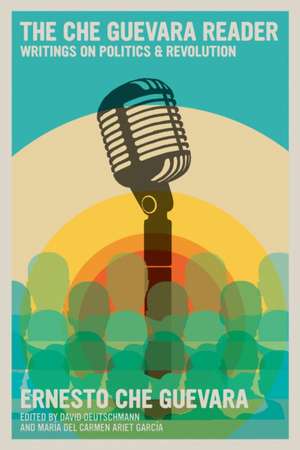
Che Guevara Reader: Writings on Politics and Revolution: Seven Stories Press,U.S.
Autor David Deutschmann, Maria del Carmen Ariet Garciaen Limba Engleză Paperback – 18 aug 2022
Din seria Seven Stories Press,U.S.
- 17%
 Preț: 139.02 lei
- 21%
 Preț: 88.03 lei
- 19%
 Preț: 125.09 lei
- 19%
 Preț: 74.57 lei
- 18%
 Preț: 83.06 lei
-
 Preț: 111.52 lei
- 20%
 Preț: 78.41 lei
- 10%
 Preț: 251.36 lei
- 24%
 Preț: 144.51 lei
- 19%
 Preț: 79.56 lei
- 19%
 Preț: 104.92 lei
- 18%
 Preț: 94.86 lei
- 22%
 Preț: 71.37 lei
- 18%
 Preț: 89.17 lei
- 23%
 Preț: 166.91 lei
- 15%
 Preț: 108.74 lei
- 20%
 Preț: 90.25 lei
- 18%
 Preț: 82.77 lei
- 18%
 Preț: 76.23 lei
- 20%
 Preț: 218.12 lei
- 17%
 Preț: 72.93 lei
- 28%
 Preț: 95.73 lei
- 19%
 Preț: 74.16 lei
- 17%
 Preț: 101.48 lei
- 20%
 Preț: 73.80 lei
- 29%
 Preț: 87.42 lei
- 12%
 Preț: 96.71 lei
- 19%
 Preț: 92.11 lei
- 19%
 Preț: 81.41 lei
- 31%
 Preț: 122.16 lei
- 18%
 Preț: 83.13 lei
- 19%
 Preț: 246.36 lei
- 21%
 Preț: 170.02 lei
- 18%
 Preț: 99.09 lei
- 19%
 Preț: 87.73 lei
- 20%
 Preț: 74.20 lei
- 19%
 Preț: 80.14 lei
- 17%
 Preț: 91.46 lei
- 17%
 Preț: 97.39 lei
- 18%
 Preț: 118.83 lei
- 20%
 Preț: 106.32 lei
- 19%
 Preț: 110.27 lei
- 18%
 Preț: 134.24 lei
- 17%
 Preț: 89.51 lei
- 15%
 Preț: 152.85 lei
-
 Preț: 81.21 lei
- 17%
 Preț: 120.49 lei
- 27%
 Preț: 90.60 lei
- 24%
 Preț: 87.23 lei
Preț: 108.87 lei
Preț vechi: 131.61 lei
-17%
Puncte Express: 163
Carte disponibilă
Livrare economică 19-25 noiembrie
Livrare express 30 octombrie-05 noiembrie pentru 57.17 lei
Livrare prin curier în România Termenul estimat este afișat lângă disponibilitate.
Transport gratuit de la 400.00 lei Plată online sau ramburs, în funcție de opțiunile comenzii.
Retur gratuit în 14 zile Comandă securizată și suport în română.
Specificații
ISBN-13: 9781644211120
ISBN-10: 1644211122
Pagini: 448
Dimensiuni: 152 x 229 x 33 mm
Greutate: 0.52 kg
Editura: Seven Stories Press
Colecția Seven Stories Press
Seria Seven Stories Press,U.S.
Locul publicării:United States
ISBN-10: 1644211122
Pagini: 448
Dimensiuni: 152 x 229 x 33 mm
Greutate: 0.52 kg
Editura: Seven Stories Press
Colecția Seven Stories Press
Seria Seven Stories Press,U.S.
Locul publicării:United States
Notă biografică
ERNESTO GUEVARA DE LA SERNA was born in Rosario, Argentina, on June 14, 1928. While studying for a medical degree in Buenos Aires, he took a trip with his friend Alberto Granado on an old Norton motorcycle through all of Latin America, the basis for The Motorcycle Diaries. During his travels he witnessed the Bolivian revolution in 1953; and, in Guatemala in 1954, the overthrow of the democratically elected government of Jacobo Arbenz by US-backed forces. Forced to leave Guatemala, he went to Mexico City, where he linked up with exiled Cuban revolutionaries and met Fidel Castro in 1955. Che joined their expedition to Cuba, where the revolutionary war began in the Sierra Maestra mountains. At first Che was the troop doctor, and later became Rebel Army commander in July 1957. Following the rebels’ victory on January 1, 1959, he was a key leader of the new revolutionary government and also of the political organization that in 1965 became the Communist Party of Cuba.
Cuprins
Ernesto Che Guevara
Introduction to the second edition by David Deutschmann
Chronology
PART 1: THE CUBAN REVOLUTIONARY WAR
Selections from Reminiscences of the Cuban Revolutionary War
A revolution begins
Alegría de Pío
The battle of La Plata
A betrayal in the making
The murdered puppy
Interlude
A decisive meeting
The final offensive and the battle of Santa Clara
El Patojo
What we have learned and what we have taught (December 1958)
The essence of guerrilla struggle (1960)
Guerrilla warfare: A method (September 1963)
PART 2: THE CUBA YEARS 1959–65
Social ideals of the Rebel Army (January 29, 1959)
Political sovereignty and economic independence (March 20, 1960)
Speech to medical students and health workers (August 20, 1960)
Notes for the study of the ideology of the Cuban Revolution (October 1960)
Cuba: Historical exception or vanguard in the anticolonial struggle? (April 9, 1961)
A new culture of work (August 21, 1962)
The cadre: Backbone of the revolution (September 1962)
To be a Young Communist (October 20, 1962)
A party of the working class (1963)
Against bureaucratism (February 1963)
On the budgetary finance system (February 1964)
Socialism and man in Cuba (1965)
PART 3: INTERNATIONAL SOLIDARITY
Speech to the Latin American youth congress (July 28, 1960)
The OAS conference at Punta del Este (August 8, 1961)
The Cuban Revolution’s influence in Latin America (May 18, 1962)
Tactics and strategy of the Latin American revolution (October–November 1962)
The philosophy of plunder must cease (March 25, 1964)
At the United Nations (December 11, 1964)
At the Afro-Asian conference in Algeria (February 24, 1965)
Create two, three, many Vietnams (Message to the Tricontinental, April 1967)
PART 4: LETTERS
To José E. Martí Leyva
To José Tiquet
To Dr. Fernando Barral
To Carlos Franqui
To Guillermo Lorentzen
To Peter Marucci
To Dr. Aleida Coto Martínez
To the compañeros of the Motorcycle Assembly Plant
To Pablo Díaz González
To Lydia Ares Rodríguez
To María Rosario Guevara
To José Medero Mestre
To Eduardo B. Ordaz Ducungé
To Haydée Santamaría
To Dr. Regino G. Boti
To Elías Entralgo
To my children
To my parents
To Hildita
To Fidel Castro
To my children
Notes
Glossary
Bibliography of Che Guevara’s writings and speeches
Index