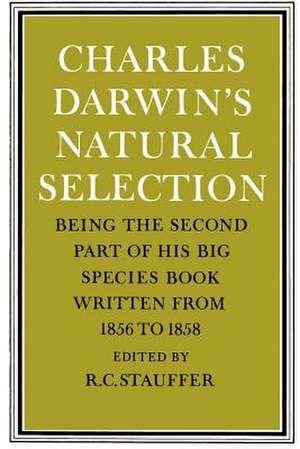
Charles Darwin's Natural Selection: Being the Second Part of his Big Species Book Written from 1856 to 1858
Autor Charles Darwin Editat de R. C. Staufferen Limba Engleză Paperback – 25 noi 1987
Preț: 676.73 lei
Preț vechi: 760.37 lei
-11%
Puncte Express: 1015
Carte tipărită la comandă
Livrare economică 16-30 iulie
Livrare prin curier în România Termenul estimat este afișat lângă disponibilitate.
Transport gratuit pentru acest produs Plată online sau ramburs, în funcție de opțiunile comenzii.
Retur gratuit în 14 zile Comandă securizată și suport în română.
Specificații
ISBN-13: 9780521348072
ISBN-10: 0521348072
Pagini: 708
Ilustrații: 1
Dimensiuni: 154 x 230 x 45 mm
Greutate: 1 kg
Ediția:Pbk.
Editura: Cambridge University Press
Colecția Cambridge University Press
Locul publicării:Cambridge, United Kingdom
ISBN-10: 0521348072
Pagini: 708
Ilustrații: 1
Dimensiuni: 154 x 230 x 45 mm
Greutate: 1 kg
Ediția:Pbk.
Editura: Cambridge University Press
Colecția Cambridge University Press
Locul publicării:Cambridge, United Kingdom
V-ar putea interesa
-
 The Invisible WorldCatherine WilsonPreț: 340.31 lei
 -
 Nevill Mott: Reminiscences And AppreciationsE. A. Davis-18%Preț: 876.71 lei1069.16 lei
 -
 Galileo's Planet: Observing Jupiter Before PhotographyThomas A Hockey-18%Preț: 1205.28 lei1469.86 lei
 -
 Evaluation Research for Educational ProductivityHerbert J. Walberg-23%Preț: 806.64 lei1047.57 lei
 -
 When Geologists Were Historians, 1665–1750Rhoda Rappaport-23%Preț: 573.67 lei745.03 lei
 -
 Preț: 471.87 lei
 -
 Indian ReligionsPeter HeehsPreț: 300.69 lei
 -
 Preț: 351.99 lei
 -
 Preț: 346.39 lei
 -
 A Naturalist in the Gran ChacoJohn Graham KerrPreț: 292.05 lei
 -
 The Mechanism of Creative EvolutionCharles Chamberlain HurstPreț: 337.08 lei
 -
 On the Power of MachinesJohn BanksPreț: 264.74 lei
 -
 -19%Preț: 616.02 lei760.52 lei
 -
 Preț: 373.65 lei
 -
 -19%Preț: 502.67 lei620.59 lei
 -
 Preț: 68.40 lei
 -
 Preț: 213.65 lei
 -
 Origin of Species Charles DarwinCharles DarwinPreț: 76.59 lei
 -
 Preț: 68.40 lei
 -
 On the Expression of the Emotions in Man and AnimalsCharles DarwinPreț: 49.13 lei
 -
 Uber Die Entstehung Der ArtenCharles DarwinPreț: 142.67 lei
Cuprins
Commonly use symbols and abbreviation code; Acknowledgements; General introduction; 1. Editorial considerations; 2. Darwin's table of contents; 3. Possibility of all organic beings crossing; 4. Variation under nature; 5. The struggle for existence; 6. On natural selection; 7. Laws of variation; 8. Difficulties on the theory; 9. Hybridism; 10. Mental powers and instincts of animals; 11. Geographical distribution; Appendices; Bibliography; Guides to the texts of the long and short versions; Collation between the Origin and Natural Selection; Index.
Recenzii
'Natural Selection is a joy to read. It is full of insights and subtle observations that never found their way into the Origin.' Science
' … enables all interested in evolutionary theories to appreciate the background information on which Darwin based the statements he made and the conclusions he reached in the Origin.' New Scientist
' … enables all interested in evolutionary theories to appreciate the background information on which Darwin based the statements he made and the conclusions he reached in the Origin.' New Scientist