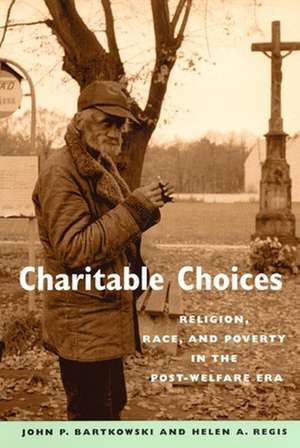
Charitable Choices
Autor John P. Bartkowski, Helen A. Regis, Robert Cottrellen Limba Engleză Hardback – feb 2003
Preț: 627.85 lei
Preț vechi: 815.38 lei
-23%
Puncte Express: 942
Carte tipărită la comandă
Livrare economică 27 noiembrie-11 decembrie
Livrare prin curier în România Termenul estimat este afișat lângă disponibilitate.
Transport gratuit pentru acest produs Plată online sau ramburs, în funcție de opțiunile comenzii.
Retur gratuit în 14 zile Comandă securizată și suport în română.
Specificații
ISBN-13: 9780814799017
ISBN-10: 0814799019
Pagini: 228
Dimensiuni: 153 x 239 x 19 mm
Greutate: 0.43 kg
Ediția:New.
Editura: NYU Press - IPS
ISBN-10: 0814799019
Pagini: 228
Dimensiuni: 153 x 239 x 19 mm
Greutate: 0.43 kg
Ediția:New.
Editura: NYU Press - IPS
V-ar putea interesa
-
 -26%Preț: 58.12 lei78.62 lei
 -
 Stones into SchoolsGreg MortensonPreț: 122.87 lei
 -
 Three Cups of TeaGreg MortensonPreț: 79.17 lei
 -
 Social Entrepreneurship: What Everyone Needs to Know®David Bornstein-19%Preț: 63.00 lei77.84 lei
 -
 -21%Preț: 286.07 lei361.06 lei
 -
 Scaling Your Social VentureP. BloomPreț: 308.39 lei
 -
 Wealth and the Will of GodPaul G. SchervishPreț: 153.81 lei
 -
 Humanitarianism and Modern CultureKeith TesterPreț: 259.33 lei
 -
 Succeeding at Social EnterprisSocial EnterpriPreț: 275.14 lei
 -
 Fighting Cancer with More Than MedicinePaul N RossiPreț: 185.55 lei
 -
 Successful Grant Applications: Bullet GuidesAnn Gawthorpe-28%Preț: 35.18 lei48.81 lei
 -
 Castles and LandscapesO.H. CreightonPreț: 334.50 lei
Recenzii
"Provides important insight into the manner in which federal support of faith-based poverty relief initiatives affect religious identity in the Golden Triangle Region of rural Mississippi."Journal of Church and State "The book provides a thorough historical overview of the events that led up to the Bush administration's decision to promote faith-based social welfare. This thoughtful book is a useful addition to the growing literature on the subject and should be widely consulted."Journal of Sociology and Social Welfare "Well-written and clearly organized."Journal of Social Services "In depth profiles...with obvious strengths."Contemporary Sociology "The findings raise serious concerns related to discriminatory practices around who will get served, and the qualification of those providing the services. . . . Highly recommended."
CHOICE "The comparative case method stretched across a complex analytical framework sketches the terrain in broad, suggestive, analytical strokes. We benefit from the timeliness of Bartkowski and Regis's study."
American Journal of Sociology "Nothing short of exceptional...Charitable Choices is a very readable book that makes an evident contribution to contemporary discourse about welfare reform and its possibilities and pitfalls."
Social Forces These stories reveal not only the profound commitment that clergy can have for their flock but how existing social structures can render the poor invisible. Charitable Choices is more useful as a description of an under-recognized aspect of American religious life than as an analysis of government welfare policy.
Religious Studies Review
"Provides important insight into the manner in which federal support of faith-based poverty relief initiatives affect religious identity in the Golden Triangle Region of rural Mississippi."--Journal of Church and State "The book provides a thorough historical overview of the events that led up to the Bush administration's decision to promote faith-based social welfare. This thoughtful book is a useful addition to the growing literature on the subject and should be widely consulted."--Journal of Sociology and Social Welfare "Well-written and clearly organized."--Journal of Social Services "In depth profiles...with obvious strengths."--Contemporary Sociology "The findings raise serious concerns related to discriminatory practices around who will get served, and the qualification of those providing the services... Highly recommended." --CHOICE "The comparative case method stretched across a complex analytical framework sketches the terrain in broad, suggestive, analytical strokes. We benefit from the timeliness of Bartkowski and Regis's study." --American Journal of Sociology "Nothing short of exceptional...Charitable Choices is a very readable book that makes an evident contribution to contemporary discourse about welfare reform and its possibilities and pitfalls." --Social Forces "These stories reveal not only the profound commitment that clergy can have for their flock but how existing social structures can render the poor invisible. Charitable Choices is more useful as a description of an under-recognized aspect of American religious life than as an analysis of government welfare policy." --Religious Studies Review
CHOICE "The comparative case method stretched across a complex analytical framework sketches the terrain in broad, suggestive, analytical strokes. We benefit from the timeliness of Bartkowski and Regis's study."
American Journal of Sociology "Nothing short of exceptional...Charitable Choices is a very readable book that makes an evident contribution to contemporary discourse about welfare reform and its possibilities and pitfalls."
Social Forces These stories reveal not only the profound commitment that clergy can have for their flock but how existing social structures can render the poor invisible. Charitable Choices is more useful as a description of an under-recognized aspect of American religious life than as an analysis of government welfare policy.
Religious Studies Review
"Provides important insight into the manner in which federal support of faith-based poverty relief initiatives affect religious identity in the Golden Triangle Region of rural Mississippi."--Journal of Church and State "The book provides a thorough historical overview of the events that led up to the Bush administration's decision to promote faith-based social welfare. This thoughtful book is a useful addition to the growing literature on the subject and should be widely consulted."--Journal of Sociology and Social Welfare "Well-written and clearly organized."--Journal of Social Services "In depth profiles...with obvious strengths."--Contemporary Sociology "The findings raise serious concerns related to discriminatory practices around who will get served, and the qualification of those providing the services... Highly recommended." --CHOICE "The comparative case method stretched across a complex analytical framework sketches the terrain in broad, suggestive, analytical strokes. We benefit from the timeliness of Bartkowski and Regis's study." --American Journal of Sociology "Nothing short of exceptional...Charitable Choices is a very readable book that makes an evident contribution to contemporary discourse about welfare reform and its possibilities and pitfalls." --Social Forces "These stories reveal not only the profound commitment that clergy can have for their flock but how existing social structures can render the poor invisible. Charitable Choices is more useful as a description of an under-recognized aspect of American religious life than as an analysis of government welfare policy." --Religious Studies Review