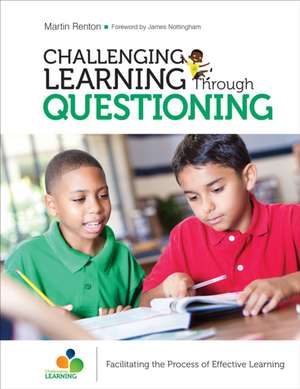
Challenging Learning Through Questioning
Autor Martin Rentonen Limba Engleză Paperback – 19 mai 2020
Preț: 288.42 lei
Carte tipărită la comandă
Livrare economică 28 noiembrie-12 decembrie
Specificații
ISBN-10: 1506376576
Pagini: 226
Dimensiuni: 216 x 280 x 12 mm
Greutate: 0.64 kg
Ediția:1
Editura: Corwin
Locul publicării:Thousand Oaks, United States
V-ar putea interesa
-
 Preț: 218.53 lei
 -
 Classroom Killers? Hallway Hostages?Kenneth S. TrumpPreț: 278.12 lei
 -
 The Career Advancement PortfolioBeverly J IrbyPreț: 218.43 lei
 -
 Prevention That Works!Cynthia R. KnowlesPreț: 317.94 lei
 -
 Becoming a Star TeacherPatricia M. HartPreț: 223.39 lei
 -
 Hold That ThoughtTimothy A CareyPreț: 107.17 lei
 -
 AmeliorationKathleen JerinPreț: 155.72 lei
 -
 Preț: 369.39 lei
 -
 Keys to Curriculum Mapping: Strategies and Tools to Make It WorkSusan K. UdelhofenPreț: 232.48 lei
 -
 The Teacher's Guide to Successful Job Transfers and PromotionsJoanne Wachter GhioPreț: 193.46 lei
 -
 Reaching and Teaching Middle School LearnersPenny A. BishopPreț: 254.07 lei
 -
 Preț: 320.37 lei
 -
 Making Your First Year a SuccessRobert L. Wyatt IIIPreț: 487.70 lei
 -
 The Blended Course Design WorkbookKathryn E Linder-37%Preț: 246.44 lei389.82 lei
 -
 ACSM Certification Review Study GuideCertified Personal Trainer (Cpt) TeamPreț: 190.12 lei
 -
 Handbook on Digital Learning for K-12 SchoolsAnn Marcus-Quinn-18%Preț: 1054.02 lei1285.39 lei
 -
 Problem-based Learning into the FutureMegan Yih Chyn A. Kek-15%Preț: 665.20 lei782.59 lei
Recenzii
Cuprins
The Challenging Learning Story
Foreword by James Nottingham
Preface
Acknowledgements
About the Author
The Language of Learning
Introduction
Part I: How to Question
Chapter 1: Questioning Essentials
1.0 The Three Essential Skills
1.1 Know Your Intent
1.2 Identifying Your Intent
1.3 Plan Your Responses
1.4 Stay Silent (and Listen)
1.5 Review
1.6 Reflection
Chapter 2: The Basic Questioning Sequence
2.0 The IRE Pattern
2.1 IRE as Closed Questioning
2.2 Problems in IRE
2.3 Rethinking the E
2.4 Using the Explore Step to Focus on Process
2.5 Challenge and the I-R-Explore Pattern
2.6 Questioning as Feedback
2.7 Review
2.8 Reflection
Chapter 3: Questioning Tools: Planning Effective Sequences
3.0 The Starting Point: Initiate—Where Questions Are Born
3.1 A Reflection Section
3.2 Your Options After the First Response: Planning With a Flow Chart
3.3 Planning to Explore: Stick With It!
3.4 Planning Questioning Sequences: The Funnelling Technique
3.5 Using the Funnelling Technique to Plan Longer Sequences
3.6 So Why Don't We Explore More?
3.7 Prompted to Explore!
3.8 Review
3.9 Reflection
Chapter 4: Questioning Flow
4.0 Pause and Paraphrase to Improve Flow
4.1 A Reflection Section
4.2 Paraphrasing
4.3 Getting in Flow
4.4 It’s Not About Giving Up Control!
4.5 Managing Questioning Sequences in Whole-Class Dialogues: Get the IDEAR!
4.6 Questioning Moves in the IDEAR Framework
4.7 A Questioning Example in the IDEAR Framework
4.8 Impact of the IDEAR Framework
4.9 Review
4.10 Reflection
Chapter 5: Stay Silent (and Listen)
5.0 Less Time to Process Means Less Impact
5.1 Wait-Time
5.2 Think-Time
5.3 Think-Pair-Share
5.4 Don’t Forget Think-Time 2!
5.5 A Taxonomy of Classroom Silences
5.6 The Skilful Use of Silences in Effective Questioning Sequences
5.7 Review
5.8 Reflection
Part II: Questioning and Challenge
Chapter 6: Thinking About Challenge
6.0 The Benefit of Struggle
6.1 How to Think About Challenge in Learning
6.2 Questioning to Encourage and Support Struggle
6.3 Know Your Intent: Get Into the Learning Zone!
6.4 The Learning Pit
6.5 The Learning Challenge Stages
6.6 Review
6.7 Reflection
Chapter 7: Questioning Activities to Challenge Thinking
7.0 Ranking Exercises
7.1 Diamond Nine
7.2 Extending Thinking With The Intention to Challenge
7.3 Your Role During the Groupwork Stage
7.4 Varying the Groupwork to Share Perceptions
7.5 Example Diamond Nine Cards for Different Age Groups
7.6 Other Shapes for Ranking
7.7 Review
7.8 Reflection
Chapter 8: Questioning for Challenge
8.0 Getting Into the Pit!
8.1 Intention to Challenge 1: The Counter-Example
8.2 Intention to Challenge 2: Comparisons
8.3 Intention to Challenge 3: Challenge Assumptions
8.4 Intention to Challenge 4: Define Extent
8.5 Advanced Questioning Techniques for Increasing Challenge
8.6 The Role of the Questioner: Teacher Stances When Questioning for Challenge
8.7 Time to Think When Questioning for Challenge
8.8 Review
8.9 Reflection
Part III: Students and Questioning
Chapter 9: Students Learning to Ask Questions
9.0 Question Stems
9.1 The Question Constructor
9.2 5 Ws (and an H!)
9.3 Inference Squares
9.4 Students Classifying Their Own Questions for Inquiry
9.5 Review
9.6 Reflection
Example Questioning Scripts
Final Reflections
10 Top Tips for Questioning
References
Index
Notă biografică
Martin Renton is Challenging Learning¿s Director of Consultancy and Evaluations. He is a highly sought-after keynote speaker, leader, facilitator and coach.
Martin's excellent reputation is well earned. His core belief that professional development is not a 'quick fix' but a deep process of change has led to some very powerful effects in schools and colleges around the world. Teachers and leaders who have worked with Martin over an extended period of time refer to increased engagement, motivation and progress for all students.
Martin ensures that all our Challenging Learning trainers blend theories of learning with active tools for the classroom, giving teachers and leaders the opportunities to put into practice new skills and approaches. The effect can be seen most dramatically in our long-term projects around the world. The most significant of these are in Sweden, Denmark, Norway, Isle of Man, Northern Ireland, Australia and New Zealand.
Martin's knowledge of pedagogy and leadership is borne out of his experiences in schools and colleges as a teacher, leader, consultant and coach. His early experiences as a nanny (2-9 year olds), then as a teacher and leader in middle schools (9-13 year olds), secondary schools (11-18 year olds) and colleges (16+) have given him a comprehensive insight into how people learn from the age of 2-adulthood. Martin uses these insights to challenge, inspire and engage his audiences.