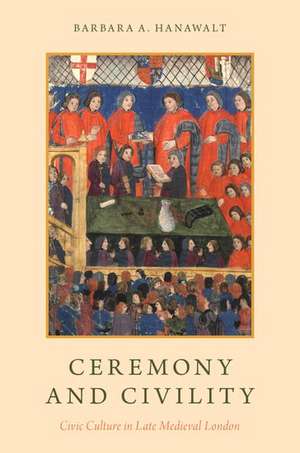
Ceremony and Civility: Civic Culture in Late Medieval London
Autor Barbara A. Hanawalten Limba Engleză Paperback – 31 aug 2017
Preț: 250.45 lei
Preț vechi: 315.67 lei
-21%
Puncte Express: 376
Carte tipărită la comandă
Livrare economică 27 noiembrie-02 decembrie
Livrare prin curier în România Termenul estimat este afișat lângă disponibilitate.
Transport gratuit de la 400.00 lei Plată online sau ramburs, în funcție de opțiunile comenzii.
Retur gratuit în 14 zile Comandă securizată și suport în română.
Specificații
ISBN-13: 9780190490409
ISBN-10: 0190490403
Pagini: 248
Dimensiuni: 155 x 231 x 13 mm
Greutate: 0.36 kg
Editura: Oxford University Press
Colecția OUP USA
Locul publicării:New York, United States
ISBN-10: 0190490403
Pagini: 248
Dimensiuni: 155 x 231 x 13 mm
Greutate: 0.36 kg
Editura: Oxford University Press
Colecția OUP USA
Locul publicării:New York, United States
V-ar putea interesa
-
 -17%Preț: 105.51 lei127.63 lei
 -
 Evolution of the BookFrederick G. Kilgour-28%Preț: 451.16 lei630.87 lei
 -
 Fiefs and Vassals: The Medieval Evidence ReinterpretedSusan Reynolds-28%Preț: 492.22 lei682.07 lei
 -
 Early Modern Europe: An Oxford HistoryEuan Cameron-11%Preț: 316.11 lei356.18 lei
 -
 -32%Preț: 543.99 lei800.73 lei
 -
 Preț: 322.73 lei
 -
 The Norman Kingdom of SicilyDonald MatthewPreț: 525.74 lei
 -
 Barbarian Migrations and the Roman West, 376-568Guy HalsallPreț: 320.39 lei
 -
 Reading Medieval LatinKeith SidwellPreț: 263.09 lei
 -
 The Ottoman Empire and Early Modern EuropeDaniel GoffmanPreț: 347.43 lei
 -
 Women, Family, and Gender in Islamic LawJudith E. TuckerPreț: 299.16 lei
 -
 The Byzantine LadyDonald M. NicolPreț: 206.07 lei
 -
 The Formation of Islam 1edJonathan P. BerkeyPreț: 389.06 lei
 -
 Portuguese Oceanic Expansion, 1400-1800Francisco BethencourtPreț: 376.96 lei
 -
 The Byzantine EconomyAngeliki E. LaiouPreț: 318.21 lei
 -
 The Jews of Medieval Western ChristendomRobert ChazanPreț: 334.40 lei
 -
 The Crusades, C.1071 C.1291Jean RichardPreț: 448.10 lei
 -
 Islamic HistoriographyChase RobinsonPreț: 277.60 lei
 -
 Roger II of SicilyHubert HoubenPreț: 337.74 lei
 -
 CharlemagneRosamond MckitterickPreț: 331.20 lei
 -
 German Histories in the Age of Reformations, 1400-1650Thomas A. Brady Jr.Preț: 313.18 lei
 -
 A Social History of England, 1200-1500Rosemary HorroxPreț: 441.75 lei
 -
 Medieval Africa, 1250 1800Roland OliverPreț: 386.58 lei
 -
 The Making of PolitiesJohn WattsPreț: 251.69 lei
 -
 Southeastern Europe in the Middle Ages, 500-1250Florin CurtaPreț: 434.18 lei
 -
 The Cambridge History of ChristianityMargaret M. MitchellPreț: 447.64 lei
 -
 An Economic History of EuropeKarl Gunnar PerssonPreț: 272.80 lei
 -
 Reformation EuropeUlinka RublackPreț: 232.26 lei
 -
 Medieval HeresiesChristine Caldwell AmesPreț: 274.47 lei
 -
 Preț: 501.58 lei
Recenzii
This book is valuable as an introduction to the culture of governance of a medieval town, and will no doubt be very helpful to undergraduates and others approaching the topic for the first time (for such readers, it contains a handy glossary of relevant terms). It also ffers a fresh perspective on the topic by virtue of its attention to the newcomers to the city and others who were not integrated into civic institutions. The paperback edition contains many reproductions (in greyscale) of prints, drawings and manuscript images which evoke the experience of the medieval city.
Hanawalt makes an original and valuable contribution by focusing on the integrative purpose of civic culture in a city where citizenship was the preserve of a relatively small group and real political power was even more restricted.This book is valuable as an introduction to the culture of governance of a medieval town, and will no doubt be very helpful to undergraduates and others approaching the topic for the first time...It also offers a fresh perspective on the topic by virtue of its attention to the newcomers to the city and others who were not integrated into civic institutions.
In Ceremony and Civility, as in her earlier work, Hanawalt carefully sifts through the archival materials and listens to what the documents have to say about Londoners' ideas of order, their annual observances, and even the smells, sights, and sounds on the streets... The reader will soak in both the civic organization of medieval London and its rich ideological and performative accoutrements. As such, Ceremony and Civility has much to offer readers as they consider the complex use and meanings of space by and for medieval actors.
Hanawalt's long record of books that combine careful scholarship with an approachable style is extended here, with an appeal to general readers as well as to students....Highly recommended.
Barbara Hanawalt's book is an excellent synthesis on London, exposing vividly nearly every aspect of urban life from the Guildhall to the ill-famed taverns. Her approach of the importance of the didactic nature of the ceremonies and rituals concerning the values and the power of the oligarchy is also very stimulating. Besides, it is well written and accessible to students and even a larger public, all the more so that it contains a glossary and an index of the notions, institutions and so on, explained in the book... This 'final book' of a fine historian is a great one and largely deserves to be read if one wants to understand the life of the most important city of late medieval England.
Hanawalt makes an original and valuable contribution by focusing on the integrative purpose of civic culture in a city where citizenship was the preserve of a relatively small group and real political power was even more restricted.This book is valuable as an introduction to the culture of governance of a medieval town, and will no doubt be very helpful to undergraduates and others approaching the topic for the first time...It also offers a fresh perspective on the topic by virtue of its attention to the newcomers to the city and others who were not integrated into civic institutions.
In Ceremony and Civility, as in her earlier work, Hanawalt carefully sifts through the archival materials and listens to what the documents have to say about Londoners' ideas of order, their annual observances, and even the smells, sights, and sounds on the streets... The reader will soak in both the civic organization of medieval London and its rich ideological and performative accoutrements. As such, Ceremony and Civility has much to offer readers as they consider the complex use and meanings of space by and for medieval actors.
Hanawalt's long record of books that combine careful scholarship with an approachable style is extended here, with an appeal to general readers as well as to students....Highly recommended.
Barbara Hanawalt's book is an excellent synthesis on London, exposing vividly nearly every aspect of urban life from the Guildhall to the ill-famed taverns. Her approach of the importance of the didactic nature of the ceremonies and rituals concerning the values and the power of the oligarchy is also very stimulating. Besides, it is well written and accessible to students and even a larger public, all the more so that it contains a glossary and an index of the notions, institutions and so on, explained in the book... This 'final book' of a fine historian is a great one and largely deserves to be read if one wants to understand the life of the most important city of late medieval England.
Notă biografică
Barbara A. Hanawalt is King George III Professor of British History Emerita, Ohio State University. Her books include The Ties That Bound: Peasant Families in Medieval England (1986); Growing Up in Medieval London: The Experience of Childhood in History (1993); Of Good and Ill Repute: Gender and Social Control in Medieval England (1999); and The Wealth of Wives: Women, Law, and the Economy in Late Medieval London (2007).