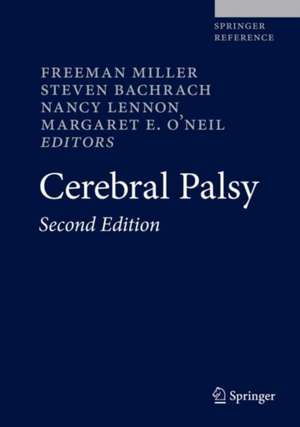
Cerebral Palsy: Cerebral Palsy
Editat de Freeman Miller, Steven Bachrach, Nancy Lennon, Margaret E. O'Neilen Limba Engleză Hardback – 4 noi 2020
În ultimele decenii, managementul paraliziei cerebrale a evoluat de la o abordare pur ortopedică spre un model de îngrijire multidisciplinar, care recunoaște natura sistemică și pe termen lung a acestei afecțiuni. Remarcăm în această a doua ediție a Cerebral Palsy o sinteză clinică riguroasă, menită să ofere specialiștilor instrumentele necesare pentru a naviga complexitatea diagnosticului și tratamentului modern. Cartea nu se rezumă la intervenția medicală imediată, ci subliniază rolul crucial al sistemului educațional și al adaptărilor sociale în atingerea potențialului maxim al pacientului.
Structura volumului reflectă o progresie logică, de la fundamentele etiologice — incluzând prematuritatea, accidentul vascular cerebral in utero și infecțiile — până la secțiuni avansate de patologie. Găsim aici detalii tehnice despre utilizarea imagisticii PET și analiza modificărilor osoase și musculare la nivel celular, elemente esențiale pentru o înțelegere profundă a neuro-motricității. Pe linia clinică a lucrării Orthopedic Care of Patients with Cerebral Palsy, dar cu un accent mult mai pronunțat pe fundamentarea științifică a patologiei și pe epidemiologia diversificată (acoperind experiențe din America, Europa, Asia și Africa), acest tratat devine o resursă enciclopedică.
Această ediție extinde viziunea autorului Freeman Miller prezentă în Physical Therapy of Cerebral Palsy, trecând de la focusul pe terapie fizică la o analiză comprehensivă a întregului spectru medical. Volumul reușește să echilibreze rigoarea academică a celor 1200 de pagini cu necesitățile practice ale clinicianului care se confruntă cu provocări precum managementul durerii la pacienții non-comunicativi sau evaluarea prognosticului prin reflexe patologice.
Preț: 11199.96 lei
Preț vechi: 11789.42 lei
-5%
Carte disponibilă
Livrare economică 29 octombrie-12 noiembrie
Specificații
ISBN-10: 3319745573
Pagini: 1200
Ilustrații: L, 3145 p. 1503 illus., 914 illus. in color. In 3 volumes, not available separately.
Dimensiuni: 178 x 254 x 132 mm
Greutate: 7.35 kg
Ediția:2nd ed. 2020
Editura: Springer International Publishing
Colecția Springer
Seria Cerebral Palsy
Locul publicării:Cham, Switzerland
V-ar putea interesa
-
 Managing Your HeadachesMark W Green-5%Preț: 124.66 lei131.22 lei
 -
 Physical Therapy of Cerebral PalsyFreeman Miller-5%Preț: 731.30 lei769.80 lei
 -
 Genes, Brain and DevelopmentMarcia A. Barnes-11%Preț: 442.67 lei497.38 lei
 -
 Pediatric Traumatic Brain InjuryVicki Anderson-14%Preț: 924.70 lei1075.23 lei
 -
 -5%Preț: 1094.05 lei1151.63 lei
 -
 Neurocritical CareJohn P. Adams-5%Preț: 779.64 lei820.68 lei
 -
 Understanding CNS Laminated PosterScientific Publishing-5%Preț: 123.70 lei130.20 lei
 -
 Understanding Parkinson's Laminated PosterScientific Publishing-5%Preț: 123.77 lei130.28 lei
 -
 Understanding Epilepsy Laminated PosterScientific Publishing-5%Preț: 123.81 lei130.33 lei
 -
 Neurology of the InfantFrancesco Guzzetta-22%Preț: 402.85 lei515.17 lei
 -
 -30%Preț: 638.88 lei911.27 lei
 -
 -5%Preț: 354.76 lei373.43 lei
 -
 Brainstem DisordersPeter P. Urban-5%Preț: 1023.30 lei1077.16 lei
 -
 NeuroethologyJ.-P. Ewert-5%Preț: 360.88 lei379.88 lei
 -
 -5%Preț: 694.59 lei731.15 lei
 -
 -5%Preț: 742.10 lei781.16 lei
 -
 Psicoanalisi e NeuroscienzeMauro Mancia-5%Preț: 730.00 lei768.42 lei
De ce să citești această carte
Această lucrare este esențială pentru neurologi pediatri, ortopezi și terapeuți care doresc o înțelegere profundă, bazată pe dovezi, a paraliziei cerebrale. Cititorul câștigă acces la protocoale actualizate de diagnostic și la o perspectivă globală asupra epidemiologiei bolii. Este un instrument de referință care transformă abordarea clinică fragmentată într-un management integrat, axat pe calitatea vieții pacientului și a familiei acestuia pe parcursul întregii existențe.
Despre autor
Dr. Freeman Miller este un expert recunoscut la nivel internațional în tratamentul copiilor cu paralizie cerebrală și tulburări ale mersului. În calitate de Co-Director al Programului de Paralizie Cerebrală și Director Medical al Laboratorului de Analiză a Mersului din cadrul Institutului Alfred I. duPont din Delaware, Dr. Miller a contribuit fundamental la standardizarea protocoalelor de intervenție. Membru activ în organizații de prestigiu precum Academia Americană de Pediatrie, acesta și-a dedicat cariera cercetării clinice, fiind autorul unor lucrări de referință care îmbină ortopedia cu neurologia și terapia recuperatorie.
Descriere scurtă
Readers also benefit from a review of current practices in their own fields.
Includes recommended treatment algorithms and is designed to help improve decision making.
Written in a very conversational style and illustrated with lots of color the volume provides rehabilitational (part 1) and surgical aspects (part 2).
Accomplished by a CD-ROM which provides lots of case studies - including walking analysis.
The most comprehensive title on this topic written by a leading expert.
Descriere
Cuprins
The Child, The Parent and the Goal
Prematurity
Congenital malformation
Infections
Congenital Metabolic
In utero Stroke
Problem during delivery
Post natal encephalopathy
Section 2 Epidemiology
Over-view of the past 50 Years
American experience
European Experience
Asian experience
African experience
Section 3 Pathology
Physical pathology
Current Imaging -PET
Muscle changes at the cellular level
Gross Anatomic Muscle changes in CP
Neuro-motor junction changes
Bone Alterations in CP
Section 4 Diagnosis
Over view of when and how to evaluate
Who should get Imaging
Indications for metabolic work up
Indications for full genetic work up Prognosis assessment - role of PE -Pathologic Reflexes
Classification Terminology
Section 5 General Medical Concerns
Over view of Normal Natural history
The Irritable Child with CP
Pain in The Non-communicative Patient
Post-operative Pain Management
Section 6 Neurologic Problems
Seizures - Diagnosis, Natural History
Seizures - Medical Management
Seizures - Ketogenic Diet - Indication and Description
Seizures - Role of VNS
Seizures - Role of Surgical Removal
Seizure Surgery - Workup and technique Description
Pseudo-seizures - Diagnosis and Treatment
Hydrocephalus Diagnosis and treatment indications
Shunting for Hydrocephalus
Surgical Ventriculostomy for Hydrocephalus
Section 7 Psychologic and Psychiatric Problems
Attention Deficient associated with CP
Autism and CP as Comorbidities
Family Stress Secondary to Disability Impact on Siblings
Depression associated with CP
Mood disorders (Bipolar and CP)
Thought disorder and CP
Section 8 Gastro-intestinal Problems
Over view and natural of feeding issues with growth and development
Aspiration - risks, work up, when is it a problem
Gastrostomy feeding - when indicated
Tracheostomy or diversion - When indicated and how done
Weight and growth in the child with CP
Feeding Therapy - Indications how long (Maybe in therapy section) GE reflux - Work up and medical Management
GE Reflux - Work up and Surgical Management
Poor Intestinal Motility
Constipation - Implications long term and treatment
Section 9 Genito-Urinary
Toilet training and bladder control - Expectations and when to work up
Neurogenic Bladder
Renal stones - risks, prevention and management
Undescended Testicles -
Section 10 Ear Nose and Throat
Drooling - diagnosis, measurement and medical management
Drooling - management with local injections - Botulinum
Drooling - Surgical treatment options and outcomes
Hearing Evaluation - When and How
Cochlear Implant Indication and role in CP
Upper Airway Obstruction - Indication for adenoid and tonsillectomy
Section 11 Pulmonary
Bronchopulmonary Dysplasia - Natural History, etiology and outcome
Bronchopulmonary Dysplasia - Medical management
Reactive airways - Chronic aspiration
Airway obstruction - Work up and medical management
Airway obstruction - Indication and options for surgical management
Section 12 Endocrine
Pitutary-hypohoseal dysfunction
Adrenal insufficency
Short Stature - Work up and treatment indications
Pillow angel treatment - indication ethics approach
Glucose intolerance due to intramuscular fat
Premature or Delayed Sexual Maturation
Section 13 Eyes
Testing Sight - how when and the outcome Strabismus
Cortical blindness
Section 14 Dental
Routine hygiene, When and how for child with CP
Dental Caries - When to treat, how often to check outcome
Gum Hypertrophy - etiology, and management and outcome
Malignments - when to treat and expected outcome
Bruxism - Management and long term outcome
Lip biting - Management and long term outcome
Section 15 Neuromuscular Function
Neurologic Control of the Muscluosketal System
Muscle tone - Spasticity - Assessment
Movement disorders - Description and assessment
Medical Management of Spasticity
Medical Management of Movement disorders
Local treatment - Botulinum, Phenol, Neurectomy
Inthrathecal Baclofen Therapy
Dorsal Rhizotomy
Deep Brain Stimulation
Ataxia - Disorder of Balance, Description and Assessment
Assessing dynamic Balance
Section 16 Gait in CP
Normal Gait
Overview and Natural history of CP Gait
Use of Diagnostic Gait Analysis to Guide Treatment
Using Gait Analysis as an Outcome Assessment
Managing Hemiplegic Gait
Diplegic Gait
Torsional Malignments
Stance phase - Crouch and Back Kneeing
Swing Phase - Toe drag
Gait with Movement Disorders
Gait in Ataxia
Complications of Gait Management and Gait Analysis
Section 17 Upper Extremity
< Overview of Natural History and Outcome
Assessment of the Upper Extremity for Diagnostic Assessment
Assessment of the Upper Extremity for Outcome Evaluation
Tone Management - Botulinum, Neurectomy, Rhizotomy
Single Event Multi-level Surgery Approach
Shoulder
Elbow
Forearm and Wrist
Thumb
Fingers
Section 18 Spine
Overview and Natural History
Non-operative Management of CP scoliosis Surgical Planning - Medical Evaluation Pre-op
Role and Response to Spinal Cord Monitoring
Anesthesia for CP Spinal Fusion
Surgical Management of Scoliosis (operative Procedure)
Surgical Management of Kyphosis and Lordosis
Post-operative Management
Managing Early Onset Scoliosis in CP
Managing Complications related to Spinal Fusion
Cervical Spinal Problems in CP
Lumbar Spondolethesis
Ambulatory child CP and Scoliosis
Scoliosis and Hip dislocation - Management considerations
Section 19 Hip
Summary Overview
Etiology and Natural History
Screening and Surveillance
Prophalactic Treatment
Reconstruction of Common Posterior Lateral Displacement
Reconstruction of the Atypical- Anterior or Inferior Displacement
Palliative or Salvage Treatment
Complications of CP hip Management
Section 20 Knee
Summary of Knee problems
Patella-femoral instability Apophositis and stress fractures
Rotatory or torsion Instability
Fixed knee flexion Contracture
Hyper-extension knee deformity
Knee extension Contracture and Stiff Knee Gait
Tibial Torsion and Bowing
Section 21 Ankle, Foot, and Toes
Over view of the FOOT in CP
Natural History of Foot posture in Children with CP
Equinus
Ankle Varus and Valgus
Planovalgus
Varus
Calcaneovalgus
Hallux
Claw toes, Over Lap, and Crossing Toes
Toe Nail Problems
Complications of Managing Foot Problems
Section 22 Physical Therapy
Over view and history of therapy for CP
Early Intervention - techniques and outcome
Habilation therapy - in middle childhood - role and outcome
Short High Intensity VS Long-term Low frequency
Rehabilitation Therapy -(Post op) Frequency and Approach
Role of Therapy in Teenagers to prevent function loss Educational Therapy - Technique outcome, how not medical therapy
Therapy Theories - NDT ECT outcome expectations
Hydrotherapy
Strength Training
Cardiovascular Endurance training
Hippotherapy
Robotic training, Suspended Treadmill training
Section 23 Occupational Therapy
Over view theories and expectations
Early intervention expectations and outcome
UE Habilation techniques - Outcomes
Constrained use - Enforced use Therapy Techniques and expected outcome UE splinting VS use encouragement
Evaluation for Driver Training and adaptations
Section 24 Speech Therapy
Over view of ST and expect outcome
Feeding Therapy Indications, techniques, outcome
Speech therapy, When techniques and expected outcome.
Augmentative communication, When and expected outcome how to evaluate
Training oral control for Drooling - Techniques and outcome
Section 25 Augmentative and Complimentary Therapies
Over view of the wide range
Swimming with Dolphins
Hyperbaric Oxygen
Acupuncture
Pressure suits and vests
Elastic Space suits
Votja Technique
ECT ECT ECT
Section 26 Durable Medical Equipment
Standers - Which, when how long, who and what is the benefit
Reclining - Side Lyers, wedges, beds - Benefit for who and when
Gait trainers - Who when how long - Benefit
Walkers - WHO WHEN how long and what is the benefit Crutches, and canes and sticks -
UE - Self feeders - WHO W WH outcome
Section 27 Wheel Chairs
General Over view of issues to be considered
Wheel chair VS stroller - difference and why and when and outcome
Power Wheel chair - WHEN WHO outcome
Early power wheeled toy mobility - Benefit outcome
Consideration of the appropriate WHEEL chair for permanent use
One arm drive chair for who and when
Section 28 Orthotics
General Overview when indicated benefits and risks
Control Foot posture - Arch supports, UCBL and SMO
Ankle control
Knee control options
Hip control
UE orthotics
Notă biografică
Caracteristici
Covers research, therapy and patient management techniques
Explores medical management of children with the disability
Includes supplementary material: sn.pub/extras