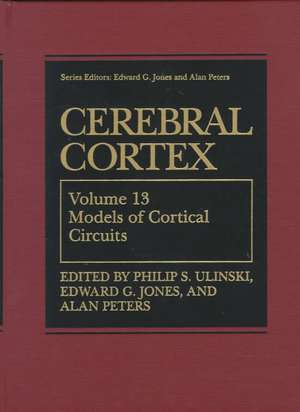
Cerebral Cortex: Cerebral Cortex, cartea 13
Editat de Philip S. Ulinskien Limba Engleză Hardback – 28 feb 1999


Preț: 1292.57 lei
Preț vechi: 1576.31 lei
-18%
Puncte Express: 1939
Carte tipărită la comandă
Livrare economică 07-21 decembrie
Livrare prin curier în România Termenul estimat este afișat lângă disponibilitate.
Transport gratuit pentru acest produs Plată online sau ramburs, în funcție de opțiunile comenzii.
Retur gratuit în 14 zile Comandă securizată și suport în română.
Specificații
ISBN-13: 9780306457272
ISBN-10: 030645727X
Pagini: 608
Ilustrații: XXI, 573 p.
Dimensiuni: 183 x 260 x 37 mm
Greutate: 1.26 kg
Ediția:1999
Editura: Springer Us
Colecția Cerebral Cortex
Seria Cerebral Cortex
Locul publicării:New York, NY, United States
ISBN-10: 030645727X
Pagini: 608
Ilustrații: XXI, 573 p.
Dimensiuni: 183 x 260 x 37 mm
Greutate: 1.26 kg
Ediția:1999
Editura: Springer Us
Colecția Cerebral Cortex
Seria Cerebral Cortex
Locul publicării:New York, NY, United States
V-ar putea interesa
-
 The New Executive Brain: Frontal Lobes in a Complex WorldElkhonon GoldbergPreț: 166.16 lei
 -
 Introduction to NeuropsychopharmacologyLeslie Iversen, PhD-30%Preț: 470.28 lei667.42 lei
 -
 Sensory Cue IntegrationJulia Trommershauser-32%Preț: 961.20 lei1417.61 lei
 -
 -30%Preț: 627.80 lei891.45 lei
 -
 Preț: 207.28 lei
 -
 Auditory PerceptionRichard M. Warren-11%Preț: 469.85 lei527.93 lei
 -
 Foundations in Evolutionary Cognitive NeuroscienceSteven M. Platek-11%Preț: 414.98 lei466.28 lei
 -
 Metabolic Basis of ObesityRexford S. Ahima-5%Preț: 759.35 lei799.31 lei
 -
 -15%Preț: 680.05 lei800.07 lei
 -
 Natural Image StatisticsAapo Hyvärinen-18%Preț: 1163.61 lei1419.05 lei
 -
 -18%Preț: 986.57 lei1203.13 lei
Public țintă
ResearchCuprins
1 Modeling Cortical Circuitry: A History and Prospectus.- 1. Introduction.- 2. Lorente de Nó through Dynamical Systems Models.- 3. Hodgkin and Huxley through Network Models.- 4. Prospectus.- 5. References.- 2 Interpretations of Data and Mechanisms for Hippocampal Pyramidal Cell Models.- 1. Introduction.- 2. The Database for Single-Neuron Models.- 3. Strategies for Single-Neuron Models.- 4. Anatomy and the Model: Data and Methods.- 5. The Linear Model: Data and Methods.- 6. Phenomenological Templates.- 7. Review of Hippocampal Models.- 8. Channel Models.- 9. Ionic Concentration Dynamics.- 10. Nonsynaptic Channels of Hippocampal Pyramidal Cells.- 11. HPC Sodium Channels.- 12. HPC Calcium Channels.- 13. HPC Potassium Channels.- 14. Nonspecific Cation and Chloride Currents.- 15. Simulations of HPC Properties with the Working Model.- 16. References.- 3 Functional Implications of Active Currents in the Dendrites of Pyramidal Neurons.- 1. Introduction.- 2. Historical Perspective.- 3. Amplification of Synaptic Inputs.- 4. Compartment Model Simulations of Amplification.- 5. Effects of Dendritic Active Currents on EPSP Shape.- 6. The Effect of Dendritic Active Currents in Shaping the Intrinsic Firing Properties of Pyramidal Cells.- 7. Effects of Potassium Currents.- 8. Linking Firing of the Soma to Depolarization at Distal Synapses and the Implementation of Hebb’s Hypothesis.- 9. Apologies.- 10. Concluding Observations.- 11. References.- 4 Comparing Different Modeling Approaches of Visual Cortical Cell Characteristics.- 1. Introduction.- 2. Foundations.- 3. Models of Cortical Orientation Specificity.- 4. Concluding Remarks.- 5. Appendix.- 6. References.- 5 The Role of Recurrent Excitation in Neocortical Circuits.- 1. Introduction.- 2. Wiring Neocortical Circuits.- 3. CanonicalMicrocircuits.- 4. Units of Construction of the Basic Cortical Circuit.- 5. The Neuronal Components of Layer 4.- 6. Computation of Orientation.- 7. Noise and Restoration.- 8. References.- 6 Neural Mechanisms Underlying the Analysis of Moving Visual Stimuli.- 1. Introduction.- 2. A Primer of Basic Concepts.- 3. Neural Mechanisms: Mammals.- 4. Neural Mechanisms: Turtles.- 5. Conclusions and Future Directions.- 6. References.- 7 Linearity and Gain Control in VI Simple Cells.- 1. Introduction.- 2. The Linear Model of Simple Cells.- 3. Some Linear Properties of Simple Cells.- 4. Biophysics of the Linear Model.- 5. Some Nonlinear Properties of Simple Cells.- 6. The Normalization Model of Simple Cells.- 7. Testing the Normalization Model.- 8. Biophysical Plausibility of the Normalization Model.- 9. Conclusions.- 10. References.- 8 Non-Fourier Cortical Processes in Texture, Form, and Motion Perception.- 1. Introduction.- 2. Analysis of Texture Boundaries by Non-Fourier Mechanisms.- 3. Area V4 Neurons and Form Vision.- 4. Two-Dimensional Motion.- 5. Discussion.- 6. References.- 9 Modeling Thalamocortical Oscillations.- 1. Slow Thalamic Rhythms.- 2. Thalamus as Magnet for Modeling—Dynamics and Neural Systems.- 3. Early Modeling Predicted a Role for Inhibitory Phasing.- 4. Modeling the T Channel.- 5. Modeling the Low-Threshold Spike.- 6. The Basic Two-Neuron Network.- 7. The Search for Origins: Whence Spindling?.- 8. Synchrony and Spread of Network Activity.- 9. Summary and Conclusions.- 10. References.- 10 Realistic Network Models of Synchronized Oscillations in Visual Cortex.- 1. Introduction.- 2. Model Structure.- 3. Model Results.- 4. Conclusion.- 5. References.- 11 Modeling the Piriform Cortex.- 1. Introduction.- 2. Summary of Data Being Modeled.- 3. Modeling ofPhysiological Data.- 4. Modeling of Functional Hypotheses.- 5. Summary and Future Directions.- 6. References.