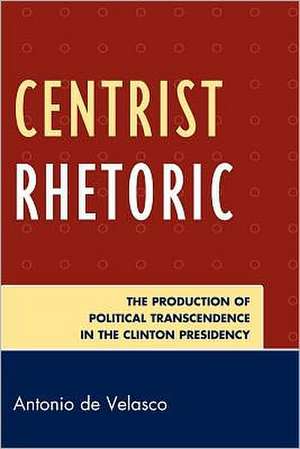
Centrist Rhetoric: The Production of Political Transcendence in the Clinton Presidency: Bloomsbury Studies in Political Communication
Autor Antonio de Velascoen Limba Engleză Paperback – 2 feb 2012
Faced with a divided and shrinking party, and later with a pitched battle against a resurgent conservative movement, Clinton used the image of a political center, a "third way" beyond liberal and conservative orthodoxies, to advance his strategic goals, define his adversaries, and overcome key political challenges. As appeals to the center helped Clinton to achieve these advantages in specific cases, however, they also served to define the means, ends, and very essence of democracy in ambiguous and contradictory ways. Touching on controversies from the early 1990s over the future of the Democratic Party, racial identity in American politics, the threat of rightwing extremism, and the role of government, Antonio de Velasco show how centrist rhetoric's call to transcendence weaved together forms of identification and division, insight and blindness, so as to defy the conventional assessments of both Clinton's supporters and his detractors.
Centrist Rhetoric thus offers general insight into the workings of political rhetoric, and a specific appreciation of Clinton's attempts to define and adjust to the political exigencies of a critical period in history of the Democratic Party and politics in the United States.
Din seria Bloomsbury Studies in Political Communication
- nou
 Preț: 537.85 lei
 - 29%
 Preț: 345.19 lei
 - 37%
 Preț: 658.57 lei
 - 24%
 Preț: 307.73 lei
 - 23%
 Preț: 334.48 lei
 - 35%
 Preț: 594.56 lei
 - 37%
 Preț: 659.73 lei
 - 23%
 Preț: 321.15 lei
 - 29%
 Preț: 344.27 lei
 - 23%
 Preț: 322.08 lei
 - 29%
 Preț: 345.39 lei
 - 29%
 Preț: 345.30 lei
 - 31%
 Preț: 404.27 lei
 - 33%
 Preț: 355.87 lei
 - 33%
 Preț: 640.50 lei
 - 29%
 Preț: 342.12 lei
 - 37%
 Preț: 659.45 lei
 - 24%
 Preț: 369.30 lei
 - 27%
 Preț: 353.58 lei
 - 29%
 Preț: 343.67 lei
 - 29%
 Preț: 343.67 lei
 - 29%
 Preț: 343.67 lei
 - 23%
 Preț: 329.78 lei
 - 36%
 Preț: 521.72 lei
 - 23%
 Preț: 336.84 lei
 - 23%
 Preț: 320.91 lei
 - 29%
 Preț: 344.70 lei
 - 35%
 Preț: 593.49 lei
 - 29%
 Preț: 344.06 lei
 - 23%
 Preț: 312.75 lei
 - 27%
 Preț: 354.59 lei
 - 25%
 Preț: 306.14 lei
 - 29%
 Preț: 343.37 lei
 - 22%
 Preț: 338.89 lei
 - 29%
 Preț: 342.63 lei
 - 29%
 Preț: 340.06 lei
Preț: 335.70 lei
Preț vechi: 435.32 lei
-23%
Puncte Express: 504
Carte tipărită la comandă
Livrare economică 10-24 noiembrie
Livrare prin curier în România Termenul estimat este afișat lângă disponibilitate.
Transport gratuit de la 400.00 lei Plată online sau ramburs, în funcție de opțiunile comenzii.
Retur gratuit în 14 zile Comandă securizată și suport în română.
Specificații
ISBN-13: 9780739139813
ISBN-10: 0739139819
Pagini: 202
Dimensiuni: 153 x 233 x 8 mm
Greutate: 0.31 kg
Editura: Bloomsbury Publishing
Colecția Lexington Books
Seria Bloomsbury Studies in Political Communication
Locul publicării:New York, United States
ISBN-10: 0739139819
Pagini: 202
Dimensiuni: 153 x 233 x 8 mm
Greutate: 0.31 kg
Editura: Bloomsbury Publishing
Colecția Lexington Books
Seria Bloomsbury Studies in Political Communication
Locul publicării:New York, United States
Cuprins
Chapter 1 Introduction
Chapter 2 Chapter 1. New Democrat Strategy: Crafting a Vital Center for the 1992 Presidential Campaign
Chapter 3 Chapter 2. Centrist Rhetoric, Whiteness, and the Ambiguities of the "Sister Souljah Moment"
Chapter 4 Chapter 3. "The Audience for This Is Huge": Oklahoma City and the Wages of Transcendence
Chapter 5 Chapter 4. The Pliability of Community: Rhetorical Idealism and Transcending the "era of big government"
Chapter 6 Conclusion
Chapter 2 Chapter 1. New Democrat Strategy: Crafting a Vital Center for the 1992 Presidential Campaign
Chapter 3 Chapter 2. Centrist Rhetoric, Whiteness, and the Ambiguities of the "Sister Souljah Moment"
Chapter 4 Chapter 3. "The Audience for This Is Huge": Oklahoma City and the Wages of Transcendence
Chapter 5 Chapter 4. The Pliability of Community: Rhetorical Idealism and Transcending the "era of big government"
Chapter 6 Conclusion
Recenzii
President Bill Clinton was rhetorically wedded to a centrist political message and returned to it repeatedly. Though at times he governed from a liberal position, his rhetoric was consistently centrist. A key figure in the Democratic Leadership Council, Clinton helped make the Democratic Party more electable in the aftermath of the Reagan Revolution. He touted a third way between the extremism of the Right and Left-referred to as 'triangulation.' Clinton's strategically sophisticated rhetoric was designed to win voters suspicious of political extremes. Communications professor Velasco (rhetoric, Univ. of Memphis) examines Clinton's rhetorical strategy, arguing two points: 'Clinton used the center as a complex, mostly tacit figure of argument to advancehis political goals, define his adversaries, and overcome key political challenges. . .' and 'as centrist rhetoric helped Clinton to achieve strategic advantage, it also yielded ambiguous and dense scenes for democratic polity that weaved together formsof identification and division in subtle and important ways.' This book is a valuable addition to the field of communications studies. Though intended for a specialized audience, it adds to the general understanding of the importance of rhetoric in govern
The meteoric and unlikely rise of William Jefferson Clinton is one of the great stories of American politics, and one with continuing resonance as the dominant political parties reshape themselves into the 21st century. Clinton's was a landmark rhetorical presidency, and Antonio de Velasco has identified its fundamental metaphor: the 'center.' This was the inventional resource upon which Clinton relied as he crafted the public address that propelled him into the presidency, that consolidated and defended his leadership, and that now sustains his legacy. The contours of this rhetorical topos is revealed through case studies and close analysis, building our understanding of its peculiar genealogy and perennial appeal. 'The center' emerges as a double-edged figure that cloaks political maneuver even as it extends the promise of democratic transcendence. Centrist Rhetoric is well-written, thoroughly researched, and forcefully argued. But more importantly, de Velasco's work provides an exemplar of the unique contribution that a thoroughly rhetorical perspective brings to the study of public culture.
In recent years, many scholars and pundits have bemoaned the increasing polarization and cynicism impacting politics in the United States. Concerns over growing red and blue divides and the shift to perpetual campaigning have led to anxiety over the ability of democracy to solve difficult problems in the twenty-first century. Such a polarized environment fuels distrust, as opposing sides discredit each other and reframe motives to fit partisan themes. Antonio de Velasco's Centrist Rhetoric is an important recent addition to the literature that seeks to examine these issues, offering a specific focus on how Bill Clinton reacted to this political environment and attempted, depending on one's perspective, to either transform it or take advantage of it. The book provides important insights into the Clinton story even as it raises questions about centrism in modern politics that scholars in multiple fields should further examine.De Velasco balances a theoretical examination of centrism as a political and rhetorical concept with four case studies of Clinton's centrist rhetoric from 1992 to 1996..In the end, de Velasco's argument is compelling, and the case studies represent high quality analysis. Centrist Rhetoric should be of most interest to scholars and students of the Clinton presidency and to presidential rhetoric scholars.
Antonio de Velasco's Centrist Rhetoric is an important recent addition to the literature..de Velasco's argument is compelling, and the case studies represent high quality analysis. Centrist Rhetoric should be of most interest to scholars and students of the Clinton presidency and to presidential rhetoric scholars.
Antonio de Velasco's Centrist Rhetoric: The Production of Political Transcendence in the Clinton Presidency is both an insightful critique of a rhetorical strategy and, more broadly, a provocative meditation on the place of this strategy in a democratic polity. Th e rhetorical strategy in question is what de Velasco labels "centrist rhetoric"-a rhetoric that claims to transcend partisan politics, a third-space rhetoric that purports to rise above the to and fro of partisan debate. It is a rhetoric that stakes its claims in a purported disinterestedness. Drawing on Kenneth Burke's famous line, de Velasco argues that the centrist speaker is persuasive precisely because she "damns an opponent's motive by calling it political" and claims thereby to transcend political faction. As it was in Clinton's first term, such rhetoric remains a powerful and pervasive force in public life. Centrist Rhetoric is a
sophisticated interrogation of this force, and it is well worth our collective attention.
The meteoric and unlikely rise of William Jefferson Clinton is one of the great stories of American politics, and one with continuing resonance as the dominant political parties reshape themselves into the 21st century. Clinton's was a landmark rhetorical presidency, and Antonio de Velasco has identified its fundamental metaphor: the 'center.' This was the inventional resource upon which Clinton relied as he crafted the public address that propelled him into the presidency, that consolidated and defended his leadership, and that now sustains his legacy. The contours of this rhetorical topos is revealed through case studies and close analysis, building our understanding of its peculiar genealogy and perennial appeal. 'The center' emerges as a double-edged figure that cloaks political maneuver even as it extends the promise of democratic transcendence. Centrist Rhetoric is well-written, thoroughly researched, and forcefully argued. But more importantly, de Velasco's work provides an exemplar of the unique contribution that a thoroughly rhetorical perspective brings to the study of public culture.
In recent years, many scholars and pundits have bemoaned the increasing polarization and cynicism impacting politics in the United States. Concerns over growing red and blue divides and the shift to perpetual campaigning have led to anxiety over the ability of democracy to solve difficult problems in the twenty-first century. Such a polarized environment fuels distrust, as opposing sides discredit each other and reframe motives to fit partisan themes. Antonio de Velasco's Centrist Rhetoric is an important recent addition to the literature that seeks to examine these issues, offering a specific focus on how Bill Clinton reacted to this political environment and attempted, depending on one's perspective, to either transform it or take advantage of it. The book provides important insights into the Clinton story even as it raises questions about centrism in modern politics that scholars in multiple fields should further examine.De Velasco balances a theoretical examination of centrism as a political and rhetorical concept with four case studies of Clinton's centrist rhetoric from 1992 to 1996..In the end, de Velasco's argument is compelling, and the case studies represent high quality analysis. Centrist Rhetoric should be of most interest to scholars and students of the Clinton presidency and to presidential rhetoric scholars.
Antonio de Velasco's Centrist Rhetoric is an important recent addition to the literature..de Velasco's argument is compelling, and the case studies represent high quality analysis. Centrist Rhetoric should be of most interest to scholars and students of the Clinton presidency and to presidential rhetoric scholars.
Antonio de Velasco's Centrist Rhetoric: The Production of Political Transcendence in the Clinton Presidency is both an insightful critique of a rhetorical strategy and, more broadly, a provocative meditation on the place of this strategy in a democratic polity. Th e rhetorical strategy in question is what de Velasco labels "centrist rhetoric"-a rhetoric that claims to transcend partisan politics, a third-space rhetoric that purports to rise above the to and fro of partisan debate. It is a rhetoric that stakes its claims in a purported disinterestedness. Drawing on Kenneth Burke's famous line, de Velasco argues that the centrist speaker is persuasive precisely because she "damns an opponent's motive by calling it political" and claims thereby to transcend political faction. As it was in Clinton's first term, such rhetoric remains a powerful and pervasive force in public life. Centrist Rhetoric is a
sophisticated interrogation of this force, and it is well worth our collective attention.