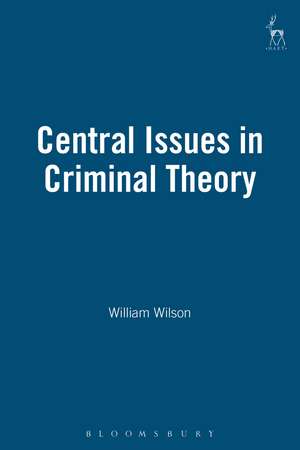
Central Issues in Criminal Theory
Autor William Wilsonen Limba Engleză Paperback – 12 noi 2002
a view to exploring the doctrinal tensions which may arise when competing justifications for criminalisation and punishment collide.
The book gives an account of the present state of criminal theory in an accessible style which will welcomed by those embarking upon courses in advanced criminal law and criminal theory, teachers, and more generally by practitioners and scholars.
Preț: 280.66 lei
Puncte Express: 421
Carte tipărită la comandă
Livrare economică 14-28 noiembrie
Livrare prin curier în România Termenul estimat este afișat lângă disponibilitate.
Transport gratuit de la 400.00 lei Plată online sau ramburs, în funcție de opțiunile comenzii.
Retur gratuit în 14 zile Comandă securizată și suport în română.
Specificații
ISBN-13: 9781841130620
ISBN-10: 1841130621
Pagini: 384
Dimensiuni: 154 x 234 x 22 mm
Greutate: 0.48 kg
Editura: Bloomsbury Publishing
Colecția Hart Publishing
Locul publicării:London, United Kingdom
ISBN-10: 1841130621
Pagini: 384
Dimensiuni: 154 x 234 x 22 mm
Greutate: 0.48 kg
Editura: Bloomsbury Publishing
Colecția Hart Publishing
Locul publicării:London, United Kingdom
V-ar putea interesa
-
 Preț: 81.95 lei
 -
 Structure and Function in Criminal LawPaul H. Robinson-33%Preț: 979.29 lei1456.80 lei
 -
 Voluntary Euthanasia and the Common LawMargaret Otlowski-28%Preț: 506.40 lei701.24 lei
 -
 Criminal JusticeLucia Zedner-21%Preț: 353.19 lei448.24 lei
 -
 International Crimes and the Ad Hoc TribunalsGuénaël Mettraux-28%Preț: 503.24 lei699.36 lei
 -
 Excusing CrimeJeremy Horder-21%Preț: 439.37 lei558.37 lei
 -
 Criminal ResponsibilityVictor Tadros-28%Preț: 441.94 lei614.60 lei
 -
 -28%Preț: 417.72 lei584.08 lei
 -
 -28%Preț: 376.46 lei521.93 lei
 -
 Corporations and Criminal ResponsibilityCelia Wells-29%Preț: 443.43 lei620.90 lei
 -
 -28%Preț: 371.67 lei519.11 lei
 -
 Killing in Self-DefenceFiona Leverick-33%Preț: 772.57 lei1148.06 lei
 -
 -13%Preț: 348.30 lei398.39 lei
 -
 Cases and Materials on Criminal LawJanet Dine-21%Preț: 398.26 lei502.52 lei
 -
 Race, Crime, and the LawRandall KennedyPreț: 139.60 lei
 -
 Preț: 463.50 lei
 -
 Courtroom 302Steve BogiraPreț: 94.08 lei
 -
 International Criminal Law DeskbookCraig Barker-15%Preț: 479.20 lei563.76 lei
Cuprins
1 Criminalising Wrongdoing
2 Punishing Wrongdoing
3 Criminal Wrongdoing: Acts and Omissions
4 Criminalising Wrongdoing: Voluntariness
5 Intention, Motives and Desert
6 Causing Harm
7 Attributing Liability to Secondary Parties
8 Criminal Attempts
9 Packaging Criminal Liability
10 Criminal Defences: Setting Limits to Justifications
11 Excusing Wrongdoing: Capacity and Virtue
2 Punishing Wrongdoing
3 Criminal Wrongdoing: Acts and Omissions
4 Criminalising Wrongdoing: Voluntariness
5 Intention, Motives and Desert
6 Causing Harm
7 Attributing Liability to Secondary Parties
8 Criminal Attempts
9 Packaging Criminal Liability
10 Criminal Defences: Setting Limits to Justifications
11 Excusing Wrongdoing: Capacity and Virtue
Recenzii
...astounding wealth of arguments discussed and the astuteness and brilliance of the analysis...
Wilson has produced a book that is relatively small but that addresses the basic questions in a logical and coherent manner. Indeed, one of the author's considerable strengths is his ability to explain particularly intricate and often obscure points in simple, comprehensible language. The way in which each chapter begins with a general introduction to the topic, identifying the important issues, is helpful in this regard.
Wilson's book is a thoughtful contribution to the developing field of theoretical writing about the criminal law.
In this engaging, well-written book, William Wilson explores the classic internal questions thrown up by criminal law doctrine. These include the principles underlying the decision to criminalise some behaviour and the nature of punishment, as well as the issues identified as central by many writers since Glanville Williams first published Criminal Law: The General Part 50 years ago.
The book is well-written, the author has read widely, and the explanation of the positions of the commentators is very good.
. . . In sum, the book provides a decent explanation of the position of theory in academic Criminal Law at the start of the twenty-first century, it could be used in undergraduate courses on Criminal Law and it is suited to be a textbook on more advanced, more theoretical, Criminal Law modules. It is also an exemplar of the coming of age of theoretical perspectives in Anglo-Welsh Criminal Law.
Wilson has produced a book that is relatively small but that addresses the basic questions in a logical and coherent manner. Indeed, one of the author's considerable strengths is his ability to explain particularly intricate and often obscure points in simple, comprehensible language. The way in which each chapter begins with a general introduction to the topic, identifying the important issues, is helpful in this regard.
Wilson's book is a thoughtful contribution to the developing field of theoretical writing about the criminal law.
In this engaging, well-written book, William Wilson explores the classic internal questions thrown up by criminal law doctrine. These include the principles underlying the decision to criminalise some behaviour and the nature of punishment, as well as the issues identified as central by many writers since Glanville Williams first published Criminal Law: The General Part 50 years ago.
The book is well-written, the author has read widely, and the explanation of the positions of the commentators is very good.
. . . In sum, the book provides a decent explanation of the position of theory in academic Criminal Law at the start of the twenty-first century, it could be used in undergraduate courses on Criminal Law and it is suited to be a textbook on more advanced, more theoretical, Criminal Law modules. It is also an exemplar of the coming of age of theoretical perspectives in Anglo-Welsh Criminal Law.