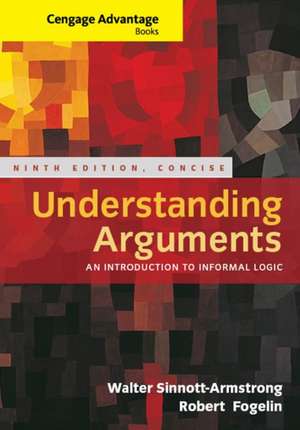
Cengage Advantage Books: Understanding Arguments, Concise Edition: Cengage Advantage Books
Autor Walter Sinnott-Armstrong, Robert J. Fogelinen Limba Engleză Paperback – 31 dec 2013
Acest manual de logică informală, publicat în seria Cengage Advantage Books, reprezintă varianta concentrată a textului academic clasic, fiind conceput special pentru a oferi claritate și eficiență în studiul argumentării. Descoperim aici o abordare pragmatică semnată de Walter Sinnott-Armstrong și Robert J. Fogelin, care elimină detaliile teoretice redundante pentru a pune accent pe mecanismele argumentării utilizate în interacțiunile de zi cu zi. Cartea acoperă aceeași arie tematică precum Critical Thinking de George Rainbolt, dar cu o abordare mai aplicată, axată pe deconstrucția limbajului natural și a actelor de vorbire.
Structura volumului este riguros organizată pentru a ghida cititorul de la elementele de bază către analize complexe. Prima parte, dedicată analizei argumentelor, trece prin utilizarea acestora ca justificări sau explicații, explorând totodată „rețeaua limbajului” prin prisma actelor de vorbire și a regulilor conversaționale. Găsim în capitolele centrale instrumente esențiale pentru identificarea markerilor de argumentare și standarde de evaluare precum validitatea, adevărul și soliditatea (soundness). Spre deosebire de How to Think Logically de Gary Seay, care păstrează rigoarea unui curs de 15 săptămâni, această ediție concisă prioritizează reconstrucția argumentelor și identificarea premiselor suprimate, oferind în final și o introducere necesară în logica formală. Apreciem în mod deosebit capitolul „The Art of Close Analysis”, unde autorii demonstrează aplicarea conceptelor pe exemple extinse, pregătind cititorul pentru o gândire critică autonomă.
![Cengage Advantage Books: Clashing Values in the Administration of Public Policy (with Infotrac) [With Infotrac]](https://i2.books-express.ro/bs/9780534601379/cengage-advantage-books.jpg)

Preț: 481.53 lei
Carte disponibilă
Livrare economică 13-27 iunie
Specificații
ISBN-10: 1285197399
Pagini: 384
Dimensiuni: 160 x 229 x 15 mm
Greutate: 0.57 kg
Ediția:9
Editura: Wadsworth Publishing
Seria Cengage Advantage Books
V-ar putea interesa
-
 Wittgenstein and Analytic Philosophy: Essays for P. M. S. HackerHans-Johann Glock-27%Preț: 678.48 lei933.33 lei
 -
 Saving Truth From ParadoxHartry FieldPreț: 348.20 lei
 -
 Doubt Truth to be a LiarGraham Priest-15%Preț: 372.82 lei436.09 lei
 -
 New PragmatistsCheryl Misak-5%Preț: 281.72 lei297.84 lei
 -
 Deflationism and ParadoxJc Beall-14%Preț: 329.56 lei382.93 lei
 -
 Wittgenstein, Finitism, and the Foundations of MathematicsMathieu Marion-14%Preț: 360.16 lei417.13 lei
 -
 -14%Preț: 615.41 lei715.58 lei
 -
 Logic for PhilosophyTheodore Sider-17%Preț: 177.48 lei213.35 lei
 -
 Relativism and Monadic TruthHerman Cappelen-8%Preț: 241.98 lei263.10 lei
 -
 Morality Without God?Walter Sinnott-Armstrong-7%Preț: 153.85 lei164.77 lei
 -
 The Theory of DescriptionsG. Stevens-15%Preț: 624.01 lei734.13 lei
 -
 -15%Preț: 678.86 lei798.67 lei
 -
 Dummett on Abstract ObjectsG. DukePreț: 379.32 lei
 -
 100 Years of PragmatismJohn J. StuhrPreț: 192.16 lei
 -
 An Introduction to MetaphysicsJohn W. CarrollPreț: 331.17 lei
 -
 ParadoxesR. M. SainsburyPreț: 223.48 lei
 -
 -42%Preț: 95.42 lei165.71 lei
 -
 Introducing Logic - compactDan CryanPreț: 63.46 lei
 -
 Introducing WittgensteinJohn H. EatonPreț: 61.96 lei
 -
 Do You Think You're Clever?John FarndonPreț: 70.67 lei
De ce să citești această carte
Recomandăm această carte studenților și autodidacților care doresc să își rafineze abilitățile de gândire critică fără a se pierde în jargon academic excesiv. Prin parcurgerea acestui manual, cititorul câștigă capacitatea de a identifica rapid structura oricărui discurs și de a evalua corectitudinea raționamentelor întâlnite în presă, politică sau discuții personale. Este un instrument esențial pentru oricine vrea să argumenteze mai convingător și să detecteze erorile de logică ale interlocutorilor.