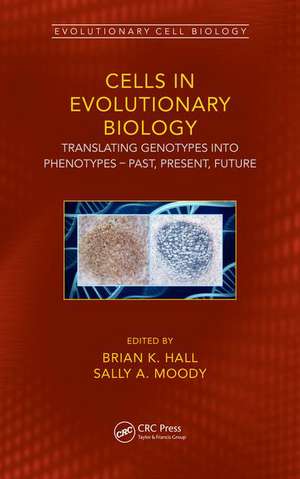
Cells in Evolutionary Biology: Translating Genotypes into Phenotypes - Past, Present, Future: Evolutionary Cell Biology
Editat de Brian K. Hall, Sally A. Moodyen Limba Engleză Hardback – 12 iun 2018
Chapter 7 of this book is freely available as a downloadable Open Access PDF at http://www.taylorfrancis.com under a Creative Commons Attribution-Non Commercial-No Derivatives (CC-BY-NC-ND) 4.0 license.
Din seria Evolutionary Cell Biology
- 21%
 Preț: 382.67 lei
 - 11%
 Preț: 439.56 lei
 - 18%
 Preț: 1005.95 lei
 - 18%
 Preț: 931.97 lei
 -
 Preț: 444.29 lei
 - 18%
 Preț: 1008.39 lei
 - 15%
 Preț: 624.32 lei
 - 18%
 Preț: 1009.27 lei
 - 18%
 Preț: 722.29 lei
 - 15%
 Preț: 434.24 lei
 -
 Preț: 470.92 lei
 -
 Preț: 483.13 lei
 - 18%
 Preț: 1067.70 lei
 - nou
 Preț: 1342.37 lei
 - nou
 Preț: 1299.00 lei
 - 24%
 Preț: 941.81 lei
 - 25%
 Preț: 1101.22 lei
 - 25%
 Preț: 1094.22 lei
 - nou
 Preț: 1104.79 lei
Preț: 1004.97 lei
Preț vechi: 1225.57 lei
-18%
Puncte Express: 1507
Carte tipărită la comandă
Livrare economică 18 noiembrie-02 decembrie
Livrare prin curier în România Termenul estimat este afișat lângă disponibilitate.
Transport gratuit pentru acest produs Plată online sau ramburs, în funcție de opțiunile comenzii.
Retur gratuit în 14 zile Comandă securizată și suport în română.
Specificații
ISBN-13: 9781498787864
ISBN-10: 149878786X
Pagini: 294
Ilustrații: Scatter color on pages 89,93,94,96,99,133,135,155,156,157,158,177,181,220,226; Scatter color on pages 89,93,94,96,99,133,135,155,156,157,158,177,181,220,226; 3 Tables, black and white; 15 Illustration
Dimensiuni: 156 x 234 x 23 mm
Greutate: 0.61 kg
Ediția:1
Editura: CRC Press
Colecția CRC Press
Seria Evolutionary Cell Biology
ISBN-10: 149878786X
Pagini: 294
Ilustrații: Scatter color on pages 89,93,94,96,99,133,135,155,156,157,158,177,181,220,226; Scatter color on pages 89,93,94,96,99,133,135,155,156,157,158,177,181,220,226; 3 Tables, black and white; 15 Illustration
Dimensiuni: 156 x 234 x 23 mm
Greutate: 0.61 kg
Ediția:1
Editura: CRC Press
Colecția CRC Press
Seria Evolutionary Cell Biology
V-ar putea interesa
-
 Preț: 416.73 lei
 -
 -15%Preț: 649.35 lei763.94 lei
 -
 Biology CAPE Unit 1 A CXC Study GuideRichard Fosbery-17%Preț: 179.09 lei216.37 lei
 -
 Raven Biology of PlantsRay Evert-18%Preț: 2086.06 lei2543.98 lei
 -
 Natur und MachtJoachim RadkauPreț: 243.40 lei
 -
 Das Leben im Wasser und das AquariumGustav Jaeger-19%Preț: 488.42 lei603.00 lei
 -
 Fortpflanzung und ZeugungErnst TeichmannPreț: 185.21 lei
 -
 Naturgeschichte des KindesHermann DekkerPreț: 185.21 lei
 -
 Das Ei und seine BefruchtungAnton SchneiderPreț: 155.76 lei
 -
 Goethes NaturauffassungTobias PöhlmannPreț: 323.61 lei
Cuprins
The role and autonomy of cells in phylogeny and evolution circa 1840-1865. Germ plasm theory and cells in evolutionary biology. The discovery of genes and the rise of genetics from 1900 in usurped cells in evolutionary biology. The study of cells, embryos and evolution through identification of cell lineages. Experimental embryology, nuclear or cytoplasmic control of development. Cytoplasmic inheritance in protozoans and divergent evolution of prokaryotes and eukaryotes. Structural (TEM) analyses of cells: evolution of cells, organelles and cell number. Recognition of the Archaea, different relationships and kingdoms of life. Cellular condensations, modularity and evolution of the phenotype.
Recenzii
"… the book is a very welcome collection of chapters that offers a good overview of the role of cells in EvoDevo. It can be recommended to anyone starting to do research in this field and should be on the bookshelf in all laboratories working in fields related to its contents. In short, a great book that taught me a lot about both subjects I thought I knew something about, and about new and exciting aspects of the role of cells in EvoDevo." Lennart Olsson. 2020. In Evolution & Development, 22.
"Cells in Evolutionary Biology is the first volume in a series. It provides a valuable historical context and review not only of the cell and evolutionary biology fields, but of developmental and molecular biology as well. Readers will gain an appreciation for the history and philosophy underlying their fields, a perspective less frequently covered in the basic textbooks used in coursework. The volume includes chapters from authors specializing not only in biology and its subfields, but in culture and philosophy. It opens with the origins of cell theory and germ plasm theory, ideas that laid the groundwork for our modern understanding of evolution. It covers historical debate regarding the origin of eukaryotic cells and of multicellular organisms with differentiated tissue types. It successfully dissects topics generally accepted as fact and guides the reader through the thought process that led to that status. To appreciate this text, a solid understanding of the current science is prerequisite. As such, this extremely interesting volume is best suited to graduate level students and established researchers." --D. Schulman, Lake Erie College
Summing Up: Recommended. Graduate students through faculty and professionals.
---
**Description**
The book offers a historical perspective of the early observations in
evolutionary biology related to the origin of cells, cell theory, Darwin's
work, and the work of many other scientists that documented all those early
studies, which is a great introduction to more detailed descriptions of germ
cells, somatic cells, cell lineages, the evolution of multicellular organisms,
cellular signaling, and multicellular patterning pathways during embryogenesis.
**Purpose**
This book is one in the Evolutionary Cell Biology series. The authors propose to
describe the importance of evolutionary developmental biology in cell biology
and stimulate further development of this field so that in current and future
cell biology studies, researchers look back and consider how current findings
fit within the evolutionary biology window. The authors encourage the readers
(cell biologists) to think in the context of evolutionary biology in order to
broaden the appeal of future research questions.
**Audience**
The book offers an interesting look at early observations regarding cell theory
and the origin of cells, which is of interest for younger scientists unfamiliar
with evolutionary biology. The narrative of how scientist in the 17th century
explained cellular division, differentiation, regeneration, and many other
subjects offers an interesting historical perspective when placed in the
context of what we know today, regardless of readers' area of study. The book
is written in accessible language and, thus, researchers at any level would
benefit from learning about this historical perspective. The authors and
contributors are leaders in their fields of study and well qualified to be part
of this book.
**Features**
The book covers a broad period of evolutionary biology. While the period of the
studies described in the book changes, the subject does not change much and
remains evolutionary biology. I found particularly interesting the first
chapter describing Darwin's work and how scientists of the time thought of
cells, inheritance, and cell theory. The book is organized beginning with these
descriptions and ending with patterning and embryology. The book does not
contain many images, but those that are part of the book are well presented and
useful.
**Assessment**
This book is definitely an important contribution to foster future work that
considers evolutionary cell biology. The authors manage to narrate early
evolutionary biology with our current understanding of development and I do not
believe there are many other books with this focus in mind.
-Renier Velez-Cruz, PhD (Midwestern University)
"Cells in Evolutionary Biology is the first volume in a series. It provides a valuable historical context and review not only of the cell and evolutionary biology fields, but of developmental and molecular biology as well. Readers will gain an appreciation for the history and philosophy underlying their fields, a perspective less frequently covered in the basic textbooks used in coursework. The volume includes chapters from authors specializing not only in biology and its subfields, but in culture and philosophy. It opens with the origins of cell theory and germ plasm theory, ideas that laid the groundwork for our modern understanding of evolution. It covers historical debate regarding the origin of eukaryotic cells and of multicellular organisms with differentiated tissue types. It successfully dissects topics generally accepted as fact and guides the reader through the thought process that led to that status. To appreciate this text, a solid understanding of the current science is prerequisite. As such, this extremely interesting volume is best suited to graduate level students and established researchers." --D. Schulman, Lake Erie College
Summing Up: Recommended. Graduate students through faculty and professionals.
---
**Description**
The book offers a historical perspective of the early observations in
evolutionary biology related to the origin of cells, cell theory, Darwin's
work, and the work of many other scientists that documented all those early
studies, which is a great introduction to more detailed descriptions of germ
cells, somatic cells, cell lineages, the evolution of multicellular organisms,
cellular signaling, and multicellular patterning pathways during embryogenesis.
**Purpose**
This book is one in the Evolutionary Cell Biology series. The authors propose to
describe the importance of evolutionary developmental biology in cell biology
and stimulate further development of this field so that in current and future
cell biology studies, researchers look back and consider how current findings
fit within the evolutionary biology window. The authors encourage the readers
(cell biologists) to think in the context of evolutionary biology in order to
broaden the appeal of future research questions.
**Audience**
The book offers an interesting look at early observations regarding cell theory
and the origin of cells, which is of interest for younger scientists unfamiliar
with evolutionary biology. The narrative of how scientist in the 17th century
explained cellular division, differentiation, regeneration, and many other
subjects offers an interesting historical perspective when placed in the
context of what we know today, regardless of readers' area of study. The book
is written in accessible language and, thus, researchers at any level would
benefit from learning about this historical perspective. The authors and
contributors are leaders in their fields of study and well qualified to be part
of this book.
**Features**
The book covers a broad period of evolutionary biology. While the period of the
studies described in the book changes, the subject does not change much and
remains evolutionary biology. I found particularly interesting the first
chapter describing Darwin's work and how scientists of the time thought of
cells, inheritance, and cell theory. The book is organized beginning with these
descriptions and ending with patterning and embryology. The book does not
contain many images, but those that are part of the book are well presented and
useful.
**Assessment**
This book is definitely an important contribution to foster future work that
considers evolutionary cell biology. The authors manage to narrate early
evolutionary biology with our current understanding of development and I do not
believe there are many other books with this focus in mind.
-Renier Velez-Cruz, PhD (Midwestern University)
Descriere
The book summarizes our views of how cells mediate evolution by transforming gene activity into evolutionary changes in morphology. Chapters explore Darwin’s use of cells in his theory of evolution. Weismann’s contrarian germ plasm theory will be assessed from several perspectives.