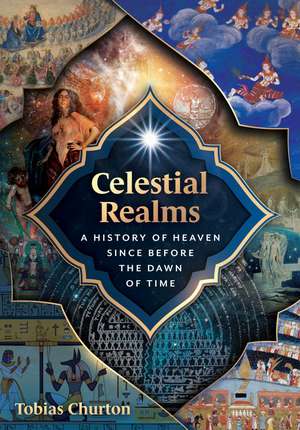
Celestial Realms: A History of Heaven since before the Dawn of Time
Autor Tobias Churtonen Limba Engleză Paperback – 7 mai 2026
• Comprehensively explores the meanings, history, ideas, and experience of Heaven throughout the world’s exoteric and esoteric traditions
• Explores the heavens of Egypt, Mesopotamia, Greece, the Abrahamic traditions, Far Eastern mythologies, and Indigenous nations
• Considers questions about our “need” for Heaven, further informed by popular culture, folklore, and personal experience
Across all ages people have wondered about the afterlife. Is Heaven a reward for good behavior, the home of the gods, or a state of being? As Tobias Churton reveals, such questions and beliefs about the nature of Heaven go back to humanity’s earliest days. Beginning with mythology in ancient Mesopotamia, Egypt, and the Far East, we find sophisticated conceptions within early philosophy and the Abrahamic religions, many of which persist unchanged.
Churton examines the complexities of Jesus’s teaching that “the Kingdom of God is within you” and Islamic ideas about paradise. He analyzes the beliefs of Eastern mystics and Maori, Australian Aboriginal, and Polynesian traditions as well as heavenly conceptions among Indigenous cultures of the Americas. He presents Renaissance-era understandings of Heaven’s connection to the body in the alchemical spiritual medicine of Paracelsus and the mysticism of Jacob Böhme and reveals that Emmanuel Swedenborg, followed by William Blake, controversially associated Heaven with sexuality. Churton then delves into the contemporary era, exploring Heaven from perspectives of spiritualism, psychedelic experience, communist materialism, and the arts, including John Lennon’s lyrical suggestion that we imagine that there is no heaven.
Whether Heaven is considered a specific place or a deeply felt state of being, this in-depth investigation emphasizes its resonance and significance for all of humanity.
Preț: 147.40 lei
Preț vechi: 189.20 lei
-22%
Puncte Express: 221
Carte disponibilă
Livrare economică 20 noiembrie-02 decembrie
Livrare express 31 octombrie-06 noiembrie pentru 89.15 lei
Livrare prin curier în România Termenul estimat este afișat lângă disponibilitate.
Transport gratuit de la 400.00 lei Plată online sau ramburs, în funcție de opțiunile comenzii.
Retur gratuit în 14 zile Comandă securizată și suport în română.
Specificații
ISBN-13: 9798888502112
Pagini: 384
Ilustrații: Full-color throughout
Dimensiuni: 168 x 241 x 18 mm
Greutate: 0.79 kg
Editura: Inner Traditions/Bear & Company
Colecția Inner Traditions
Pagini: 384
Ilustrații: Full-color throughout
Dimensiuni: 168 x 241 x 18 mm
Greutate: 0.79 kg
Editura: Inner Traditions/Bear & Company
Colecția Inner Traditions
Notă biografică
Tobias Churton is Britain’s leading scholar of Western Esotericism and a world authority on Gnosticism, Hermeticism, and Rosicrucianism. Holding a master’s degree in theology from Brasenose College, Oxford, he was appointed honorary fellow of Exeter University in 2005. Author of many books, including Gnostic Philosophy, The Invisible History of the Rosicrucians, The Books of Enoch Revealed, and Aleister Crowley in America, he lives in England.
Extras
ONE
As Below, So Above
Unless the process suffers interruption via human or natural calamity, it’s often assumed that the longer time extends, the greater grows our stock of knowledge. Some would rightly caution that as we learn, we also forget. What is remembered, furthermore, is vulnerable to changeable fashions: fashions that often distort earlier insights without enhancing them. Be that as it may, it is still striking to consider that when I attended high school during the early to mid-1970s, textbooks asserted that the earliest evidence for species Homo sapiens dated from around 30,000 BC (this was of course before the initials BCE became fashionable). Now, of course, we know more. Ethiopia has since yielded skull evidence for Homo sapiens from around 200,000 years ago, while evidence from Morocco puts the date some 100,000 years or so before that.* Fair it would be to conclude that we don’t know when men and women identifiable as Homo sapiens first appeared. Such ought to disconcert slightly because while we know more than we did fifty years ago, in another way, we are certain of less, and uncertainty underlines a lack of knowledge; the figures dizzy us.
Evidence for so-called hominins may disconcert further. Hominins are creatures classified as humanlike (more humanlike than chimps or gorillas), and able to employ tools of stone. Evidence for this classification is used to date the onset of a so-called Paleolithic (or Old Stone) Age. This age has for archeological purposes been dated variously from around 3.3 million or 2.58 million years ago to its close around 11,700 years ago. A so-called Neolithic (New Stone) Age is thought to have more or less followed the old and apparently ran until some 4,200 years ago, by which time civilization was well established at particular loci in the world. The distinction of the classification Neolithic lies chiefly in the period’s offering evidence for farming and for animism. Animism, broadly, denotes human belief in spirits inhabiting visible nature (from Latin animus = soul or spirit), arguably a primary stage in the development of religion.
Questions about origins of religion naturally concern us. Rudolf Otto (1869–1937) in his influential book Das Heilige (The Idea of the Holy, 1917), opined that religion derived from the operation of a nonrational or prerational factor he associated with the word numinous. Derived from the Latin numen, loosely indicating a will of God, Otto applied it as adjective and noun to experience inspiring awe or sense of the mysterious. In Otto’s estimation, our remote ancestors felt a mysterious force in certain places or in proximity to certain objects. An experience different from ordinary experience, its occurrence generated bafflement, as well as inchoate fascination or fear: a sense of the uncanny, which, while registered on the fringe spectra of the sensorium, may overwhelm the continuum of consciousness. Awareness of the numinous might provoke terror, terror for a force or presence unseen, beyond the perceiver’s ability to integrate it into familiar reality. Our word panic derives from the Greek god Pan, whose name means “All” or “the All.” Too much of the All induces panic; have you ever felt that way?—overwhelmed by sudden ingress of the infinite? Otto believed that before men began to ratiocinate on the source of the experience, there was already a “unique original feeling response,” which experience of the numinous constituted the primary germ of consciousness of the sacred. Or as psalmist and proverb insist: “The fear of the Lord is the beginning of wisdom” (Proverbs 9:10; Psalms 111:10).
According to scholar of comparative religion S. G. F. Brandon, Otto’s inspiration was “essentially theological.”1 I presume by this Brandon thought Otto was influenced by theological doctrines of revelation, of special experience of the divine as initiator of spiritual movements, for example, Moses and the burning bush, or even the Buddha and the Bodhi tree, or Elijah and the earthquake, wind, and fire (1 Kings 19:11–13); encounters with the numinous abound in religion and mythology.
How far back such experience might go we cannot say. Indeed, there really isn’t much we can say with confidence or certainty about preliterate cultures. Methodological issues multiply if we try too hard, or look in the wrong places, to find answers to the question of what preliterate cultures actually assumed about life, death, or any kind of afterward. Work by anthropologists studying Aboriginal and Indigenous customs extant over the past five hundred years has often fused into archaeological studies of the Paleolithic and Neolithic Ages, largely on the basis of understandable, but possibly misleading, presumptions that since preliterate societies apparently share with Indigenous cultures a lack of developed technology or amenities of familiar civilization—such as written language—then one might assume Indigenous beliefs provide insight into “primitive,” prehistoric mentalities. We are, however, in no position to assume that prehistoric inhabitants of what is now central Africa would find common understanding with persons living there now, even among people attached to traditional beliefs held prior to Christian or Islamic conversion. It has been commonly assumed that “primitive humans” were likely to have embraced animistic polytheism until some kind of spiritual and intellectual evolution encouraged belief in a dominant creator god, with family members. It might equally be speculated that remote prehistoric Homo sapiens may once have believed in forms of monotheism or henotheism that “degenerated” into polytheism and/or animism (the biblical view). In truth, we don’t know. Pots, stones, flints, and bones—essential indices for the archaeologist of prehistory—can tell us very little in themselves, never being intended to be evidence of anything, while visual evidence such as rock paintings are as wide-open to interpretation as modernist painting. “Simpler” cultures are not necessarily lacking anything vital. Indeed, they coexist with today’s world, while romantics and some ecological idealists have dreamed of a supposed healthy return from civilization’s merry-go-round to very ancient conditions. I wonder if they understand fully the psychological and spiritual tremors involved in such a wish.
“Fings ain’t wot they used to be,” no doubt, but some things never change. We can share with our remotest forebears subjection to numerous facts: life has its mortal perils in the face of nature; men and women must eat, drink, and reproduce their own kind; they need to keep warm; when we look up at the sky we see the sun by day and the moon, planets, and stars by night; climate changes are signaled in the sky, which, unaided, is unreachable; people suffer sickness, weakness, and death from disease, mishaps, and conflicts; all males and females live, communicate, and die. And what then
That is the question.
From around 50,000 BCE, the manner in which dead people were disposed of makes it difficult to imagine there was no conception of life after death. Death is, as it were, protected from indifference. Care was taken over arrangement of corpses, which often exhibit compressing of limbs to fetal-like forms prior to rigor mortis, as well as red ocher dye smeared on the skin, suggesting blood or life, and arguably a case of sympathetic magic, that is, using something like a desired thing to invoke its actual presence. Gifts of food and familiar objects are often interred with bodies. The impression left is that survivors wished to be “on the right side” of the dead and do well by them. Apart from natural affection, special measures may be attributed to fear that the dead might not rest, returning to haunt or pursue the living. For what they are worth, such ideas abound in Indigenous cultures today.
From Paleolithic and Neolithic remains, we gain no certain notion of a heaven. Certainly we may conclude the presence of magical powers related to survival after death. Magical powers were apparently attributed to animals. The necessity for hunting involved magic to counter fears and assert dominance over living beings likely seen as animated by invisible spirits. We may assume belief in a world visible and a world invisible, at least to non-shamans, though it might be felt or evoked deliberately in ritual. How shamans may have come about is unknown. They have proved useful to express continued communion with the departed, or to propitiate higher powers for assistance and protection. The dead may have been expected to be “around” their graves, or to have gone to another world, but whether that might have been considered an underworld—as a long barrow or cave burial might suggest—or in the sky or another conception altogether, we cannot certainly say. If Indigenous or Aboriginal beliefs are brought into the picture, then we may be right in thinking that actual beliefs depended very much on geography and the tribal memories of those involved. Proximity to the sea, or to lakes, volcanoes, mountains, forests, deserts, or a remembered land far away, or particular climatic conditions may be assumed to have shaped imaginations of preliterate peoples in terms of places most desirable to inhabit after death. The image of afterlife was likely shaped or influenced by what the culture considered most desirable in the visible world. If the greatest joy was hunting, then we may imagine their heaven was a place of easy or happy hunting. If the greatest desire was table fellowship, or the like, then we may imagine heaven envisaged as an exceptional feast. Whatever our remote ancestors may have believed was the lot of the dead, we may consider that the very least it involved was an encounter with powers that in this world remained, happily or unhappily, invisible. The sky might be visible but remained unreachable, at least in the body, but if folk believed the sky was home to the agent or agents of their creation, then they might reasonably have expected to reside there, if welcome.
As Below, So Above
Unless the process suffers interruption via human or natural calamity, it’s often assumed that the longer time extends, the greater grows our stock of knowledge. Some would rightly caution that as we learn, we also forget. What is remembered, furthermore, is vulnerable to changeable fashions: fashions that often distort earlier insights without enhancing them. Be that as it may, it is still striking to consider that when I attended high school during the early to mid-1970s, textbooks asserted that the earliest evidence for species Homo sapiens dated from around 30,000 BC (this was of course before the initials BCE became fashionable). Now, of course, we know more. Ethiopia has since yielded skull evidence for Homo sapiens from around 200,000 years ago, while evidence from Morocco puts the date some 100,000 years or so before that.* Fair it would be to conclude that we don’t know when men and women identifiable as Homo sapiens first appeared. Such ought to disconcert slightly because while we know more than we did fifty years ago, in another way, we are certain of less, and uncertainty underlines a lack of knowledge; the figures dizzy us.
Evidence for so-called hominins may disconcert further. Hominins are creatures classified as humanlike (more humanlike than chimps or gorillas), and able to employ tools of stone. Evidence for this classification is used to date the onset of a so-called Paleolithic (or Old Stone) Age. This age has for archeological purposes been dated variously from around 3.3 million or 2.58 million years ago to its close around 11,700 years ago. A so-called Neolithic (New Stone) Age is thought to have more or less followed the old and apparently ran until some 4,200 years ago, by which time civilization was well established at particular loci in the world. The distinction of the classification Neolithic lies chiefly in the period’s offering evidence for farming and for animism. Animism, broadly, denotes human belief in spirits inhabiting visible nature (from Latin animus = soul or spirit), arguably a primary stage in the development of religion.
Questions about origins of religion naturally concern us. Rudolf Otto (1869–1937) in his influential book Das Heilige (The Idea of the Holy, 1917), opined that religion derived from the operation of a nonrational or prerational factor he associated with the word numinous. Derived from the Latin numen, loosely indicating a will of God, Otto applied it as adjective and noun to experience inspiring awe or sense of the mysterious. In Otto’s estimation, our remote ancestors felt a mysterious force in certain places or in proximity to certain objects. An experience different from ordinary experience, its occurrence generated bafflement, as well as inchoate fascination or fear: a sense of the uncanny, which, while registered on the fringe spectra of the sensorium, may overwhelm the continuum of consciousness. Awareness of the numinous might provoke terror, terror for a force or presence unseen, beyond the perceiver’s ability to integrate it into familiar reality. Our word panic derives from the Greek god Pan, whose name means “All” or “the All.” Too much of the All induces panic; have you ever felt that way?—overwhelmed by sudden ingress of the infinite? Otto believed that before men began to ratiocinate on the source of the experience, there was already a “unique original feeling response,” which experience of the numinous constituted the primary germ of consciousness of the sacred. Or as psalmist and proverb insist: “The fear of the Lord is the beginning of wisdom” (Proverbs 9:10; Psalms 111:10).
According to scholar of comparative religion S. G. F. Brandon, Otto’s inspiration was “essentially theological.”1 I presume by this Brandon thought Otto was influenced by theological doctrines of revelation, of special experience of the divine as initiator of spiritual movements, for example, Moses and the burning bush, or even the Buddha and the Bodhi tree, or Elijah and the earthquake, wind, and fire (1 Kings 19:11–13); encounters with the numinous abound in religion and mythology.
How far back such experience might go we cannot say. Indeed, there really isn’t much we can say with confidence or certainty about preliterate cultures. Methodological issues multiply if we try too hard, or look in the wrong places, to find answers to the question of what preliterate cultures actually assumed about life, death, or any kind of afterward. Work by anthropologists studying Aboriginal and Indigenous customs extant over the past five hundred years has often fused into archaeological studies of the Paleolithic and Neolithic Ages, largely on the basis of understandable, but possibly misleading, presumptions that since preliterate societies apparently share with Indigenous cultures a lack of developed technology or amenities of familiar civilization—such as written language—then one might assume Indigenous beliefs provide insight into “primitive,” prehistoric mentalities. We are, however, in no position to assume that prehistoric inhabitants of what is now central Africa would find common understanding with persons living there now, even among people attached to traditional beliefs held prior to Christian or Islamic conversion. It has been commonly assumed that “primitive humans” were likely to have embraced animistic polytheism until some kind of spiritual and intellectual evolution encouraged belief in a dominant creator god, with family members. It might equally be speculated that remote prehistoric Homo sapiens may once have believed in forms of monotheism or henotheism that “degenerated” into polytheism and/or animism (the biblical view). In truth, we don’t know. Pots, stones, flints, and bones—essential indices for the archaeologist of prehistory—can tell us very little in themselves, never being intended to be evidence of anything, while visual evidence such as rock paintings are as wide-open to interpretation as modernist painting. “Simpler” cultures are not necessarily lacking anything vital. Indeed, they coexist with today’s world, while romantics and some ecological idealists have dreamed of a supposed healthy return from civilization’s merry-go-round to very ancient conditions. I wonder if they understand fully the psychological and spiritual tremors involved in such a wish.
“Fings ain’t wot they used to be,” no doubt, but some things never change. We can share with our remotest forebears subjection to numerous facts: life has its mortal perils in the face of nature; men and women must eat, drink, and reproduce their own kind; they need to keep warm; when we look up at the sky we see the sun by day and the moon, planets, and stars by night; climate changes are signaled in the sky, which, unaided, is unreachable; people suffer sickness, weakness, and death from disease, mishaps, and conflicts; all males and females live, communicate, and die. And what then
That is the question.
From around 50,000 BCE, the manner in which dead people were disposed of makes it difficult to imagine there was no conception of life after death. Death is, as it were, protected from indifference. Care was taken over arrangement of corpses, which often exhibit compressing of limbs to fetal-like forms prior to rigor mortis, as well as red ocher dye smeared on the skin, suggesting blood or life, and arguably a case of sympathetic magic, that is, using something like a desired thing to invoke its actual presence. Gifts of food and familiar objects are often interred with bodies. The impression left is that survivors wished to be “on the right side” of the dead and do well by them. Apart from natural affection, special measures may be attributed to fear that the dead might not rest, returning to haunt or pursue the living. For what they are worth, such ideas abound in Indigenous cultures today.
From Paleolithic and Neolithic remains, we gain no certain notion of a heaven. Certainly we may conclude the presence of magical powers related to survival after death. Magical powers were apparently attributed to animals. The necessity for hunting involved magic to counter fears and assert dominance over living beings likely seen as animated by invisible spirits. We may assume belief in a world visible and a world invisible, at least to non-shamans, though it might be felt or evoked deliberately in ritual. How shamans may have come about is unknown. They have proved useful to express continued communion with the departed, or to propitiate higher powers for assistance and protection. The dead may have been expected to be “around” their graves, or to have gone to another world, but whether that might have been considered an underworld—as a long barrow or cave burial might suggest—or in the sky or another conception altogether, we cannot certainly say. If Indigenous or Aboriginal beliefs are brought into the picture, then we may be right in thinking that actual beliefs depended very much on geography and the tribal memories of those involved. Proximity to the sea, or to lakes, volcanoes, mountains, forests, deserts, or a remembered land far away, or particular climatic conditions may be assumed to have shaped imaginations of preliterate peoples in terms of places most desirable to inhabit after death. The image of afterlife was likely shaped or influenced by what the culture considered most desirable in the visible world. If the greatest joy was hunting, then we may imagine their heaven was a place of easy or happy hunting. If the greatest desire was table fellowship, or the like, then we may imagine heaven envisaged as an exceptional feast. Whatever our remote ancestors may have believed was the lot of the dead, we may consider that the very least it involved was an encounter with powers that in this world remained, happily or unhappily, invisible. The sky might be visible but remained unreachable, at least in the body, but if folk believed the sky was home to the agent or agents of their creation, then they might reasonably have expected to reside there, if welcome.
Cuprins
Acknowledgments
Foreword by Reverend Canon Paul Greenwell
INTRODUCTION
Innocent Experience:
Or Heaven and Me
ONE
As Below, So Above
Ancient Mesopotamia
TWO
Heaven as Moral Reward: Ancient Egypt
The Weighing of Souls
THREE
Across the East
Persia
India
Buddhism
China
Japan
FOUR
Israel
The Essene View According to Josephus
FIVE
Greece
Plato and the Bliss of Ideas
The Myth of Er
SIX
A New Heaven: The Books of Enoch
Holy Guardian Angels—Whose Idea?
The Parables of Enoch
2 Enoch and Ten Heavens
3 Enoch
SEVEN
Jesus and the Kingdom of Heaven
Heaven on Earth
The Kingdom of the Heavens
The Child
The Kingdom of Heaven Is Nigh and Within Us
Natural Beauty, a Mirror of Heaven
EIGHT
Heaven among the Gnostics
Valentinian Sex and Heaven
Heaven in the Gospel of Judas
The Hermetic Ascent
NINE
Romans, Celts, and
Some Unconquered Peoples
The Celts
Teutonic and Other Peoples
Slavonic Heaven
Finno-Ugric Heaven
TEN
Heaven in the Qur’an
ELEVEN
After the Diaspora: Jewish Ideas of Heaven
Rabbinic Traditions
Heaven in Early Kabbalah
TWELVE
Heaven in the Americas
North America
THIRTEEN
Heaven and Health: Ficino and Paracelsus
Paracelsus (1493/94–1541)
Paracelsus and the Heavens
FOURTEEN
Jacob Böhme, Paracelsus, and Heaven
What Heaven Is
FIFTEEN
Oceania
SIXTEEN
Swedenborg and Blake
Other Swedenborgian Doctrines on Heaven
SEVENTEEN
Africa
EIGHTEEN
Allan Kardec and Spiritism
NINETEEN
Communist Heaven versus Catholic Heaven
TWENTY
Psychedelia
TWENTY-ONE
Heaven at the Movies
TWENTY-TWO
Do We Need Heaven?
Notes
Bibliography
Index
Foreword by Reverend Canon Paul Greenwell
INTRODUCTION
Innocent Experience:
Or Heaven and Me
ONE
As Below, So Above
Ancient Mesopotamia
TWO
Heaven as Moral Reward: Ancient Egypt
The Weighing of Souls
THREE
Across the East
Persia
India
Buddhism
China
Japan
FOUR
Israel
The Essene View According to Josephus
FIVE
Greece
Plato and the Bliss of Ideas
The Myth of Er
SIX
A New Heaven: The Books of Enoch
Holy Guardian Angels—Whose Idea?
The Parables of Enoch
2 Enoch and Ten Heavens
3 Enoch
SEVEN
Jesus and the Kingdom of Heaven
Heaven on Earth
The Kingdom of the Heavens
The Child
The Kingdom of Heaven Is Nigh and Within Us
Natural Beauty, a Mirror of Heaven
EIGHT
Heaven among the Gnostics
Valentinian Sex and Heaven
Heaven in the Gospel of Judas
The Hermetic Ascent
NINE
Romans, Celts, and
Some Unconquered Peoples
The Celts
Teutonic and Other Peoples
Slavonic Heaven
Finno-Ugric Heaven
TEN
Heaven in the Qur’an
ELEVEN
After the Diaspora: Jewish Ideas of Heaven
Rabbinic Traditions
Heaven in Early Kabbalah
TWELVE
Heaven in the Americas
North America
THIRTEEN
Heaven and Health: Ficino and Paracelsus
Paracelsus (1493/94–1541)
Paracelsus and the Heavens
FOURTEEN
Jacob Böhme, Paracelsus, and Heaven
What Heaven Is
FIFTEEN
Oceania
SIXTEEN
Swedenborg and Blake
Other Swedenborgian Doctrines on Heaven
SEVENTEEN
Africa
EIGHTEEN
Allan Kardec and Spiritism
NINETEEN
Communist Heaven versus Catholic Heaven
TWENTY
Psychedelia
TWENTY-ONE
Heaven at the Movies
TWENTY-TWO
Do We Need Heaven?
Notes
Bibliography
Index
Recenzii
“Tobias Churton is a meticulous researcher who combines a detective’s eye with a poet’s heart. This latest book of his is an exhilarating examination of a topic that has fired the imaginations of people of every culture throughout the ages. Thorough, insightful, and groundbreaking in its scope, Celestial Realms is nothing less than a true tour de force.”
“Renowned esoteric scholar Tobias Churton’s diverse spiritual interests converge in this comprehensive study of a subject central to human experience since the dawn of consciousness. Filled with profound philosophical observations worthy of Eco, Barthes, and Blake, this captivating appreciation of Heaven, as represented in religious, mystical, shamanic, cultural, and popular traditions worldwide, is no dry historical study—Churton has woven a beautifully poetic adventure bursting with mind-bending insights and intimate personal anecdotes. With exciting revelations on every page, this magical compendium is yet another masterpiece from one of the world’s foremost spiritual archaeologists.”
“This is an ambitious title, and I think that the author has succeeded in his aim of giving an overview of the history of heaven across cultures and different historical eras. It is a book of remarkable scope, and beautifully illustrated, about both ideas and experiences of heaven, beginning in ancient Mesopotamia and Egypt, then moving to Persia, India, Buddhism, China, Japan, Israel and Greece.”
“Renowned esoteric scholar Tobias Churton’s diverse spiritual interests converge in this comprehensive study of a subject central to human experience since the dawn of consciousness. Filled with profound philosophical observations worthy of Eco, Barthes, and Blake, this captivating appreciation of Heaven, as represented in religious, mystical, shamanic, cultural, and popular traditions worldwide, is no dry historical study—Churton has woven a beautifully poetic adventure bursting with mind-bending insights and intimate personal anecdotes. With exciting revelations on every page, this magical compendium is yet another masterpiece from one of the world’s foremost spiritual archaeologists.”
“This is an ambitious title, and I think that the author has succeeded in his aim of giving an overview of the history of heaven across cultures and different historical eras. It is a book of remarkable scope, and beautifully illustrated, about both ideas and experiences of heaven, beginning in ancient Mesopotamia and Egypt, then moving to Persia, India, Buddhism, China, Japan, Israel and Greece.”
Descriere
An investigation into ideas and experiences of Heaven across religious and cultural traditions throughout history