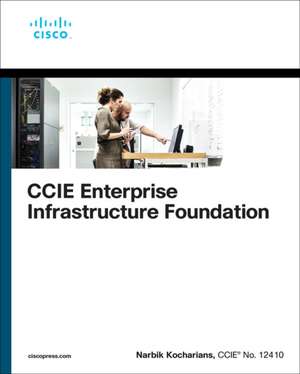
CCIE Enterprise Infrastructure Foundation
Autor Narbik Kochariansen Limba Engleză Paperback – 25 iul 2022
Apreciem în mod deosebit abordarea lui Narbik Kocharians, a cărui experiență în livrarea cursurilor de pregătire pentru certificările de vârf Cisco se reflectă direct în rigoarea tehnică a acestui volum. Autorul nu se limitează la teorie, ci transpune conceptele în scenarii de implementare reală, bazându-se pe o carieră dedicată ecosistemului de networking. CCIE Enterprise Infrastructure Foundation este concepută special pentru a ajuta specialiștii să facă saltul critic de la cunoștințele de bază CCNP către competențele practice profunde cerute în laboratoarele CCIE. Structura cărții urmărește o progresie logică, pornind de la fundamentele de Switching (Trunking, EtherChannels, STP) și avansând rapid către protocoale de rutare complexe precum EIGRP, OSPF și BGP. Credem că valoarea principală rezidă în cele peste 40 de laboratoare practice care acoperă de la liste de prefixe IP până la scenarii avansate de redistribuire și managementul VPN-urilor dinamice (DMVPN). Complementar volumului CCNP Enterprise Advanced Routing ENARSI 300-410 Official Cert Guide, acest titlu acoperă zona de integrare holistică a tehnologiilor, oferind acel „walkthrough” final pentru configurații complexe pe care ghidurile oficiale de certificare axate pe examene scrise nu îl aprofundează la același nivel practic. Reținem atenția acordată atât tehnologiilor mature, cât și soluțiilor moderne de tip „intent-driven”. Fiecare capitol, de la operarea IPv6 în medii complexe până la mecanismele de QoS și tunelurile MPLS, este susținut de ilustrații structurate ale protocoalelor. Această abordare transformă cele 944 de pagini într-un instrument de lucru esențial pentru orice inginer care vizează excelența tehnică în infrastructuri enterprise.
Preț: 745.23 lei
Preț vechi: 931.53 lei
-20%
Carte disponibilă
Livrare economică 16-30 noiembrie
Livrare express 31 octombrie-06 noiembrie pentru 79.40 lei
Specificații
ISBN-10: 0137374240
Pagini: 944
Dimensiuni: 195 x 235 x 51 mm
Greutate: 1.76 kg
Ediția:2. Auflage
Editura: Cisco Press
V-ar putea interesa
-
 Conservation management system The Ultimate Step-By-Step GuideGerardus Blokdyk-19%Preț: 557.61 lei688.40 lei
 -
 SAS A Clear and Concise ReferenceGerardus Blokdyk-19%Preț: 563.92 lei696.20 lei
 -
 Cold calling A Clear and Concise ReferenceGerardus Blokdyk-19%Preț: 556.43 lei686.96 lei
 -
 Team composition Complete Self-Assessment GuideGerardus Blokdyk-19%Preț: 557.36 lei688.10 lei
 -
 Critical incident stress management Second EditionGerardus Blokdyk-19%Preț: 557.61 lei688.40 lei
 -
 Certified management consultant The Ultimate Step-By-Step GuideGerardus Blokdyk-19%Preț: 557.90 lei688.77 lei
 -
 Enterprise performance management A Complete GuideGerardus Blokdyk-19%Preț: 557.36 lei688.10 lei
 -
 Entrepreneurship Complete Self-Assessment GuideGerardus Blokdyk-19%Preț: 556.43 lei686.96 lei
 -
 Environmental stewardship Third EditionGerardus Blokdyk-19%Preț: 557.36 lei688.10 lei
 -
 Contact centre The Ultimate Step-By-Step GuideGerardus Blokdyk-19%Preț: 556.14 lei686.59 lei
 -
 -8%Preț: 552.97 lei601.05 lei
 -
 -8%Preț: 551.96 lei599.96 lei
 -
 InclusionJennifer BrownPreț: 173.23 lei
 -
 Preț: 82.03 lei
 -
 Preț: 75.28 lei
 -
 Preț: 239.48 lei
 -
 Preț: 82.11 lei
 -
 Preț: 81.67 lei
 -
 Les Chemins de Fer Et l'ÉtatAlphonse de CalonnePreț: 97.92 lei
 -
 Preț: 90.21 lei
 -
 Preț: 74.97 lei
 -
 Le Monopole des agents de change et l'article 76 du Code de commerceÉdouard Badon-PascalPreț: 75.14 lei
 -
 Rentes Dites Cinq Pour Cent Sur l'État, Remboursement, Conversion, RetranchementJacques-Charles BailleulPreț: 82.11 lei
 -
 Budgets d'Autrefois, Budgets d'Aujourd'huiHélion de LuçayPreț: 82.11 lei
 -
 Preț: 81.67 lei
 -
 Preț: 120.37 lei
 -
 de l'Impôt Sur Les SuccessionsAchille BardonPreț: 89.20 lei
De ce să citești această carte
Recomandăm această carte profesioniștilor în rețele care se pregătesc pentru proba practică a examenului CCIE Enterprise Infrastructure. Cititorul câștigă o înțelegere aplicată prin intermediul celor 40+ laboratoare, învățând să configureze și să depaneze scenarii complexe de rutare, switching și securitate. Este resursa ideală pentru a trece de la memorarea comenzilor la stăpânirea arhitecturilor de rețea în condiții de stres de examen.
Despre autor
Narbik Kocharians este un instructor certificat Cisco cu o reputație consolidată în industria IT, fiind cunoscut la nivel mondial pentru calitatea cursurilor sale de pregătire CCIE. Cu o experiență de zeci de ani în proiectarea și implementarea rețelelor complexe, el deține multiple certificări CCIE și este fondatorul unei companii de training specializate. Expertiza sa practică este transpusă în publicațiile Cisco Press, unde Kocharians reușește să simplifice concepte tehnice dense prin exemple de laborator și metodologii de configurare testate în medii de producție reale.