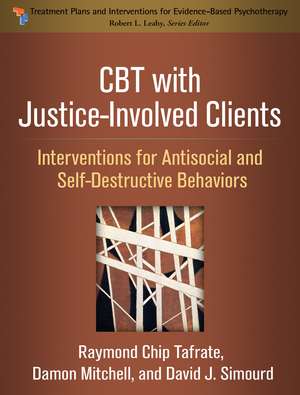
CBT with Justice-Involved Clients: Interventions for Antisocial and Self-Destructive Behaviors: Treatment Plans and Interventions for Evidence-Based Psychotherapy
Autor Raymond Chip Tafrate, Damon Mitchell, David J. Simourden Limba Engleză Paperback – 23 iul 2018
Grounded in science and clinical experience, this treatment planner provides essential tools for conducting cognitive-behavioral therapy (CBT) with justice-involved clients in a wide range of settings. Guidelines are presented for assessment, case formulation, and intervention to alter criminogenic thinking and destructive lifestyle patterns. With a focus on reducing recidivism, the book demonstrates ways to enhance clients' motivation for change and elicit prosocial values and life priorities. Practitioner-friendly features include case examples, recommended assessment instruments, over 35 sample scripts, and 27 reproducible forms and worksheets; the large-size format facilitates photocopying. Purchasers get access to a Web page where they can download and print the reproducible materials.
Winner--Significant Contribution Award, Criminal Justice Psychology Section of the Canadian Psychological Association
Winner--Significant Contribution Award, Criminal Justice Psychology Section of the Canadian Psychological Association
Preț: 157.46 lei
Puncte Express: 236
Carte disponibilă
Livrare economică 30 octombrie-13 noiembrie
Livrare express 16-22 octombrie pentru 248.87 lei
Livrare prin curier în România Termenul estimat este afișat lângă disponibilitate.
Transport gratuit de la 400.00 lei Plată online sau ramburs, în funcție de opțiunile comenzii.
Retur gratuit în 14 zile Comandă securizată și suport în română.
Specificații
ISBN-13: 9781462534906
ISBN-10: 1462534902
Pagini: 307
Dimensiuni: 203 x 267 x 22 mm
Greutate: 0.71 kg
Ediția:1
Editura: Guilford Publications
Colecția Guilford Press
Seria Treatment Plans and Interventions for Evidence-Based Psychotherapy
ISBN-10: 1462534902
Pagini: 307
Dimensiuni: 203 x 267 x 22 mm
Greutate: 0.71 kg
Ediția:1
Editura: Guilford Publications
Colecția Guilford Press
Seria Treatment Plans and Interventions for Evidence-Based Psychotherapy
Public țintă
Professional and Professional Practice & DevelopmentCuprins
I. Forensic Basics
1. The Forensic Treatment Landscape
2. An Integrated Forensic Cognitive-Behavioral Therapy Approach
II. Engagement
3. Successfully Engaging Justice-Involved Clients
4. Clarifying Values and Life Priorities
III. Assessment, Case Formulation, and Focus
5. Assessing Criminal Risk Domains
6. Case Formulation
7. Establishing Collaborative Goals and Focusing Conversations
IV. Detailed Treatment Plans for Criminogenic Thinking and Antisocial Orientation
8. Connecting Criminogenic Thinking to Decision Making in Criminal Risk Domains
9. Monitoring and Restructuring Criminogenic Thinking
V. Detailed Treatment Plans for Harmful Lifestyle Patterns
10. Developing New Routines: Leisure Activities and Employment/Education
11. Restructuring Relationships: Friends and Family
12. Managing Destructive Habits: Substance Use and Anger Reactions
VI. Practice Management
13. Documentation and Report Writing
Postscript
Appendix A. Standardized Test Recommendations
Appendix B. Resources for Practitioners
1. The Forensic Treatment Landscape
2. An Integrated Forensic Cognitive-Behavioral Therapy Approach
II. Engagement
3. Successfully Engaging Justice-Involved Clients
4. Clarifying Values and Life Priorities
III. Assessment, Case Formulation, and Focus
5. Assessing Criminal Risk Domains
6. Case Formulation
7. Establishing Collaborative Goals and Focusing Conversations
IV. Detailed Treatment Plans for Criminogenic Thinking and Antisocial Orientation
8. Connecting Criminogenic Thinking to Decision Making in Criminal Risk Domains
9. Monitoring and Restructuring Criminogenic Thinking
V. Detailed Treatment Plans for Harmful Lifestyle Patterns
10. Developing New Routines: Leisure Activities and Employment/Education
11. Restructuring Relationships: Friends and Family
12. Managing Destructive Habits: Substance Use and Anger Reactions
VI. Practice Management
13. Documentation and Report Writing
Postscript
Appendix A. Standardized Test Recommendations
Appendix B. Resources for Practitioners
Notă biografică
Raymond Chip Tafrate, PhD, a clinical psychologist, is Professor of Criminology and Criminal Justice at Central Connecticut State University. He co-chairs the Forensic Issues and Externalizing Behaviors special interest group for the Association for Behavioral and Cognitive Therapies, is a Fellow and Supervisor at the Albert Ellis Institute in New York City, and is a member of the Motivational Interviewing Network of Trainers. Dr. Tafrate frequently consults with criminal justice agencies regarding difficult-to-change problems such as anger dysregulation and criminal behavior. He has presented his research throughout North America, Europe, Asia, and Australia, and has published numerous journal articles, book chapters, and books.
Damon Mitchell, PhD, a clinical psychologist, is Professor of Criminology and Criminal Justice at Central Connecticut State University. As a criminal justice consultant, Dr. Mitchell has developed and delivered training workshops related to forensic assessment and treatment and has conducted evaluations of criminal justice programs. He has published numerous journal articles and book chapters as well as a coedited book.
David J. Simourd, PhD, CPsych, until his death in 2022, was in private practice in Kingston, Ontario, Canada, and had a 30-year career as a consultant/trainer, clinician, and researcher. Dr. Simourd published articles, delivered training workshops, and served as a consultant on offender assessment and treatment to a variety of correctional organizations throughout North America, Asia, and the Caribbean. He was on the editorial board of Criminal Justice and Behavior and was a member of the Ontario Review Board, the civil commitment board for mentally disordered offenders in Ontario. In 2019, he was elected as a Fellow of the Canadian Psychological Association.
Damon Mitchell, PhD, a clinical psychologist, is Professor of Criminology and Criminal Justice at Central Connecticut State University. As a criminal justice consultant, Dr. Mitchell has developed and delivered training workshops related to forensic assessment and treatment and has conducted evaluations of criminal justice programs. He has published numerous journal articles and book chapters as well as a coedited book.
David J. Simourd, PhD, CPsych, until his death in 2022, was in private practice in Kingston, Ontario, Canada, and had a 30-year career as a consultant/trainer, clinician, and researcher. Dr. Simourd published articles, delivered training workshops, and served as a consultant on offender assessment and treatment to a variety of correctional organizations throughout North America, Asia, and the Caribbean. He was on the editorial board of Criminal Justice and Behavior and was a member of the Ontario Review Board, the civil commitment board for mentally disordered offenders in Ontario. In 2019, he was elected as a Fellow of the Canadian Psychological Association.
Recenzii
"This book provides an excellent introduction, planner, guide, and resource for mental health and criminal justice professionals who want to help offenders change their behavior. The authors’ approach is grounded in CBT, which is empirically proven to be the most effective intervention with this population, whether in justice-controlled settings or in the community. I highly recommend it.”--Bruce D. Sales, PhD, JD, ScD (h.c.), Virginia L. Roberts Professor, Department of Criminal Justice, Indiana University Bloomington
"Tafrate, Mitchell, and Simourd have done a first-rate job of balancing the need for structured learning and professional discretion in this treatment planner. The book is clearly written and filled with helpful tips and practical exercises that can be used to help a wide range of justice-involved clients make prosocial changes. Students of correctional rehabilitation and staff who work with offenders, whether just beginning their career or highly experienced, will want this valuable resource on their shelves."--James Bonta, PhD, Director (retired), Corrections Research, Public Safety Canada; coauthor of The Psychology of Criminal Conduct
"This exceptionally well-structured guide builds on CBT to provide step-by-step information for treatment of justice-involved clients. The discussions of cognitive restructuring, motivational interviewing, risk reduction, and managing anger episodes are especially helpful. The book is jam-packed with practical examples of what to say and do, in the form of sample scripts and therapeutic responses. It is nicely suited for courses in correctional, mental health, and rehabilitation counseling, as well as for psychology and social work programs that address behavior change in the criminal justice system."--Stanley L. Brodsky, PhD, Professor Emeritus and Scholar in Residence, Department of Psychology, University of Alabama
"This book represents a landmark in the application of CBT principles to the problems of people involved in the criminal justice system. The authors have developed a well-formulated, scientifically based theory on the cognitive vulnerabilities to these clients’ behavioral problems. Their approach to treatment is novel, creative, and exciting. This is a 'must-read' book for all those working with such populations."--Raymond A. DiGiuseppe, PhD, ABPP, Department of Psychology, St. John’s University; past president, Association for Behavioral and Cognitive Therapies
"Justice-involved clients present some of the least-addressed diversity challenges in all of mental health. With impeccable clinical credentials and top research pedigrees, Tafrate et al. present a masterful integration of evidence-based practices in this book--one of those rare works that spans theoretical foundations and actionable techniques. This book would serve as an excellent text for intervention courses with a focus on community mental health and diversity. If we could get every mental health practitioner who works with justice-involved clients to read about and implement this approach, we could alter our current criminalization of mental illness."--Christopher M. Weaver, PhD, Associate Professor and Director, Forensic Psychology Program, Palo Alto University
"This impressive treatment planner deftly addresses the challenges and complexities of doing psychotherapeutic work in forensic contexts and provides rich tools for assessment, treatment, and practice management. It expertly guides the reader in the clinical application of CBT principles and techniques for working with the multifaceted psychological and behavioral problems of clients in various sectors of the justice system. The book is filled with case examples, offers scripts throughout that are easily adapted for personal use, and contains marvelous reproducible worksheets to assist in treatment planning, as well as 'helpsheets' to boost clients' self-monitoring skills and facilitate therapeutic change in goals, cognitions, and behaviors. Clinicians learn strategies for integrating case formulation with judgments about risk and identifying treatment targets across criminal risk domains."--Raymond W. Novaco, PhD, Department of Psychology and Social Behavior, University of California, Irvine
"This book is innovative, extremely informative, and chock-full of exercises, scripts, and clear advice on the 'whats' and 'hows' of treatment planning and implementation. The authors are to be commended for their evidence-based conceptualization of high-risk clients that many consider to be the most difficult to reach. Beginning with forensic basics and relevant techniques of motivational interviewing, readers are shown how to help clients identify their values and enter into the process of change. The authors recommend ways to deal with realities such as clients who cling to criminogenic thought patterns, have poor employment prospects, or lack prosocial friends or family. This program offers real hope of effective behavioral change, brighter futures for clients, and a safer world for us all. This is an essential text for any graduate-level practicum placement that serves justice-involved and at-risk juveniles or adults, and a great resource for experienced CBT therapists."--Denise D. Davis, PhD, Department of Psychology, Vanderbilt University
-Tafrate et. al…have crafted a [book] that is easily readable and deeply practical. Good examples include the use of case vignettes throughout the text, which illustrate typical progress and struggles between the client and the clinician….The informative summaries, scripts, and handouts available for the clinician flow naturally, and will be a helpful addition to any graduate trainee working with this population. Finally, the authors do well in providing a [manual] that a clinical supervisor can easily follow and build upon as needed….[It] is a useful addition to the field of forensic treatment.--The Behavior Therapist, 9/2/2019ƒƒThis book does a good job of addressing an important issue in the criminal justice system. The authors give clinicians tools to deal with antisocial personality traits and criminogenic thought processes using cognitive behavioral therapy. It is a great resource which should be in the libraries of therapists working in prisons, jails, and probation offices.--Doody's Review Service, 7/20/2018"Tafrate, Mitchell, and Simourd have done a first-rate job of balancing the need for structured learning and professional discretion in this treatment planner. The book is clearly written and filled with helpful tips and practical exercises that can be used to help a wide range of justice-involved clients make prosocial changes. Students of correctional rehabilitation and staff who work with offenders, whether just beginning their career or highly experienced, will want this valuable resource on their shelves."--James Bonta, PhD, Director (retired), Corrections Research, Public Safety Canada; coauthor of The Psychology of Criminal Conduct
"This exceptionally well-structured guide builds on CBT to provide step-by-step information for treatment of justice-involved clients. The discussions of cognitive restructuring, motivational interviewing, risk reduction, and managing anger episodes are especially helpful. The book is jam-packed with practical examples of what to say and do, in the form of sample scripts and therapeutic responses. It is nicely suited for courses in correctional, mental health, and rehabilitation counseling, as well as for psychology and social work programs that address behavior change in the criminal justice system."--Stanley L. Brodsky, PhD, Professor Emeritus and Scholar in Residence, Department of Psychology, University of Alabama
"This book represents a landmark in the application of CBT principles to the problems of people involved in the criminal justice system. The authors have developed a well-formulated, scientifically based theory on the cognitive vulnerabilities to these clients’ behavioral problems. Their approach to treatment is novel, creative, and exciting. This is a 'must-read' book for all those working with such populations."--Raymond A. DiGiuseppe, PhD, ABPP, Department of Psychology, St. John’s University; past president, Association for Behavioral and Cognitive Therapies
"Justice-involved clients present some of the least-addressed diversity challenges in all of mental health. With impeccable clinical credentials and top research pedigrees, Tafrate et al. present a masterful integration of evidence-based practices in this book--one of those rare works that spans theoretical foundations and actionable techniques. This book would serve as an excellent text for intervention courses with a focus on community mental health and diversity. If we could get every mental health practitioner who works with justice-involved clients to read about and implement this approach, we could alter our current criminalization of mental illness."--Christopher M. Weaver, PhD, Associate Professor and Director, Forensic Psychology Program, Palo Alto University
"This impressive treatment planner deftly addresses the challenges and complexities of doing psychotherapeutic work in forensic contexts and provides rich tools for assessment, treatment, and practice management. It expertly guides the reader in the clinical application of CBT principles and techniques for working with the multifaceted psychological and behavioral problems of clients in various sectors of the justice system. The book is filled with case examples, offers scripts throughout that are easily adapted for personal use, and contains marvelous reproducible worksheets to assist in treatment planning, as well as 'helpsheets' to boost clients' self-monitoring skills and facilitate therapeutic change in goals, cognitions, and behaviors. Clinicians learn strategies for integrating case formulation with judgments about risk and identifying treatment targets across criminal risk domains."--Raymond W. Novaco, PhD, Department of Psychology and Social Behavior, University of California, Irvine
"This book is innovative, extremely informative, and chock-full of exercises, scripts, and clear advice on the 'whats' and 'hows' of treatment planning and implementation. The authors are to be commended for their evidence-based conceptualization of high-risk clients that many consider to be the most difficult to reach. Beginning with forensic basics and relevant techniques of motivational interviewing, readers are shown how to help clients identify their values and enter into the process of change. The authors recommend ways to deal with realities such as clients who cling to criminogenic thought patterns, have poor employment prospects, or lack prosocial friends or family. This program offers real hope of effective behavioral change, brighter futures for clients, and a safer world for us all. This is an essential text for any graduate-level practicum placement that serves justice-involved and at-risk juveniles or adults, and a great resource for experienced CBT therapists."--Denise D. Davis, PhD, Department of Psychology, Vanderbilt University
Descriere
Grounded in science and clinical experience, this treatment planner provides essential tools for conducting cognitive-behavioral therapy (CBT) with justice-involved clients in a wide range of settings.