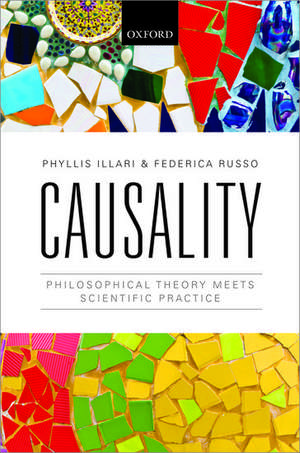
Causality: Philosophical Theory meets Scientific Practice
Autor Phyllis Illari, Federica Russoen Limba Engleză Hardback – 2 oct 2014
Preț: 376.19 lei
Preț vechi: 475.47 lei
-21%
Puncte Express: 564
Carte tipărită la comandă
Livrare economică 03-08 decembrie
Livrare prin curier în România Termenul estimat este afișat lângă disponibilitate.
Transport gratuit de la 400.00 lei Plată online sau ramburs, în funcție de opțiunile comenzii.
Retur gratuit în 14 zile Comandă securizată și suport în română.
Specificații
ISBN-13: 9780199662678
ISBN-10: 0199662673
Pagini: 328
Ilustrații: 8 b/w line drawings
Dimensiuni: 158 x 241 x 23 mm
Greutate: 0.59 kg
Editura: OUP OXFORD
Colecția OUP Oxford
Locul publicării:Oxford, United Kingdom
ISBN-10: 0199662673
Pagini: 328
Ilustrații: 8 b/w line drawings
Dimensiuni: 158 x 241 x 23 mm
Greutate: 0.59 kg
Editura: OUP OXFORD
Colecția OUP Oxford
Locul publicării:Oxford, United Kingdom
V-ar putea interesa
-
 An Introduction to Probability TheoryP. A. P. Moran-32%Preț: 591.89 lei874.90 lei
 -
 -33%Preț: 791.90 lei1173.91 lei
 -
 Stochastic Processes and ModelsDavid Stirzaker-28%Preț: 428.96 lei598.33 lei
 -
 The Oxford Handbook of Applied Bayesian AnalysisAnthony O' Hagan-19%Preț: 469.16 lei579.21 lei
 -
 The Oxford Dictionary of Statistical TermsYadolah Dodge-18%Preț: 361.27 lei440.83 lei
 -
 Bayesian Statistics 8J. M. Bernardo-31%Preț: 784.33 lei1129.94 lei
 -
 Data Mining AlgorithmsCichosz-8%Preț: 568.24 lei617.66 lei
 -
 Preț: 299.82 lei
 -
 Applied Linear Regression 4ESanford Weisberg-23%Preț: 865.68 lei1124.25 lei
 -
 Making Sense of Data IGlenn J Myatt-19%Preț: 502.19 lei619.98 lei
 -
 Chemometrics in ExcelAlexey L Pomerantsev-20%Preț: 581.01 lei726.26 lei
 -
 Online Panel ResearchCallegaro-8%Preț: 626.02 lei680.45 lei
 -
 Handbook of Brownian Motion - Facts and FormulaeAndrei N. Borodin-18%Preț: 1400.80 lei1708.29 lei
Recenzii
Causality is a hot topic in philosophy of science. Illari (lecturer, University College London) and Russo (researcher, Univ. of Ferrara, Italy) provide a much-needed travel guide through this landscape while sticking close to actual scientific practice from both the natural and social sciences. ... Highly recommended.
This is also one of those wonderful, concise tomes that sports a very good bibliography, and makes no bones about sending the reader to one of the works there for more details about specific topics. I found no topic that was poorly explained in the main text but, as the authors [themselves say, "[we] offer a map, not an encyclopedia." Illari and Russo very deftly point out the major attractions of the landscape but send you, well-prepared now to find your own way, to the library for more.
The book is an excellent resource, well written and referenced, and a sheer pleasure to read. The authors' two main goals are to offer an introduction to the philosophy of causality and to be highly accessible. They have clearly achieved both goals. I recommend the text to medical and epidemiology students, fellow epidemiologists, and physicians unfamiliar with the philosophy of causality.
the book covers an impressively wide range of interrelated topics in the philosophy of causation and their application to the natural sciences, and with a prose highly readable, often entertaining, and sprinkled with interesting, relevant, and illustrative historical anecdotes. For these reasons alone, it is easy to recommend this book to interested colleagues in either discipline: a highly accessible and candid treatment of this complex topic which sacrifices neither breadth nor depth no doubt deserves the attention of both parties.
This is also one of those wonderful, concise tomes that sports a very good bibliography, and makes no bones about sending the reader to one of the works there for more details about specific topics. I found no topic that was poorly explained in the main text but, as the authors [themselves say, "[we] offer a map, not an encyclopedia." Illari and Russo very deftly point out the major attractions of the landscape but send you, well-prepared now to find your own way, to the library for more.
The book is an excellent resource, well written and referenced, and a sheer pleasure to read. The authors' two main goals are to offer an introduction to the philosophy of causality and to be highly accessible. They have clearly achieved both goals. I recommend the text to medical and epidemiology students, fellow epidemiologists, and physicians unfamiliar with the philosophy of causality.
the book covers an impressively wide range of interrelated topics in the philosophy of causation and their application to the natural sciences, and with a prose highly readable, often entertaining, and sprinkled with interesting, relevant, and illustrative historical anecdotes. For these reasons alone, it is easy to recommend this book to interested colleagues in either discipline: a highly accessible and candid treatment of this complex topic which sacrifices neither breadth nor depth no doubt deserves the attention of both parties.
Notă biografică
Phyllis Illari is Lecturer in Philosophy of Science in the Science and Technology Studies department at University College London. Before joining UCL in 2013, she finished a project on Information Quality with Luciano Floridi, and previously completed a project on Mechanisms and Causality with Jon Williamson. She is primarily research active in the philosophy of science, particularly the philosophy of causality and the philosophy of information. She is on the editorial board of the journal Philosophy and Technology, and on the committee of the British Society for the Philosophy of Science. She is the author of numerous articles in the philosophy of science and edited volumes and special issues on causality in the sciences, including Causality in the Sciences (OUP 2011) with Federica Russo and Jon Williamson. Since 2008, she and Federica Russo have been members of the Steering Committee of the 'Causality in the Sciences' conference series.Federica Russo is Assistant Professor at the University of Amsterdam and has visited the Centre for Philosophy of Natural and Social Science (London School of Economics) from April 2004 to January 2005 and the Center for Philosophy of Science (Pittsburgh) from January to April 2009. She is interested in causality and probability in the social, biomedical and policy sciences, as well as in the philosophical, legal, and social, implications of technology. Federica is part of the editorial board of the journals Philosophy and Technology and Topoi. She is the author of Causality and causal modelling in the social sciences. Measuring variations (Springer, 2009), and of numerous articles (sole or co-authored) on causality in the social, biomedical, and policy sciences. She has edited several volumes in philosophy of science and technology, including Causality in the Sciences (OUP 2011) with Phyllis Illari and Jon Williamson.
Cuprins
- I PRELUDE TO CAUSALITY
- 1: Problems of causality in the sciences
- 2: A scientific toolbox for philosophy
- 3: A philosophical toolbox for science
- II CAUSALITY: ACCOUNTS, CONCEPTS, AND METHODS
- 4: Necessary and sufficient components
- 5: Levels of causation
- 6: Causality and evidence
- 7: Causal methods: probing the data
- 8: Difference-making: probabilistic causality
- 9: Difference-making: counterfactuals
- 10: Difference-making: manipulation and invariance
- 11: Production accounts: processes
- 12: Production accounts: mechanisms
- 13: Production accounts: information
- 14: Capacities, powers, dispositions
- 15: Regularity
- 16: Variation
- 17: Causality and action
- 18: Causality and inference
- III APPROACHES TO EXAMINING CAUSALITY
- 19: How we got to the Causality in the Sciences approach (CitS)
- 20: Examples and counterexamples
- 21: Truth or models?
- 22: Epistemology, metaphysics, method, semantics, use
- IV CONCLUSION: TOWARDS A CAUSAL MOSAIC
- 23: Pluralism
- 24: The causal mosaic under construction: the example of exposomics