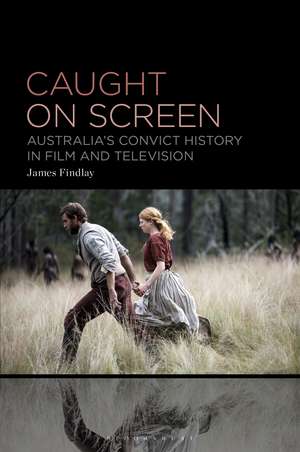
Caught on Screen: Australia’s Convict History in Film and Television
Autor James Findlayen Limba Engleză Hardback – 16 oct 2025
Convicts loom large in Australian history. As transported criminals and the first European settlers, they have shackled the nation to a curious and contested origin story. Historians were largely silent on their exploits until the second half of the twentieth century, but before then a tradition of convict representation on screen appeared with the rise of cinema, taking hold of the popular imagination. From silent films to more recent television series, screen culture has elevated the convict experience to become a key historical narrative through which filmmakers and audiences have repeatedly reframed and challenged an understanding of Australia's colonial past. Caught on Screen traverses this history of convict representation for the first time.
Through detailed archival research into their production and reception, the book explores engaging case studies produced in Australia and internationally, including the work of Douglas Sirk, Alfred Hitchcock and Jennifer Kent. It illuminates the fact that the convict as historical symbol is one that intersected with, and helped to direct, major debates about nationalism, the legacies of colonisation, Aboriginal dispossession and the origins and character of Australian society.
Preț: 569.04 lei
Preț vechi: 843.99 lei
-33%
Puncte Express: 854
Carte tipărită la comandă
Livrare economică 30 noiembrie-14 decembrie
Livrare express 23-29 octombrie pentru 174.43 lei
Livrare prin curier în România Termenul estimat este afișat lângă disponibilitate.
Transport gratuit pentru acest produs Plată online sau ramburs, în funcție de opțiunile comenzii.
Retur gratuit în 14 zile Comandă securizată și suport în română.
Specificații
ISBN-13: 9798765100523
Pagini: 270
Ilustrații: 30 bw illus
Dimensiuni: 160 x 152 x 24 mm
Greutate: 1.08 kg
Editura: Bloomsbury Publishing
Colecția Bloomsbury Academic
Locul publicării:New York, United States
Pagini: 270
Ilustrații: 30 bw illus
Dimensiuni: 160 x 152 x 24 mm
Greutate: 1.08 kg
Editura: Bloomsbury Publishing
Colecția Bloomsbury Academic
Locul publicării:New York, United States
V-ar putea interesa
-
 The Fatal ShoreRobert Hughes-26%Preț: 93.08 lei125.17 lei
 -
 The Commonwealth of ThievesThomas Keneally-18%Preț: 77.79 lei94.75 lei
 -
 AustraliaPhillip Knightley-19%Preț: 76.32 lei93.66 lei
 -
 The Colonial Screen: Early Cinema in Hong KongEmilie Yueh-yu Yeh-21%Preț: 190.58 lei240.68 lei
 -
 -32%Preț: 586.79 lei861.36 lei
 -
 The PlaymakerThomas Keneally-25%Preț: 59.15 lei79.02 lei
 -
 Preț: 241.00 lei
 -
 The Representation of Vikings in Cinema and Television: Epic and Barbarism on ScreenAlberto Robles DelgadoPreț: 380.83 lei
 -
 Our Country''s GoodTimberlake Wertenbaker-11%Preț: 80.51 lei90.07 lei
 -
 -32%Preț: 554.45 lei821.37 lei
 -
 A History of Modern Britain in Twenty MurdersDavid Wilson-25%Preț: 92.00 lei122.69 lei
 -
 Dreaming Down the Track: Awakenings in Aboriginal CinemaWilliam LempertPreț: 182.00 lei
 -
 A Traveller's History of AustraliaJohn H. Chambers-17%Preț: 91.42 lei110.32 lei
 -
 Double NationIan McLean-16%Preț: 224.97 lei267.61 lei
 -
 Outback: Westerns in Australian CinemaBrian McFarlane-23%Preț: 615.11 lei798.84 lei
 -
 Making Film and Television Histories: Australia and New ZealandJames E. Bennett-25%Preț: 187.29 lei251.32 lei
 -
 Preț: 178.45 lei
 -
 -29%Preț: 596.95 lei838.74 lei
 -
 -16%Preț: 160.49 lei192.11 lei
 -
 Crime Films of the 1970s: Contemporary PerspectivesDavid A. Mackey-29%Preț: 520.42 lei736.35 lei
Cuprins
List of Figures
Acknowledgements
Introduction. How to Watch a Flogging
1. Framing the Innocent: The Silent Era
2. Us Colonials Through Their Eyes: Convict Cinema Goes Global
3. The Ghosts of Port Arthur: Travelogues and Dark Tourism
4. They Came in Chains to Build a Television Nation: Emancipation,
Egalitarianism, and New Nationalism on the Small Screen
5. Bolters and Bushtopias: Narratives of Convict Escape
6. A New Stain: Screening Convict Violence on the Frontier
Conclusion
Bibliography
Index
Acknowledgements
Introduction. How to Watch a Flogging
1. Framing the Innocent: The Silent Era
2. Us Colonials Through Their Eyes: Convict Cinema Goes Global
3. The Ghosts of Port Arthur: Travelogues and Dark Tourism
4. They Came in Chains to Build a Television Nation: Emancipation,
Egalitarianism, and New Nationalism on the Small Screen
5. Bolters and Bushtopias: Narratives of Convict Escape
6. A New Stain: Screening Convict Violence on the Frontier
Conclusion
Bibliography
Index
Recenzii
While not all Australians have convict ancestry, we have all inherited vivid stories of the convict experience through our television and cinema screens. Why do we keep telling these stories, and what do they mean? James Findlay's marvellous book is a fascinating history of the ways that our screen culture has imagined the convict, from silent films to reality TV and beyond.
Australia has a rich cinematic history, and Findlay has shown us that we have so much more to learn. Caught on Screen offers a fresh perspective on how moving images have sustained and even shaped national identity through representations of convict history.
Innocent, heroic or horrific, successive cinematic portrayals have shaped Australia's engagement with its convict past. In this remarkable book, James Findlay unwinds those celluloid layers to reveal the power of film as historical device.
Drawing on case studies from the silent film era to 21st-century reality TV, Caught on Screen examines the evolving and often contradictory representations of the convict amidst political, literary and academic debates about Australian nationhood and cultural identity. James Findlay highlights the enduring global fascination with this cinematically malleable and emblematic figure of Australian history and popular culture, as well as the role film and television play in shaping public memory of colonization in Australia. Thoroughly researched and engagingly written, Caught on Screen is a must-read for students, scholars and curious viewers alike.
Findlay does an admirable job of drawing out his major themes, in the process demonstrating the convergence and divergence of film and written historiography, and the value of attending to both.
Australia has a rich cinematic history, and Findlay has shown us that we have so much more to learn. Caught on Screen offers a fresh perspective on how moving images have sustained and even shaped national identity through representations of convict history.
Innocent, heroic or horrific, successive cinematic portrayals have shaped Australia's engagement with its convict past. In this remarkable book, James Findlay unwinds those celluloid layers to reveal the power of film as historical device.
Drawing on case studies from the silent film era to 21st-century reality TV, Caught on Screen examines the evolving and often contradictory representations of the convict amidst political, literary and academic debates about Australian nationhood and cultural identity. James Findlay highlights the enduring global fascination with this cinematically malleable and emblematic figure of Australian history and popular culture, as well as the role film and television play in shaping public memory of colonization in Australia. Thoroughly researched and engagingly written, Caught on Screen is a must-read for students, scholars and curious viewers alike.
Findlay does an admirable job of drawing out his major themes, in the process demonstrating the convergence and divergence of film and written historiography, and the value of attending to both.