
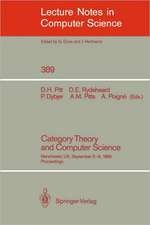
Category Theory and Computer Programming
Editat de David Pitt, Samson Abramsky, Axel Poigne, David Rydehearden Limba Engleză Paperback – oct 1986
Preț: 347.39 lei
Preț vechi: 434.23 lei
-20%
Puncte Express: 521
Carte tipărită la comandă
Livrare economică 01-15 decembrie
Livrare prin curier în România Termenul estimat este afișat lângă disponibilitate.
Transport gratuit de la 400.00 lei Plată online sau ramburs, în funcție de opțiunile comenzii.
Retur gratuit în 14 zile Comandă securizată și suport în română.
Specificații
ISBN-13: 9783540171621
ISBN-10: 3540171622
Pagini: 532
Ilustrații: X, 522 p.
Dimensiuni: 155 x 235 x 29 mm
Greutate: 0.8 kg
Ediția:1986
Editura: Springer
Locul publicării:Berlin, Heidelberg, Germany
ISBN-10: 3540171622
Pagini: 532
Ilustrații: X, 522 p.
Dimensiuni: 155 x 235 x 29 mm
Greutate: 0.8 kg
Ediția:1986
Editura: Springer
Locul publicării:Berlin, Heidelberg, Germany
V-ar putea interesa
-
 The Future of the EnvironmentDavid Pitt-18%Preț: 1111.68 lei1355.70 lei
 -
 Head First HTML and CSS 2eElisabeth Robson-20%Preț: 299.12 lei373.90 lei
 -
 Tex Reference ManualDavid Bausum-20%Preț: 1032.86 lei1291.06 lei
 -
 -37%Preț: 498.47 lei789.96 lei
 -
 KanbanDavid J. Anderson-20%Preț: 264.20 lei330.25 lei
 -
 Preț: 299.96 lei
 -
 Professional GitBrent Laster-20%Preț: 256.78 lei320.97 lei
 -
 Pro ASP.NET Web API SecurityBadrinarayanan Lakshmiraghavan-20%Preț: 525.86 lei657.33 lei
 -
 Android CookbookIan F Darwin-20%Preț: 443.80 lei554.76 lei
 -
 Where Is Your Final DestinationDavid PittPreț: 160.72 lei
 -
 Continuous Delivery with Visual Studio ALM 2015Mathias Olausson-20%Preț: 299.70 lei374.63 lei
 -
 The Enterprise Big Data LakeAlex Gorelik-20%Preț: 378.05 lei472.57 lei
 -
 Feature Engineering for Machine LearningAlice Zheng-20%Preț: 342.62 lei428.28 lei
 -
 Mastering ServiceNow - Second EditionMartin Wood-20%Preț: 368.74 lei460.93 lei
 -
 Program ConstructionF. L. Bauer-20%Preț: 423.11 lei528.88 lei
 -
 CoroutinesC. D. Marlin-20%Preț: 320.32 lei400.41 lei
 -
 Program SpecificationJ. Staunstrup-20%Preț: 329.14 lei411.42 lei
 -
 Category Theory and Computer ScienceDavid H. PittPreț: 376.97 lei
 -
 Coordination Languages and ModelsAntonio Porto-20%Preț: 325.88 lei407.36 lei
 -
 Typed Lambda Calculi and ApplicationsSamson AbramskyPreț: 400.42 lei
 -
 Turing Machines with Sublogarithmic SpaceAndrzej Szepietowski-20%Preț: 326.10 lei407.61 lei
 -
 Partial-Order Methods for the Verification of Concurrent SystemsPatrice Godefroid-20%Preț: 314.81 lei393.51 lei
 -
 -20%Preț: 316.71 lei395.88 lei
Public țintă
ResearchCuprins
Categories.- Elements of categorical reasoning : Products and coproducts and some other (co-)limits.- Functors and natural transformations.- Adjunctions.- Cartesian closure — Higher types in categories.- Algebra categorically.- Category theory and logic.- Categories, data types, and imperative languages.- Category theory and programming language semantics: An overview.- Weakest preconditions: Categorical insights.- A categorical view of weakest liberal preconditions.- Functor-category semantics of programming languages and logics.- Finite approximation of spaces.- Categories of partial morphisms and the ?P-calculus.- A note on distributive laws and power domains.- Category theory and models for parallel computation.- Categorical models of process cooperation.- Galois connections and computer science applications.- A study in the foundations of programming methodology: Specifications, institutions, charters and parchments.- Bits and pieces of the theory of institutions.- Extended ML: An institution-independent framework for formal program development.- Behavioural program specification.- Key extensions of abstract data types, final algebras, and database semantics.- Theories as categories.- Internal completeness of categories of domains.- Formalising the network and hierarchical data models — an application of categorical Logic.- A categorical unification algorithm.- Computing with categories.