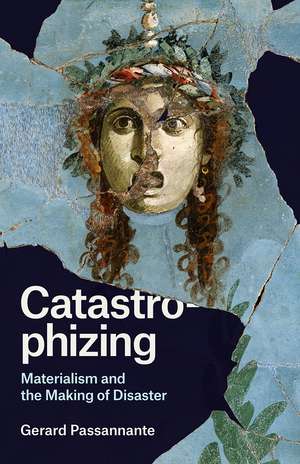
Catastrophizing: Materialism and the Making of Disaster
Autor Gerard Passannanteen Limba Engleză Hardback – 25 mar 2019
When we catastrophize, we think the worst. We make too much of too little, or something of nothing. Yet what looks simply like a bad habit, Gerard Passannante argues, was also a spur to some of the daring conceptual innovations and feats of imagination that defined the intellectual and cultural history of the early modern period.
Reaching back to the time between the Renaissance and the Enlightenment, Passannante traces a history of catastrophizing through literary and philosophical encounters with materialism—the view that the world is composed of nothing but matter. As artists, poets, philosophers, and scholars pondered the physical causes and material stuff of the cosmos, they conjured up disasters out of thin air and responded as though to events that were befalling them. From Leonardo da Vinci’s imaginative experiments with nature’s destructive forces to the fevered fantasies of doomsday astrologers, from the self-fulfilling prophecies of Shakespeare’s tragic characters to the mental earthquakes that guided Kant toward his theory of the sublime, Passannante shows how and why the early moderns reached for disaster when they ventured beyond the limits of the sensible. He goes on to explore both the danger and the critical potential of thinking catastrophically in our own time.
Reaching back to the time between the Renaissance and the Enlightenment, Passannante traces a history of catastrophizing through literary and philosophical encounters with materialism—the view that the world is composed of nothing but matter. As artists, poets, philosophers, and scholars pondered the physical causes and material stuff of the cosmos, they conjured up disasters out of thin air and responded as though to events that were befalling them. From Leonardo da Vinci’s imaginative experiments with nature’s destructive forces to the fevered fantasies of doomsday astrologers, from the self-fulfilling prophecies of Shakespeare’s tragic characters to the mental earthquakes that guided Kant toward his theory of the sublime, Passannante shows how and why the early moderns reached for disaster when they ventured beyond the limits of the sensible. He goes on to explore both the danger and the critical potential of thinking catastrophically in our own time.
Preț: 170.30 lei
Preț vechi: 223.73 lei
-24%
Puncte Express: 255
Carte indisponibilă temporar
Doresc să fiu notificat când acest titlu va fi disponibil:
Se trimite...
Specificații
ISBN-13: 9780226612218
ISBN-10: 022661221X
Pagini: 240
Ilustrații: 5 color plates, 7 halftones
Dimensiuni: 140 x 216 x 28 mm
Greutate: 0.54 kg
Ediția:First Edition
Editura: University of Chicago Press
Colecția University of Chicago Press
ISBN-10: 022661221X
Pagini: 240
Ilustrații: 5 color plates, 7 halftones
Dimensiuni: 140 x 216 x 28 mm
Greutate: 0.54 kg
Ediția:First Edition
Editura: University of Chicago Press
Colecția University of Chicago Press
Notă biografică
Gerard Passannante is associate professor of English and comparative literature at the University of Maryland, College Park. He is the author of The Lucretian Renaissance: Philology and the Afterlife of Tradition, also published by the University of Chicago Press.
Cuprins
List of Illustrations
Introduction. Catastrophizing: A Beginner’s Guide
1. Leonardo’s Disasters
2. Earthquakes of the Mind
3. Shakespeare’s Catastrophic “Anything”
4. The Earthquake and the Microscope
5. Disaster before the Sublime; or, Kant’s Catastrophes
Afterword. Catastrophizing in the Age of Climate Change
Acknowledgments
Bibliography
Index
Introduction. Catastrophizing: A Beginner’s Guide
1. Leonardo’s Disasters
2. Earthquakes of the Mind
3. Shakespeare’s Catastrophic “Anything”
4. The Earthquake and the Microscope
5. Disaster before the Sublime; or, Kant’s Catastrophes
Afterword. Catastrophizing in the Age of Climate Change
Acknowledgments
Bibliography
Index
Recenzii
"Passannante presents a materialist examination of the notion of catastrophe. He offers a tour through the ages as this concept developed, from the Renaissance, to the Enlightenment, to the modern period, which he notes is consumed with anxiety of catastrophe brought on by climate change. Chapters cover important figures who have contributed to the evolution of the concept, among them Leonardo da Vinci, Shakespeare, and Kant. In the afterword, Passannante notes the 'opportunity for agency in the moment of response' to situations such as climate change. In this way he suggests the potential for positive change to come from what otherwise appears as humanity’s tendency to imagine the worst possible outcomes. . . . Summing Up: Recommended."
“Who’d have thought, though, that da Vinci’s work could help us think about climate change? That is the fascinating suggestion of a new book by Gerard Passannante . . . it examines how disasters spur us to make productive use of the imagination – letting us grasp events that might otherwise seem to be mere abstract scientific notions. ”
"This closely argued consideration of the response to classical philosophical materialism during the Renaissance and early scientific revolution delineates the crise de conscience of a select group of thinkers on the cusp of modernity who experienced profound doubt about empiricist hermeneutics. . . . Passannante reflects on the potential value of catastrophizing in relation to climate change, stressing the parameters of normal thought and inducing involuntary fantasies of disaster. Positing catastrophizing as useful in transforming the overwhelming and unthinkable into 'affective experience,' he warns against apocalyptic, 'bad' catastrophizing, rendering us helpless in the face of our fantasies of disaster."
"Few books could be more relevant than Gerard Passannante’s Catastrophizing. In this 2020 British Society for Literature and Science book prize winner, Passannante examines the human inclination to imagine sudden, all-consuming destruction. In pandemic times, we all witness our minds taking us to cataclysmic ends, and with this book, Passannante helps us step back from the precipice to observe some of the key through lines of, and applications for, our catastrophizing proclivity."
"Passannante’s timely study brings together literature, visual art, and the history of science to provide rich insights into catastrophic thinking and the history of materialist thought. His accounts of analogy and of the juxtaposition of incompatible scales will be stimulating to readers working across a wide range of periods."
"Passannante’s fascinating book Catastrophizing explores the recurring descriptions of imaginary disasters in early modern Europe and the role they play at the junction between empirical and speculative forms of knowledge. . . . Passannante’s work offers new and captivating insights on a particularly tumultuous period in the history of philosophical and scientific thought."
"Catastrophizing is a tour de force of intellectual history and humanistic inquiry."
“In this deeply historical and urgently contemporary book, Gerard Passannante turns to the subtle ligature between philosophical materialism in the school of Lucretius and the imaginary (but not always, in the event, factually erroneous) phenomenon of disaster, or catastrophe, the sudden downturn and collapse. Following the perfect storm of materialist catastrophism, ‘the making of disaster,’ from Leonardo’s ‘Deluge’ drawings to Donne’s earthquakes and cosmic trepidations, to Shakespeare’s King Lear, Pascal’s twin abysses, and the Kantian sublime, and concluding with a wise analysis of the coming ecological catastrophe, this book is, among much else for literary historians, a forceful and caring intervention in our contemporary debate on the future.”
“With Catastrophizing, Passannante explores how Renaissance thinkers, including Leonardo, Donne, Montaigne, and Shakespeare, responded to sudden, inexplicable manifestations of nature’s powers—‘the action of the mind when it approaches the imperceptible.’ At a moment when the force of natural disasters could not be more sadly relevant, Passannante wisely reminds us that our predicament has an intellectual history—and that the worst responses would be either to succumb to fantasies of mastery or to utter helplessness.”
“Passannante’s beautifully crafted study of the epistemological anxieties of early modern materialist thought shakes up the boundaries between comparative literature, art history, and history of science. It reveals new ways of juxtaposing historical voices and visions as diverse as Leonardo’s deluge drawings, Shakespeare’s aporeitic ‘anything’ and ‘nothing,’ Robert Hooke’s micrographic demonstrations of providential order, the Kantian sublime, and the Museum of Jurassic Technology. With its themes of cosmic disintegration, ecological collapse, and political upheaval, Catastrophizing is also very much a book about humanism and the humanities in the twenty-first century.”