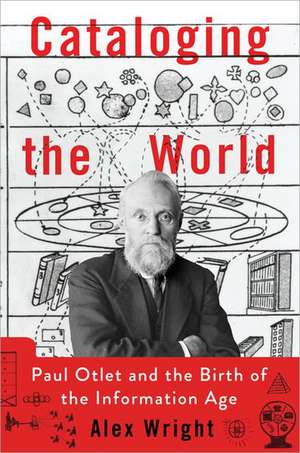
Cataloging the World: Paul Otlet and the Birth of the Information Age
Autor Alex Wrighten Limba Engleză Hardback – 10 iul 2014
Preț: 144.73 lei
Preț vechi: 191.31 lei
-24%
Puncte Express: 217
Carte tipărită la comandă
Livrare economică 10-15 decembrie
Livrare prin curier în România Termenul estimat este afișat lângă disponibilitate.
Transport gratuit de la 400.00 lei Plată online sau ramburs, în funcție de opțiunile comenzii.
Retur gratuit în 14 zile Comandă securizată și suport în română.
Specificații
ISBN-13: 9780199931415
ISBN-10: 0199931410
Pagini: 360
Ilustrații: 46 b/w
Dimensiuni: 145 x 211 x 31 mm
Greutate: 0.48 kg
Editura: Oxford University Press
Colecția OUP USA
Locul publicării:New York, United States
ISBN-10: 0199931410
Pagini: 360
Ilustrații: 46 b/w
Dimensiuni: 145 x 211 x 31 mm
Greutate: 0.48 kg
Editura: Oxford University Press
Colecția OUP USA
Locul publicării:New York, United States
V-ar putea interesa
-
 The Catalogue of Shipwrecked BooksEdward Wilson-LeePreț: 94.16 lei
 -
 KNOWING WHAT WE KNOW PBSimon WinchesterPreț: 79.75 lei
 -
 ProtoLaura SpinneyPreț: 123.57 lei
 -
 The Age of EarthquakesDouglas CouplandPreț: 106.59 lei
 -
 OutcastOliver BascianoPreț: 145.55 lei
 -
 This Is for EveryoneTim Berners-LeePreț: 124.30 lei
 -
 -15%Preț: 197.03 lei231.85 lei
 -
 -27%Preț: 81.72 lei112.35 lei
 -
 -24%Preț: 60.77 lei80.16 lei
 -
 A Place For EverythingJudith Flanders-43%Preț: 61.86 lei107.73 lei
 -
 NexusYuval Noah HarariPreț: 94.97 leiRecomandat
 -
 EscapeMarie Le Conte-18%Preț: 59.03 lei72.25 lei
 -
 The History of the Internet in Byte-Sized ChunksChris Stokel-Walker-29%Preț: 58.59 lei82.40 lei
 -
 Dysphoria MundiPaul B. PreciadoPreț: 124.00 lei
 -
 The Best of All Possible WorldsMichael KempePreț: 93.61 lei
 -
 EnshittificationCory DoctorowPreț: 170.65 lei
 -
 -18%Preț: 112.33 lei137.70 leiRecomandat
 -
 The Thinking MachineStephen WittPreț: 123.17 lei
Descriere
In 1934, a Belgian entrepreneur named Paul Otlet sketched out plans for a worldwide network of computers--or "electric telescopes," as he called them -- that would allow people anywhere in the world to search and browse through millions of books, newspapers, photographs, films and sound recordings, all linked together in what he termed a réseau mondial: a "worldwide web." Today, Otlet and his visionary proto-Internet have been all but forgotten, thanks to a series of historical misfortunes -- not least of which involved the Nazis marching into Brussels and destroying most of his life's work. In the years since Otlet's death, however, the world has witnessed the emergence of a global network that has proved him right about the possibilities -- and the perils -- of networked information. In Cataloging the World, Alex Wright brings to light the forgotten genius of Paul Otlet, an introverted librarian who harbored a bookworm's dream to organize all the world's information. Recognizing the limitations of traditional libraries and archives, Otlet began to imagine a radically new way of organizing information, and undertook his life's great work: a universal bibliography of all the world's published knowledge that ultimately totaled more than 12 million individual entries. That effort eventually evolved into the Mundaneum, a vast "city of knowledge" that opened its doors to the public in 1921 to widespread attention. Like many ambitious dreams, however, Otlet's eventually faltered, a victim to technological constraints and political upheaval in Europe on the eve of World War II. Wright tells not just the story of a failed entrepreneur, but the story of a powerful idea -- the dream of universal knowledge -- that has captivated humankind since before the great Library at Alexandria. Cataloging the World explores this story through the prism of today's digital age, considering the intellectual challenge and tantalizing vision of Otlet's digital universe that in some ways seems far more sophisticated than the Web as we know it today.
Recenzii
The index is excellent, of a quality rarely seen nowadays
Meticulously researched.
A remarkable read in its entirety, not only in illuminating history but in extracting from it a beacon for the future.
An excellent study of a Belgian, Paul Otlet, who in the late nineteenth century began 'a vast intellectual enterprise that attempted to organize and code everything ever published' ... Relevant of course to the origins of the web, Wikipedia, and current sites such as Vox.com.
a great introduction to Paul Otlet's life ... [Wright] provides a thorough overview of its historical context and how it relates to our Internet Age.
Meticulously researched.
A remarkable read in its entirety, not only in illuminating history but in extracting from it a beacon for the future.
An excellent study of a Belgian, Paul Otlet, who in the late nineteenth century began 'a vast intellectual enterprise that attempted to organize and code everything ever published' ... Relevant of course to the origins of the web, Wikipedia, and current sites such as Vox.com.
a great introduction to Paul Otlet's life ... [Wright] provides a thorough overview of its historical context and how it relates to our Internet Age.
Notă biografică
Alex Wright is Director of User Experience and Product Research at The New York Times and the author of Glut: Mastering Information Through the Ages.
Cuprins
- Introduction
- 1. The Libraries of Babel
- 2. The Dream of the Labyrinth
- 3. Belle Epoque
- 4. The Microphotic Book
- 5. The Index Museum
- 6. Castles in the Air
- 7. Hope, Lost and Found
- 8. Mundaneum
- 9. The Collective Brain
- 10. The Radiated Library
- 11. The Intergalactic Network
- 12. Entering the Steam
- Conclusion