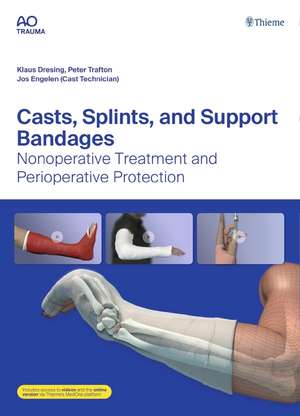
Casts, Splints, and Support Bandages
Autor Klaus Dresing, Peter Trafton, Jos Engelenen Limba Engleză Mixed media product – 17 dec 2014
Provocarea majoră în ortopedia contemporană nu rezidă doar în complexitatea intervențiilor chirurgicale, ci și în menținerea standardelor de aur pentru tratamentul conservator și protecția perioperatorie. Observăm adesea o erodare a competențelor practice în aplicarea imobilizărilor, motiv pentru care lucrarea Casts, Splints, and Support Bandages, semnată de Klaus Dresing și Peter Trafton, devine o resursă clinică indispensabilă. Aceasta nu este doar un manual tehnic, ci o fundamentare teoretică și practică a utilizării ghipsului și a materialelor sintetice moderne. Pe linia clinică a lucrării Cast Manual for Adults and Children, dar cu accent pe integrarea tehnologiei video și a dovezilor din medicina bazată pe dovezi, acest volum publicat de Georg Thieme Verlag acoperă spectrul complet al îngrijirii non-operatorii. Structura este riguros organizată: prima parte analizează proprietățile fizice ale materialelor și logistica sălii de ghips, a doua oferă ghiduri specifice pentru extremități și coloană, iar secțiunea finală detaliază 55 de tehnici individuale. Apreciem în mod deosebit calitatea vizuală, cele 2497 de ilustrații și secvențele video fiind esențiale pentru înțelegerea nuanțelor de aplicare care previn complicațiile neurovasculare sau escarele sub ghips. Suntem de părere că progresia de la istorie și biofizică la protocoale clinice pentru fracturi pediatrice sau leziuni de tendon oferă o perspectivă unitară asupra traumatologiei. Spre deosebire de Manual of Splinting and Casting, care se concentrează pe managementul inițial de urgență, acest tratat AOTrauma aprofundează monitorizarea pe termen lung și considerentele socioeconomice ale tratamentului conservator, fiind un pilon de referință pentru orice unitate de ortopedie.
Preț: 1472.40 lei
Preț vechi: 1549.89 lei
-5%
Carte disponibilă
Livrare economică 09-16 noiembrie
Livrare express 29 octombrie-04 noiembrie pentru 134.47 lei
Specificații
ISBN-10: 3132444723
Pagini: 652
Ilustrații: 2497 Abbildungen
Dimensiuni: 216 x 285 x 37 mm
Greutate: 1.95 kg
Editura: Georg Thieme Verlag
V-ar putea interesa
-
 Oxford Handbook of Trauma and OrthopaedicsKunal Kulkarni-5%Preț: 307.75 lei323.94 lei
 -
 Operative Techniques: Orthopaedic Trauma SurgeryEmil Schemitsch-23%Preț: 1507.69 lei1946.68 lei
 -
 McRae's Orthopaedic Trauma and Emergency Fracture ManagementTimothy O. White-29%Preț: 370.88 lei519.00 lei
 -
 Manual of Splinting and CastingStephen R. Thompson-28%Preț: 419.12 lei580.05 lei
 -
 -27%Preț: 464.71 lei639.77 lei
 -
 Current Practice in Hand SurgeryJin Bo Tang-28%Preț: 1575.55 lei2178.50 lei
 -
 Miller's Review of OrthopaedicsStephen R. Thompson-27%Preț: 893.67 lei1223.55 lei
 -
 Atlas of Orthoses and Assistive DevicesDouglas P. Murphy-28%Preț: 1169.10 lei1618.81 leiRecomandat
 -
 Sabiston Textbook of Surgery: The Biological Basis of Modern Surgical PracticeDouglas Scott Tyler-29%Preț: 1169.15 lei1645.26 leiRecomandat
 -
 Equine Bandaging, Splinting, and Casting TechniquesJ Dylan Lutter-5%Preț: 887.37 lei934.08 lei
 -
 Musculoskeletal EmergenciesBruce D. Browner-23%Preț: 748.12 lei974.24 lei
 -
 Handbook of FracturesKenneth Egol MD-5%Preț: 591.76 lei622.91 lei
 -
 -5%Preț: 383.85 lei404.05 leiRecomandat
 -
 Master Techniques in Orthopaedic Surgery: FracturesMichael J. Gardner MD-15%Preț: 1913.02 lei2239.20 lei
 -
 -25%Preț: 699.58 lei934.86 lei
 -
 -18%Preț: 4510.90 lei5511.75 lei
 -
 Operative Techniques in Orthopaedic Trauma SurgeryPaul Tornetta, III MD-15%Preț: 1872.67 lei2204.33 lei
 -
 Rockwood and Green's Fractures in Adults: Print + eBook with MultimediaPaul Tornetta, III MD-26%Preț: 3120.22 lei4225.28 lei
 -
 Handbook of Fractures: Print + eBook with MultimediaKENNETH A. EGOL MD-21%Preț: 537.27 lei677.30 lei
De ce să citești această carte
Această lucrare este esențială pentru chirurgii ortopezi, rezidenți și tehnicienii ghipsari care doresc să stăpânească arta imobilizării corecte. Cititorul câștigă acces la o metodologie validată de AOTrauma, susținută de aproape 2500 de imagini și demonstrații video. Este resursa definitivă pentru a asigura o recuperare optimă a pacientului, reducând riscul complicațiilor post-imobilizare prin tehnici precise, explicate pas cu pas.
Cuprins
1 Introduction
2 History of casting-from the beginning to the present
3 Principles of casting
4 Thrombosis prophylaxis
5 Logistics and resources in the cast room
6 Properties of cast materials
7 Socioeconomic considerations
8 Outcomes after nonoperative fracture treatment-what information can be gained from evidence-based medicine?
Section 2: Guidelines for nonoperative treatment and perioperative protection
9.1 Fractures, dislocations, and subluxations of the upper extremity
9.2 Fractures, dislocations, and subluxations of the lower extremity
9.3 Nonoperative treatment of spinal fractures
9.4 Pediatric fractures
10 Soft-tissue damage and defects
11.1 Ligament and tendon injuries
11.2 Nerve injuries
12 Indications for nonoperative treatment of infections
13 Overload Injuries
Section 3: Techniques-casts, splints, and support bandages
14.1 Overview of cast, splint, orthosis, and bandage techniques
14.2 Overview of cast, splint, orthosis, and bandage techniques-demonstration format and icons
15 Upper extremity
16 Lower extremity
17 Spine
18 Support bandages