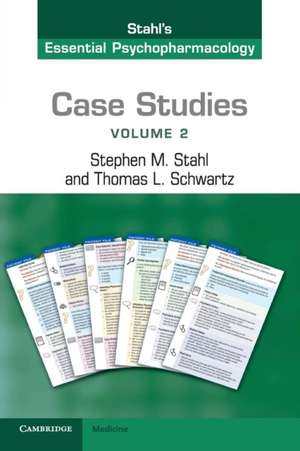
Case Studies: Stahl's Essential Psychopharmacology: Volume 2
Autor Stephen M. Stahl, Thomas L. Schwartzen Limba Engleză Paperback – 29 mar 2016
Observăm că Case Studies se distinge prin formatul său extrem de pragmatic, fiind un volum de tip „paperback” de peste 500 de pagini, organizat meticulos pentru o consultare rapidă. Structura celor 17 capitole urmărește o progresie logică a complexității, utilizând un sistem vizual de iconițe, tabele sintetice și secțiuni de întrebări și răspunsuri care facilitează învățarea activă. Ne-a atras atenția abordarea onestă a autorilor Stephen M. Stahl și Thomas L. Schwartz, care nu se limitează la succese terapeutice, ci explorează și momentele de impas, tratamentele eșuate și erorile de judecată clinică, oferind o perspectivă autentică asupra psihiatriei de zi cu zi. Suntem de părere că acest volum reprezintă o resursă vitală pentru rafinarea raționamentului diagnostic. Manual de referință comparabil cu Case Studies: Stahl's Essential Psychopharmacology: Volume 1, dar actualizat pentru a reflecta provocările clinice contemporane, acesta completează perfect arsenalul teoretic oferit de lucrările anterioare ale autorului, precum Prescriber's Guide. În timp ce Prescriber's Guide se concentrează pe mecanisme și dozaje, Case Studies aplică aceste cunoștințe în scenarii reale, precum managementul dischineziilor sau ajustarea diagnosticului în cazuri de depresie majoră. Față de Practical Psychopharmacology de Joseph F. Goldberg, care pune accent pe polifarmacie, lucrarea de față excelează prin narativul clinic complet, integrând factori diverși, de la terapia asistată de animale la nuanțele utilizării medicamentelor generice.
Preț: 544.28 lei
Preț vechi: 572.93 lei
-5%
Carte tipărită la comandă
Livrare economică 23 noiembrie-07 decembrie
Specificații
ISBN-10: 1107607337
Pagini: 504
Ilustrații: 1 b/w illus. 24 colour illus. 6 tables
Dimensiuni: 141 x 227 x 27 mm
Greutate: 0.69 kg
Editura: Cambridge University Press
Locul publicării:New York, United States
V-ar putea interesa
-
 Love, Guilt and ReparationMelanie Klein-18%Preț: 90.19 lei109.36 lei
 -
 The Psycho-Analysis of ChildrenMelanie Klein-19%Preț: 86.80 lei107.36 lei
 -
 -25%Preț: 524.77 lei704.11 lei
 -
 -28%Preț: 506.08 lei707.25 lei
 -
 Stahl Illustrate Chronic Pain FibroStephen M. Stahl-5%Preț: 444.79 lei468.20 lei
 -
 Case StudiesStephen M. Stahl-5%Preț: 530.05 lei557.94 lei
 -
 Stahl's Illustrated Mood StabilizersStephen M. Stahl-5%Preț: 418.24 lei440.25 lei
 -
 Case Studies: Stahl's Essential Psychopharmacology: Volume 3Takesha Cooper-5%Preț: 524.76 lei552.38 lei
 -
 Stahl's Illustrated Sleep and Wake DisordersStephen M. Stahl-8%Preț: 433.10 lei470.76 lei
 -
 -5%Preț: 2334.61 lei2457.48 lei
 -
 -5%Preț: 984.69 lei1036.52 lei
 -
 Aspects of PsychopharmacologyDavid J. Sanger-5%Preț: 239.67 lei252.28 lei
 -
 100 Cases in PsychiatryBarry Wright-5%Preț: 283.83 lei298.77 lei
 -
 Embrace Your ExcellenceDiana Rangaves-23%Preț: 864.93 lei1123.29 lei
 -
 Managing the Side Effects of Psychotropic MedicationsJoseph F Goldberg-5%Preț: 510.03 lei536.87 lei
 -
 -5%Preț: 597.71 lei629.17 lei
 -
 Emergency Psychiatry: Principles and PracticeRachel Lipson Glick MD-21%Preț: 759.57 lei959.76 lei
 -
 -5%Preț: 116.36 lei122.49 lei
De ce să citești această carte
Recomandăm această carte psihiatrilor și rezidenților care doresc să treacă dincolo de algoritmii rigizi de tratament. Cititorul câștigă acces la experiența acumulată a unor experți de renume, învățând cum să gestioneze complicațiile neprevăzute și cum să ajusteze schemele terapeutice pentru pacienții „dificili”. Este o oportunitate rară de a vedea cum teoria farmacologică se transformă în decizie clinică în fața unor cazuri reale, complexe și adesea imprevizibile.
Despre autor
Stephen M. Stahl este Profesor Adjunct de Psihiatrie la Universitatea din California, San Diego și cercetător senior onorific la Universitatea Cambridge. Cu o carieră academică și clinică de excepție, Dr. Stahl a publicat peste 350 de articole și capitole de specialitate, fiind recunoscut la nivel mondial pentru capacitatea sa de a simplifica concepte neuroștiințifice complexe. Proiectele sale de cercetare au fost premiate de instituții prestigioase precum Institutul Național de Sănătate Mintală (NIMH), consolidându-i statutul de figură centrală în psihofarmacologia modernă, autoritate reflectată în succesul global al seriei sale de ghiduri esențiale pentru prescriptori.