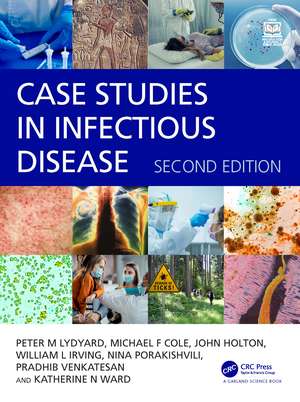
Case Studies in Infectious Disease
Autor Peter Lydyard, Michael Cole, John Holton, Will Irving, Nino Porakishvili, Pradhib Venkatesan, Kate Warden Limba Engleză Paperback – 17 mai 2023
Five core sets of questions are posed in each case, with the answers covering the nature of the infectious agent, route(s) of spread and of infection, pathogenesis of disease, host response to infection, clinical manifestations, diagnosis, treatment and prevention. This standardized approach provides the reader with a logical basis for understanding these diverse and medically important organisms and diseases, fully integrating microbiology and immunology throughout.
KEY FEATURES
- High-resolution photos accompany each case, from the causative agents of disease to the clinical manifestations of the infection.
- Exquisite artwork helps to illustrate important concepts throughout the book.
- Eight new cases added to this new edition, extending coverage of important infectious diseases of worldwide significance.
- A standardized set of core questions allows students to compare directly differences between microbes such as their structure, clinical manifestations, host response, pathogenesis and availability of vaccines.
- Questions and answers available online, test the reader’s understanding of each case study.
The book provides essential case-based learning for undergraduate and graduate microbiology students, while medical students and trainee physicians will also find the up-to-date information on 48 globally important infectious diseases outlined in a clear, digestible form, invaluable during undergraduate studies and in future clinical practice.
Preț: 503.68 lei
Preț vechi: 530.19 lei
-5%
Puncte Express: 756
Carte disponibilă
Livrare economică 31 octombrie-14 noiembrie
Livrare express 17-23 octombrie pentru 76.66 lei
Livrare prin curier în România Termenul estimat este afișat lângă disponibilitate.
Transport gratuit pentru acest produs Plată online sau ramburs, în funcție de opțiunile comenzii.
Retur gratuit în 14 zile Comandă securizată și suport în română.
Specificații
ISBN-13: 9780367696399
ISBN-10: 0367696398
Pagini: 430
Ilustrații: 44 Tables, color; 81 Line drawings, color; 140 Halftones, color; 20 Halftones, black and white; 241 Illustrations, color
Dimensiuni: 210 x 280 x 20 mm
Greutate: 1.5 kg
Ediția:2. Auflage
Editura: CRC Press
Colecția CRC Press
Locul publicării:Boca Raton, United States
ISBN-10: 0367696398
Pagini: 430
Ilustrații: 44 Tables, color; 81 Line drawings, color; 140 Halftones, color; 20 Halftones, black and white; 241 Illustrations, color
Dimensiuni: 210 x 280 x 20 mm
Greutate: 1.5 kg
Ediția:2. Auflage
Editura: CRC Press
Colecția CRC Press
Locul publicării:Boca Raton, United States
Public țintă
Postgraduate, Undergraduate, and Undergraduate AdvancedRecenzii
"a handsome, excellent book on most common pathogens, with a clear orientation to immunology, physiopathology, and microbiology … It reads well and is an excellent textbook for medical students and a good source of illustrations, tables, and question ideas for teachers." Gary P. Wormser and Guillaume Béraud for Clinical Infectious Diseases.
"a valuable compilation of information on the most common diseases that cause illness and death worldwide. The presentation format with distinct sections makes it readable and well suited for either students just learning about the pathogens causing infectious disease or clinicians who need an update. The level of detail is well thought out and gives the reader a useful summary of each pathogen and disease state. The condensed presentations make it a good reference source for those with insufficient time to read through more detailed textbooks." Philip S. Brachman for Emerging Infectious Disease.
"a valuable compilation of information on the most common diseases that cause illness and death worldwide. The presentation format with distinct sections makes it readable and well suited for either students just learning about the pathogens causing infectious disease or clinicians who need an update. The level of detail is well thought out and gives the reader a useful summary of each pathogen and disease state. The condensed presentations make it a good reference source for those with insufficient time to read through more detailed textbooks." Philip S. Brachman for Emerging Infectious Disease.
Cuprins
Aspergillus fumigatus
Borrelia burgdorferi and related species
Campylobacter jejuni
Candida albicans
Chlamydia trachomatis
Clostridiodies difficile
Cytomegalovirus
Echinococcus spp.
Enteroviruses
Epstein-Barr virus
Escherichia coli
Giardia lamblia
Helicobacter pylori
Hepatitis B virus
Hepatitis C virus
Herpes simplex virus
Histoplasma capsulatum
Human immunodeficiency virus
Influenza virus
Leishmania spp.
Leptospira spp.
Listeria monocytogenes
Mycobacterium leprae
Mycobacterium tuberculosis
Neisseria gonorrhoeae
Neisseria meningitidis
Norovirus
Plasmodium spp.
Respiratory syncytial virus
Rickettsia spp.
Salmonella typhi
Schistosoma spp.
Staphylococcus aureus
Streptococcus pneumoniae
Streptococcus pyogenes
Toxoplasma gondii
Trypanosoma spp.
Trichophyton spp. and dermatophytes
Varicella-zoster virus
Wuchereria bancrofti
Plus online cases:
Bartonella bacilliformis
Brucella
Coxiella burnetti
Dengue virus
Enterococcus faecalis and E. faecium
Mycobacterium abscessus
SARS-CoV-2
Streptococcus mitis
Borrelia burgdorferi and related species
Campylobacter jejuni
Candida albicans
Chlamydia trachomatis
Clostridiodies difficile
Cytomegalovirus
Echinococcus spp.
Enteroviruses
Epstein-Barr virus
Escherichia coli
Giardia lamblia
Helicobacter pylori
Hepatitis B virus
Hepatitis C virus
Herpes simplex virus
Histoplasma capsulatum
Human immunodeficiency virus
Influenza virus
Leishmania spp.
Leptospira spp.
Listeria monocytogenes
Mycobacterium leprae
Mycobacterium tuberculosis
Neisseria gonorrhoeae
Neisseria meningitidis
Norovirus
Plasmodium spp.
Respiratory syncytial virus
Rickettsia spp.
Salmonella typhi
Schistosoma spp.
Staphylococcus aureus
Streptococcus pneumoniae
Streptococcus pyogenes
Toxoplasma gondii
Trypanosoma spp.
Trichophyton spp. and dermatophytes
Varicella-zoster virus
Wuchereria bancrofti
Plus online cases:
Bartonella bacilliformis
Brucella
Coxiella burnetti
Dengue virus
Enterococcus faecalis and E. faecium
Mycobacterium abscessus
SARS-CoV-2
Streptococcus mitis
Notă biografică
Peter M Lydyard, Emeritus Professor of Immunology, University College Medical School, London, UK, Honorary Professor of Immunology, School of Life Sciences, University of Westminster, London, UK and Professor of Immunology, University of Georgia, Tbilisi, Georgia.
Michael F Cole, Emeritus Professor of Microbiology and Immunology, Georgetown University Department of Microbiology & Immunology, Washington DC. USA.
John Holton, Dept of Natural Sciences University of Middlesex London UK and Department of Pathology Darrent Valley Hospital Dartford UK.
William L Irving, Professor and Honorary Consultant in Virology, University of Nottingham and Nottingham University Hospitals NHS Trust.
Nina Porakishvili, Principal Lecturer in Life Sciences, University of Westminster, London, UK.
Dr Pradhib Venkatesan, Consultant in Infectious Diseases, Department of Infectious Diseases, Nottingham University Hospitals City Campus, Nottingham. UK.
Katherine N Ward, Honorary Professor, Division of Infection and Immunity, University College London, London, UK.
Michael F Cole, Emeritus Professor of Microbiology and Immunology, Georgetown University Department of Microbiology & Immunology, Washington DC. USA.
John Holton, Dept of Natural Sciences University of Middlesex London UK and Department of Pathology Darrent Valley Hospital Dartford UK.
William L Irving, Professor and Honorary Consultant in Virology, University of Nottingham and Nottingham University Hospitals NHS Trust.
Nina Porakishvili, Principal Lecturer in Life Sciences, University of Westminster, London, UK.
Dr Pradhib Venkatesan, Consultant in Infectious Diseases, Department of Infectious Diseases, Nottingham University Hospitals City Campus, Nottingham. UK.
Katherine N Ward, Honorary Professor, Division of Infection and Immunity, University College London, London, UK.
Descriere
A list of engaging case studies featuring the most important human infectious diseases. Written for students of microbiology and medicine this book describes, through five core questions, the natural history of infection from point of entry of the pathogen through pathogenesis, followed by the clinical presentation, diagnosis and treatment.