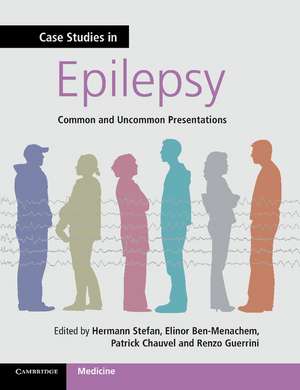
Case Studies in Epilepsy
Editat de Hermann Stefan, Elinor Ben-Menachem, Patrick Chauvelen Limba Engleză Paperback – 25 oct 2013
Ne-a atras atenția, în primul rând, rigoarea vizuală a acestui volum: cele 118 ilustrații alb-negru și cele 16 planșe color nu sunt simple anexe, ci piloni centrali ai procesului de învățare bazat pe probleme. În Case Studies in Epilepsy, componenta imagistică și datele clinice brute sunt utilizate pentru a antrena ochiul specialistului în recunoașterea tiparelor epileptice și non-epileptice. Considerăm că structura propusă de Hermann Stefan și echipa sa de experți transformă lectura într-un exercițiu de diagnostic diferențial activ, forțând cititorul să evalueze critic fiecare simptom, de la sincope la erori înnăscute de metabolism. Această lucrare se situează pe linia clinică a volumului Epilepsy Case Studies de William O. Tatum, dar se diferențiază prin accentul pus pe complexitatea prezentărilor atipice și pe consecințele sociale ale bolii. Dacă în lucrările sale anterioare, precum Epilepsy, Part I: Basic Principles and Diagnosis, Hermann Stefan oferea o perspectivă enciclopedică și teoretică asupra fenomenului, volumul de față din seria Case Studies in Neurology acționează ca o punte către practica nemijlocită. Textul navighează cu precizie clinică prin situații dificile, precum crizele rezistente la tratament sau gestionarea pacienților în stare critică, oferind acele „perle clinice” menționate de European Neurology, care pot rafina deciziile terapeutice în momente de incertitudine. Este o resursă care prioritizează raționamentul integrativ în detrimentul memorării mecanice, fiind esențială pentru rafinarea abilităților de comunicare și lucru în echipă multidisciplinară.
Preț: 466.85 lei
Preț vechi: 491.43 lei
-5%
Carte tipărită la comandă
Livrare economică 27 noiembrie-11 decembrie
Specificații
ISBN-10: 0521167124
Pagini: 214
Ilustrații: 118 b/w illus. 16 colour illus.
Dimensiuni: 189 x 246 x 12 mm
Greutate: 0.42 kg
Ediția:New.
Editura: Cambridge University Press
Locul publicării:Cambridge, United Kingdom
V-ar putea interesa
-
 A Video Atlas of Neuromuscular DisordersAziz Shaibani-5%Preț: 1575.36 lei1658.27 lei
 -
 -24%Preț: 608.90 lei805.17 lei
 -
 Peripheral Neurology: Case StudiesJay Liveson-24%Preț: 934.72 lei1237.43 lei
 -
 Fifty Neurologic Cases from Mayo ClinicJohn H. Noseworthy-25%Preț: 413.46 lei547.72 lei
 -
 Amyotrophic Lateral Sclerosis and the Frontotemporal DementiasMichael J. Strong-26%Preț: 1547.31 lei2098.18 lei
 -
 Stroke Rehabilitation: Insights from Neuroscience and ImagingLeeanne M. Carey-26%Preț: 1550.51 lei2107.73 lei
 -
 -23%Preț: 523.88 lei681.45 lei
 -
 -5%Preț: 530.88 lei558.82 lei
 -
 Common Movement Disorders PitfallsAlberto J. Espay-5%Preț: 697.85 lei734.58 lei
 -
 Palliative NeurologyIan Maddocks-5%Preț: 671.15 lei706.47 lei
 -
 Common Neuro-Ophthalmic PitfallsValerie A. Purvin-5%Preț: 979.56 lei1031.12 lei
 -
 Neural Basis of Semantic MemoryJohn Hart-5%Preț: 894.03 lei941.08 lei
 -
 Autonomic DisordersPaola Sandroni-5%Preț: 711.21 lei748.64 lei
 -
 Smart But StuckThomas E. Brown-5%Preț: 144.20 lei151.79 lei
 -
 Genetic Neuromuscular DisordersCorrado Angelini-5%Preț: 1028.89 lei1083.05 lei
 -
 Atlas of Muscle Innervation ZonesMarco Barbero-5%Preț: 1136.24 lei1196.05 lei
De ce să citești această carte
Recomandăm această carte oricărui neurolog care dorește să își testeze limitele diagnostice dincolo de cazurile clasice. Cititorul câștigă o metodologie clară de abordare a crizelor „puzzling”, învățând să diferențieze cu precizie epilepsia de tulburările de somn sau psihoze. Este un instrument de educație medicală continuă care oferă încredere în gestionarea scenariilor complexe, precum epilepsia în timpul sarcinii sau în unitățile de primiri urgențe.
Despre autor
Hermann Stefan, MD PhD, este o autoritate recunoscută la nivel internațional în domeniul neurologiei, ocupând funcția de profesor de neurologie și epileptologie la Departamentul Neurologic al Universității din Erlangen. Cariera sa este marcată de o contribuție vastă la literatura de specialitate, fiind editorul unor volume fundamentale în seria Handbook of Clinical Neurology. Expertiza sa acoperă întreg spectrul epileptologiei, de la mecanismele de bază și epidemiologie, până la strategii avansate de tratament chirurgical și farmacologic, experiență care se reflectă în calitatea selecției cazurilor clinice din acest volum.