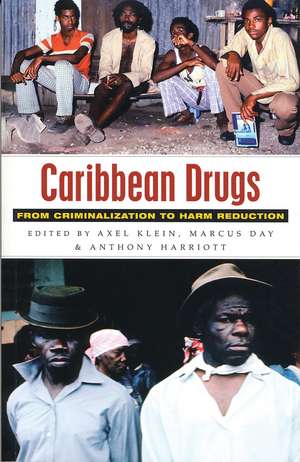
Caribbean Drugs: From Criminalization to Harm Reduction
Editat de Axel Klein, Marcus Day, Anthony Harriotten Limba Engleză Paperback – aug 2004
The dimensions of the illicit drugs market in the Caribbean are made clear. The origins of the problem lie in part, it is argued, with the impact of neoliberal economic policies that have opened up the region's borders and gravely undermined its traditional sources of employment and exports, like bananas and sugar. The islands, in part under external US pressure, have adopted a region-wide policy of criminalization This has involved the creation of specialized drug courts and serious human and social consequences as a result of criminalizing traditional cultural practices around ganja consumption.
Fascinating light is thrown on the difficulties facing drug abuse and rehabilitation centres and the dilemmas they throw up. Harm reduction as a fundamentally alternative approach to the drugs problem is also explored. This is the first book to examine the experiences of Caribbean countries since they adopted a coordinated approach to the drugs problem. There are valuable lessons to be learned at both policy and practical levels for other countries, and in particular those like the UK and US with large Caribbean populations.
Preț: 260.08 lei
Preț vechi: 339.84 lei
-23%
Puncte Express: 390
Carte disponibilă
Livrare economică 09-23 noiembrie
Livrare prin curier în România Termenul estimat este afișat lângă disponibilitate.
Transport gratuit de la 400.00 lei Plată online sau ramburs, în funcție de opțiunile comenzii.
Retur gratuit în 14 zile Comandă securizată și suport în română.
Specificații
ISBN-13: 9781842774991
ISBN-10: 1842774999
Pagini: 272
Ilustrații: Illustrations
Dimensiuni: 136 x 214 x 16 mm
Greutate: 0.32 kg
Ediția:New.
Editura: Bloomsbury Publishing
Colecția Zed Books
Locul publicării:London, United Kingdom
ISBN-10: 1842774999
Pagini: 272
Ilustrații: Illustrations
Dimensiuni: 136 x 214 x 16 mm
Greutate: 0.32 kg
Ediția:New.
Editura: Bloomsbury Publishing
Colecția Zed Books
Locul publicării:London, United Kingdom
V-ar putea interesa
-
 Cognition and AddictionMarcus Munafó-24%Preț: 565.02 lei745.96 lei
 -
 Cannabis Policy: Moving beyond stalemateRobin Room-18%Preț: 570.03 lei697.17 lei
 -
 Global Tobacco ControlP. Cairney-15%Preț: 669.89 lei788.10 lei
 -
 A Million Little PiecesJames FreyPreț: 109.51 lei
 -
 Parents Who Misuse Drugs and aDonald ForresterPreț: 318.76 lei
 -
 Community Treatment of Drug MisuseNicholas Seivewright-5%Preț: 543.02 lei571.61 lei
 -
 Cannabis: A HistoryMartin Booth-18%Preț: 77.42 lei94.54 lei
 -
 Food Of The GodsTerence Mckenna-28%Preț: 88.03 lei121.97 lei
 -
 -5%Preț: 171.66 lei180.70 lei
 -
 Little Red Book, The:Study GuideBill P.Preț: 105.23 lei
 -
 Seeking Safety: A Treatment Manual for PTSD and Substance AbuseLisa M. Najavits-15%Preț: 469.35 lei552.18 lei
 -
 In the Shadows of the NetPATRICK J CARNES-18%Preț: 95.23 lei116.32 lei
Cuprins
Part I: Background and Context
Introduction - Axel Klein, Marcus Day, Anthony Harriott
1. The Search for a New Drug Policy Framework: From the Barbados Plan of action to the Ganja Commission - Axel Klein
Part II: Policy Responses
2. Criminalizing Cultural Practice: The Case of Ganja in Jamaica - Barry Chevannes
3. Drugs Court in Jamaica: Means to an End or End in Itself? - Anthony Harriott and Marlyn Jones
4. Drugs and the Prison System: Impact of Legislative Changes on the Prison Crises in the Commonwealth Caribbean Region - Wendy Singh
5. Rethinking Privatisation: The State and Illegal Drugs in the Commonwealth Caribbean - Philip Nanton
Part III: Interventions on the Ground
6. Drug Abuse Treatment and Rehabilitation in Jamaica and the Caribean - Howard Gough
7. What's the Hook? Diary of a Drop-in Centre or Rehabilitation Before Abstinence - Marcus Day
8. Cayman Drug Council: Practising Harm Reduction in a Zero Tolerance Society - Catherine Chestnut
9. Ethical Dilemmas Surrounding Drug Research: Pitfalls of Gathering Sensitive Information in the Caribbean Context - Jennifer Hillebrand
Part IV: Responses to Opportunity
10. Illicit Drug Markets in the Caribbean: Analysis of Information on Drug Flows Through the Region - Michael Platzer
11. The Ganja Industry and Alternative Development in St Vincent and the Grenadines - Axel Klein
Introduction - Axel Klein, Marcus Day, Anthony Harriott
1. The Search for a New Drug Policy Framework: From the Barbados Plan of action to the Ganja Commission - Axel Klein
Part II: Policy Responses
2. Criminalizing Cultural Practice: The Case of Ganja in Jamaica - Barry Chevannes
3. Drugs Court in Jamaica: Means to an End or End in Itself? - Anthony Harriott and Marlyn Jones
4. Drugs and the Prison System: Impact of Legislative Changes on the Prison Crises in the Commonwealth Caribbean Region - Wendy Singh
5. Rethinking Privatisation: The State and Illegal Drugs in the Commonwealth Caribbean - Philip Nanton
Part III: Interventions on the Ground
6. Drug Abuse Treatment and Rehabilitation in Jamaica and the Caribean - Howard Gough
7. What's the Hook? Diary of a Drop-in Centre or Rehabilitation Before Abstinence - Marcus Day
8. Cayman Drug Council: Practising Harm Reduction in a Zero Tolerance Society - Catherine Chestnut
9. Ethical Dilemmas Surrounding Drug Research: Pitfalls of Gathering Sensitive Information in the Caribbean Context - Jennifer Hillebrand
Part IV: Responses to Opportunity
10. Illicit Drug Markets in the Caribbean: Analysis of Information on Drug Flows Through the Region - Michael Platzer
11. The Ganja Industry and Alternative Development in St Vincent and the Grenadines - Axel Klein
Recenzii
A refreshing look at how the criminalization of ganja has driven a wedge between society and the state in the Caribbean, and how the prosecution of possession fills up the gaols while the differential application of the law allows traffickers to go free. The book is realistic in acknowledging the irresistible pressure from North America and Europe to stop the trafficking through these countries but cogently makes the point that this should not drive domestic policy into more and more punitive responses.
This very welcome book provides a unique insight into smaller countries' attempts to shape their policy and response to drugs in the context of national, regional and international imperatives.
This book fills a major gap, providing substance abuse researchers, clinicians, policy makers, and general readers on both sides of the Atlantic with a collection of interesting and provocative essays. I highly recommend it.
Provides a useful introduction and examination of key policy issues raised by illicit drugs and their considerable impact on Caribbean societies...the book would be useful in courses like Drugs and Society or those on Cultures of the Caribbean.
About a century ago a few colonial countries plus the USA designed a system of prohibiting drugs that now can be considered a major problem for human rights and state sovereignty. This book's useful analysis of the unintended consequences in the Caribbean transit zone of prohibition as drug 'control' may help bring about a much needed review of the system.
It offers a unique quasi-Historical-Comparative (H-C) analysis of illicit drug use, its production, and transshipment across Caribbean countries and beyond...offer readers a thorough review of the contemporary challenges and opportunities enacting an effective Caribbean drug policy entails. The editors show great diligence in outlining social, economic, political, and historical Caribbean realities which few texts currently offer; a practice which surely will keep audiences engaged...The editors of Caribbean Drugs set out to dismantle centuries old stereotypes surrounding illicit drug use in Caribbean region. To this end, they were successful.
This very welcome book provides a unique insight into smaller countries' attempts to shape their policy and response to drugs in the context of national, regional and international imperatives.
This book fills a major gap, providing substance abuse researchers, clinicians, policy makers, and general readers on both sides of the Atlantic with a collection of interesting and provocative essays. I highly recommend it.
Provides a useful introduction and examination of key policy issues raised by illicit drugs and their considerable impact on Caribbean societies...the book would be useful in courses like Drugs and Society or those on Cultures of the Caribbean.
About a century ago a few colonial countries plus the USA designed a system of prohibiting drugs that now can be considered a major problem for human rights and state sovereignty. This book's useful analysis of the unintended consequences in the Caribbean transit zone of prohibition as drug 'control' may help bring about a much needed review of the system.
It offers a unique quasi-Historical-Comparative (H-C) analysis of illicit drug use, its production, and transshipment across Caribbean countries and beyond...offer readers a thorough review of the contemporary challenges and opportunities enacting an effective Caribbean drug policy entails. The editors show great diligence in outlining social, economic, political, and historical Caribbean realities which few texts currently offer; a practice which surely will keep audiences engaged...The editors of Caribbean Drugs set out to dismantle centuries old stereotypes surrounding illicit drug use in Caribbean region. To this end, they were successful.