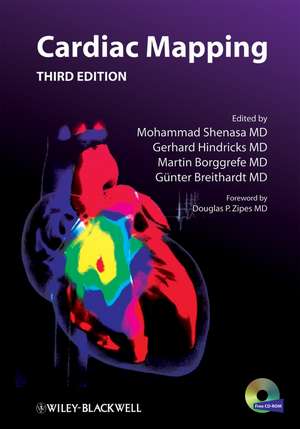
Cardiac Mapping
Editat de Mohammad Shenasa, Gerhard Hindricks, Martin Borggrefe, Gunter Breithardten Limba Engleză Hardback – 4 dec 2008
Reținem, de la prima deschidere a volumului Cardiac Mapping, impactul vizual al celor peste 500 de pagini care transformă semnalele intracardiace abstracte în reprezentări cromatice precise. Ediția a treia marchează tranziția definitivă a tehnologiei de mapare de la un instrument de cercetare la o componentă indispensabilă a laboratorului de electrofiziologie clinică. Subliniem introducerea unui DVD care ilustrează date în timp real din cazuri clinice, oferind o dimensiune dinamică procesului de învățare a ablației prin cateter.
Structura volumului este riguros organizată, debutând cu o perspectivă istorică semnată de Hein J. Wellens și progresând spre fundamentele anatomice și metodologice. Capitolele centrale analizează în detaliu principiile mapării endocardice non-contact și ale navigației magnetice, oferind o analiză critică a punctelor forte și a limitărilor fiecărei tehnologii, precum NavX sau sistemele non-fluoroscopice. Comparativ cu Electrophysiology of Arrhythmias, care se concentrează pe un atlas de înregistrări, Cardiac Mapping pune accentul pe integrarea imaginilor și pe sistemele de navigație 3D, fiind un manual de referință comparabil cu Clinical Arrhythmology and Electrophysiology, dar actualizat conform progreselor tehnologice din 2013.
În contextul operei editorului Mohammad Shenasa, această lucrare completează viziunea sa asupra managementului aritmiilor, regăsită și în Management of Atrial Fibrillation. Dacă lucrările sale anterioare se concentrau pe stratificarea riscului și epidemiologie, Cardiac Mapping plonjează în execuția tehnică și interpretarea substratului aritmogen, fiind esențială pentru înțelegerea mecanismelor electrofiziologice moderne.
Preț: 1523.97 lei
Preț vechi: 1650.34 lei
-8%
Carte disponibilă
Livrare economică 06-20 noiembrie
Specificații
ISBN-10: 1405175729
Pagini: 544
Dimensiuni: 188 x 263 x 34 mm
Greutate: 1.46 kg
Ediția:3rd Edition
Colecția Wiley–Blackwell
Locul publicării:Chichester, United Kingdom
V-ar putea interesa
-
 -5%Preț: 715.54 lei753.20 lei
 -
 Cardiac MappingMohammad Shenasa-5%Preț: 606.56 lei638.48 lei
 -
 Vaccines and AutoimmunityShoenfeld-9%Preț: 1026.62 lei1128.15 lei
 -
 Autophagy, Infection, and the Immune ResponseWilliam T Jackson-9%Preț: 976.03 lei1072.57 lei
 -
 -5%Preț: 427.64 lei450.15 lei
 -
 -5%Preț: 994.48 lei1046.82 lei
 -
 Off-label PrescribingDavid CavallaPreț: 381.77 lei
 -
 Implantable Defibrillator Therapy: A Clinical GuideAntonio Pacifico-5%Preț: 1143.46 lei1203.64 lei
 -
 The Joint KitchenMichael David Ries-5%Preț: 193.61 lei203.80 lei
 -
 Liquid Conspiracy 2Xaviant Haze-5%Preț: 104.71 lei110.21 lei
 -
 Diabetes im AlterJürgen Wernecke-5%Preț: 500.29 lei526.62 lei
 -
 -5%Preț: 694.80 lei731.37 lei
 -
 -5%Preț: 378.91 lei398.86 lei
Public țintă
EP Fellows, EP–Physicians, particularly those performing transcatheter ablation of cardiac arrhythmiasDe ce să citești această carte
Această ediție este vitală pentru specialiștii în electrofiziologie care efectuează ablații complexe. Cititorul câștigă o înțelegere profundă a integrării imaginilor și a sistemelor de navigație non-fluoroscopică, elemente esențiale pentru tratarea fibrilației atriale. Este resursa definitivă pentru a transforma semnalele electrice în hărți anatomice precise, facilitând intervenții mai sigure și mai eficiente.
Despre autor
Mohammad Shenasa este un reputat specialist în electrofiziologie cardiacă, recunoscut la nivel internațional pentru contribuțiile sale editoriale în domeniu. A coordonat numeroase publicații de referință, inclusiv volume din seria „Cardiac Electrophysiology Clinics”, axându-se pe managementul fibrilației atriale și pe stratificarea riscului aritmic. Alături de co-editorii Gerhard Hindricks și Gunter Breithardt, Shenasa a reunit o echipă globală de experți pentru a documenta evoluția tehnicilor de mapare cardiacă de la stadiul experimental la standardul clinic actual.
Descriere scurtă
Descriere
This thoroughly updated third edition focuses on new developments in the field such as mapping of complex arrhythmias, navigation systems, and image integration, with information on the strengths and limitations of each mapping technology. New to this edition is the inclusion of a DVD illustrating real time data from actual cases. Cardiac Mapping remains an integral part of the science and practice of complex rhythm management, and a central resource for the interventional electrophysiologist, rhythmologist and all those interested in understanding the mechanisms of cardiac arrhythmias.
Cuprins
Contributors.
Preface to the First Edition.
Preface to the Second Edition.
Preface to the Third Edition.
Foreword.
Part I Historical Perspectives.
1. Cardiac Activation Mapping: The Amsterdam Years: Hein J. Wellens.
Part II. Methodological and Technical Considerations.
2. Construction and Interpretation of Maps: Lars Eckardt and Günter Breithardt.
3. Cardiac Anatomy for Interventional Electrophysiology and Mapping: Siew Yen Ho, José Angel Cabrera, Damian Sánchez–Quintana.
4. Principles of Noncontact Endocardial Cardiac Mapping: Kim Rajappan and Richard J. Schilling.
5. Principles of Nonfluoroscopic Electroanatomical and Electromechanical Cardiac Mapping: Yitzhack Schwartz and Shlomo A. Ben–Haim.
6. Principles of NavX Mapping: Christopher Piorkowski and Gerhard Hindricks.
7. Magnetic Navigation: Catheter Ablation: Sabine Ernst.
8. CT Angiography Cardiac Anatomy for Mapping and Ablation of Arrhythmias: Jerold S. Shinbane, Daniel Goodwin, Leslie A. Saxon and Matthew J. Budoff.
9. MRI Anatomy for Cardiac Mapping and Ablation: Aravindan Kolandaivelu, Henry R. Halperin and Albert C. Lardo.
10. Challenges and Limitations of Electroanatomical Mapping Technologies: Jeff M. Hsing, Paul Zei, Henry H. Hsia, Paul J. Wang and Amin Al–Ahmad.
.
Part III. Mapping in Experimental Models of Cardiac Arrhythmias.
11. Mapping of Atrial Neural Stimulation and Inhibition in Atrial Fibrillation – Pierre Pagé and Reneé Cardinal.
12. Mapping of Neurally Based Atrial Arrhythmias: Guo–Dong Niu, Benjamin J. Scherlag, Zhibing Lu, Jeffery Edwards, Eugene Patterson, Muhammad Ghias, Annerie Moers, Shu Zang, Ralph Lazzara, Warren M. Jackman and Sunny S. Po.
13. Electrophysiological Mapping of the Right and Left Ventricle in Experimental Animals: Jacques MT de Bakker, Jérôme GM Jungschleger and Marc A. Vos.
Part IV. Mapping of Supraventricular Tachyarrhythmias.
14. Endocardial Catheter Mapping in Patients with Wolff–Parkinson–White Syndrome and Variants of Preexcitation: Nikolaos Dagres and Hans Kottkamp.
15. Transcatheter Cryomapping in AV Nodal Reentrant Tachycardias: Mohammad R. Jazayeri.
16. Mapping and Ablation of AV NRT and its Subtypes: Stephan Willems, Daniel Steven, Boris Lutomsky, Imke Drewitz, Helge Servatius, Thomas Meinertz and Thomas Rostock.
17. New Observations on Mapping and Ablation of Atrial Flutter: Navinder S. Sawhney and Gregory K. Feld.
18. Mapping of Macroreentrant Right and Left Atrial Tachycardias: Mohammad Shenasa, Hossein Shenasa, Christopher Piorkowski and Gerhard Hindricks.
19. Mapping of Focal Atrial Tachycardias: Nitish Badhwar, Byron K. Lee and Jeffery E. Olgin.
20. Interpretation of Atrial Electrograms During Atrial Fibrillation: Sébastien Knecht, Rajesh Subbiah, Mélèze Hocini, Pierre Jaïs, Kang–Teng Lim, Seiichiro Matsuo, Leonardo Arantes, Mark D. O′Neill, Nicolas Derval, Frederic Sacher, Antoine Deplange, Pierre Bordachar, Jacques Clémenty and Michel Haïssaguerre.
21. Different Mapping Approaches for Atrial Fibrillation Ablation: KR Julian Chan, Feifan Ouyand and Karl–Heinze Kuck.
22. Integration of other Imaging Technologies into the Mapping of Atrial Fibrillation: Tamer s. Fahmy, J. David Burkhardt and Andrea Natale.
.
Part V. Mapping of Ventricular Tachyarrhythmias.
23. Substrate Mapping for Ablation of Ventricular Tachycardia in Coronary Artery Disease: John V. Wylie Jr., Timothy W. Smith and Mark E. Josephson.
24. Mapping of Unstable Ventricular Tachycardia: Usha B. Tedrow and William Stevenson.
25. Endocardial and Epicardial Mapping of Nonischemic Right and Left Ventricular Nonischemic Cardiomyopathy: Matthew D. Hutchinson and Francis E. Marchlinski.
26. Role of Mapping in Arrhythmogenic Right Ventricular Cardiomyopathy: Molly Sachdev and Hugh Calkins.
27. Mapping of Idiopathic Ventricular Tachycardias: RV and LV Outflow and Septal Tachycardias: Mohammad Ali Sadr–Ameli, Majid Haghjoo and Zahra Emkanjoo.
28. Role of Different Stimulation Techniques (Pace Mapping, Entrainment Mapping) in Different Subset of Ventricular Tachycardias: Frank Bogun and Fred Morady.
29. Endocardial Catheter Pace Mapping of Ventricular Tachycardias: Mithilesh K. Das, John C. Lopshire, Deepak Bhakta, Anil V. Yadav and John M. Miller.
30. Electrical and Anatomical Mapping of Different Pathologies: Ischemic, Dilated, and Hypertrophic Cardiomyopathies: Arash Arya, Hans Kottkamp, Christopher Piorkowski and Gerhard Hindricks.
31. Mapping and Ablation of Tachyarrhythmias in Patients with Congential Heart Disease: Edward P. Walsh.
32. Transthoracic Epicardial Mapping and Ablation of Ventricular Tachycardia: André d′Avila, Mauricio Scanavacca and Eduardo Sosa.
Part VI. New Frontiers.
33. Mapping of Ventricular Tachycardia and Fibrillation: Role of the Purkinje System: Paul B. Tabereaux, Derek J. Dodsall and Raymond E. Ideker.
34. Mapping Rotors in Animals and Humans during Atrial Fibrillation: Omer Berenfield and Jérôme Khalifa.
35. Role of Mapping in Channelopathies: Brugada Syndrome, Long–QT Syndrome and Idiopathic VF: Sergio Richter and Pedro Brugada.
36. Molecular Cardiovascular Imaging with SPECT and PET: Micahel Schäfers, Günter Breithardt and Otmar Schober.
37. Optical Mapping: Its Impact on Understanding Arrhythmia Mechanisms: Guy Salama and Bum–Rak Choi.
38. The Kinetics of Intracellular Calcium and Arrhythmogenesis in Ischemia/Reperfusion: A Calcium–Centric Mechanism of Arrhythmia: Nabil El–Sharif, Gil Bub and Vikram Lakireddy.
39. Role of Body Surface Mapping: Christian Vahlhaus, Günter Breidthardt and Lars Eckhardt.
40. Electrocardiographic Imaging of Heart Failure Patients with Left Bundle Branch Block: Effects of Right Ventricular Pacing and Cardiac Resynchronization Therapy: Niraj Varma, Ping Jia and Yorum Rudy.
41. How to Better Map and Future Directions in Cardiac Mapping: Mohammad Shenasa, Jafar Shenasa and Javad Rahmian.
Index.
DVD
Recenzii
"This text provides a comprehensive, in–depth insight into current electrophysiological mapping techniques and is written by eminent specialists in the field.... Very well written and has clear explanations along with excellent illustrations." (British Journal of Cardiac Nursing, April 2009)
Notă biografică
Attending Physician
Department of Cardiovascular Services
O Connor Hospital
San Jose, CA, USA
Gerhard Hindricks, MD
Professor of Medicine (Cardiology)
Department of Electrophysiology
Director, University Leipzig – Heart Center
Leipzig, Germany
Martin Borggrefe, MD
Professor of Medicine (Cardiology)
1st Department of Medicine – Cardiology
University Hospital of Mannheim
Mannheim, Germany
Günter Breithardt, MD
Professor of Medicine (Cardiology)
Head, Department of Cardiology and Angiology
Hospital of the University of Münster
Münster, Germany
FOREWORD BY:
Douglas P. Zipes, MD
Distinguished Professor
Krannert Institute of Cardiology
Indiana University School of Medicine
Indianapolis, IN, USA; and
Editor–in–Chief, Heart Rhythm Journal