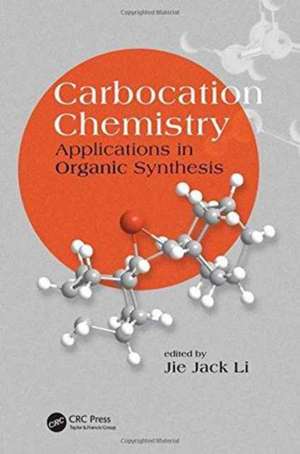
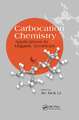
Carbocation Chemistry: Applications in Organic Synthesis: New Directions in Organic & Biological Chemistry
Editat de Jie Jack Lien Limba Engleză Hardback – 13 oct 2016
Din seria New Directions in Organic & Biological Chemistry
- 18%
 Preț: 1473.76 lei
 -
 Preț: 477.59 lei
 -
 Preț: 485.98 lei
 -
 Preț: 424.32 lei
 - 15%
 Preț: 519.15 lei
 -
 Preț: 488.53 lei
 - 18%
 Preț: 2085.42 lei
 - 18%
 Preț: 1913.23 lei
 - 5%
 Preț: 465.80 lei
 - 18%
 Preț: 1482.67 lei
 - 5%
 Preț: 462.57 lei
 - 25%
 Preț: 1202.25 lei
 - 24%
 Preț: 536.81 lei
 - 25%
 Preț: 1100.37 lei
 - nou
 Preț: 1348.46 lei
 - nou
 Preț: 1345.06 lei
 - nou
 Preț: 2563.87 lei
Preț: 1339.58 lei
Preț vechi: 1778.52 lei
-25%
Puncte Express: 2009
Carte indisponibilă temporar
Doresc să fiu notificat când acest titlu va fi disponibil:
Se trimite...
Specificații
ISBN-13: 9781498729086
ISBN-10: 1498729088
Pagini: 222
Ilustrații: 379
Dimensiuni: 156 x 234 x 15 mm
Greutate: 0.45 kg
Ediția:1
Editura: CRC Press
Colecția CRC Press
Seria New Directions in Organic & Biological Chemistry
Locul publicării:Boca Raton, United States
ISBN-10: 1498729088
Pagini: 222
Ilustrații: 379
Dimensiuni: 156 x 234 x 15 mm
Greutate: 0.45 kg
Ediția:1
Editura: CRC Press
Colecția CRC Press
Seria New Directions in Organic & Biological Chemistry
Locul publicării:Boca Raton, United States
Cuprins
Chapter 1. Introduction
- Nomenclature, Structure, and Stability
- Generation of Carbocations
- The Non-Classical Ion Controversy
- Electrophilic Addition to Alkenes
- Electrophilic Aromatic Substitution
- Elimination reactions
- Rearrangement Reactions of Carbocations
- References
- Introduction
- -Activated Alcohols—Brønsted Acids
- -Activated Alcohols—Lewis Acids
- Alkylation of Aldehydes and Ketones
- Glycosylation
- Friedel–Crafts Alkylation and Acylation
- Electrophilic Fluorination Using Fluoronium Ion
- Miscellaneous SN1-related Reactions
- References
- Construction of Quaternary Stereogenic Centers
- Sulfur Chemistry
- Organometallic Chemistry
- Macrocyclization
- Glycosylation
- Nucleoside Analogues
- N-Alkylation
- Cyclotetraphosphazenes
- Conformationally Locked Tetrahydropyran Ring
- The Ionic Liquid Effect
- Silver Chemistry
- References
- Introduction
- Cyclopropanation
- Hydroboration/Oxidation
- The Pauson–Khand Reaction
- Prins Reaction
- Schmidt Reaction
- Halogenation
- Oxymercuration/Reduction
- Epoxidation
- Gold-Catalyzed Alkyne Hydration
- Conclusion
- References
- Introduction
- Nitration
- Halogenation
- Friedel–Crafts Alkylation
- Friedel–Crafts Acylation
- Applications of Friedel–Crafts Reaction on Total Synthesis
- Miscellaneous Electrophilic Aromatic Substitution Reactions
- References
- Claisen Rearrangements
- Cope Rearrangements
- Cope Rearrangements
- Aldehyde (or Ketone) Formation Rearrangements
- Carboxylic Acid Formation Rearrangements
- Alcohol Formation Rearrangements
- Amine Formation Rearrangement
- Amides
- Hydrocarbon Rearrangements
- Oxacyclic, Carbocyclic, Oxazoles, Tetrahydrapuran and Tetrahydropuran Formation Rearrangements
- Rearrangements resulting in less common functional groups
- Fragmentations
- References
Notă biografică
Jie Jack Li earned his Ph.D. in organic chemistry in 1995 at Indiana University. After a stint as a postdoctoral fellow at MIT, he worked as a medicinal chemist at Pfizer and Bristol-Myers Squibb from 1997 to 2012. Since then he has been an Associate Professor of Chemistry at the University of San Francisco teaching organic and medicinal chemistry. He has published 23 books ranging from organic and medicinal chemistry, to the history of drug discovery.
Descriere
Organic chemistry is the science of carbon-containing compounds. There are four major types of reactive intermediates in organic chemistry: carbocations, carboanions, radicals and carbenes. Therefore, carbocation chemistry is not only fundamental to the advancement of organic chemistry, it also has found widespread applications in organic synthesis. It is not an exaggeration to say that carbocation chemistry is part of the foundation of organic chemistry. This book provides a panoramic view of carbocation chemistry with an emphasis on synthetic applications.