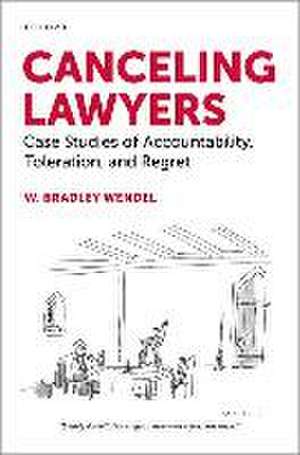
Canceling Lawyers: Case Studies of Accountability, Toleration, and Regret
Autor W. Bradley Wendelen Limba Engleză Hardback – 24 apr 2025
Preț: 218.26 lei
Preț vechi: 254.92 lei
-14%
Puncte Express: 327
Carte disponibilă
Livrare economică 19-25 noiembrie
Livrare express 31 octombrie-06 noiembrie pentru 70.41 lei
Livrare prin curier în România Termenul estimat este afișat lângă disponibilitate.
Transport gratuit de la 400.00 lei Plată online sau ramburs, în funcție de opțiunile comenzii.
Retur gratuit în 14 zile Comandă securizată și suport în română.
Specificații
ISBN-13: 9780197673423
ISBN-10: 0197673422
Pagini: 304
Dimensiuni: 150 x 229 x 33 mm
Greutate: 0.54 kg
Editura: Oxford University Press
Colecția OUP USA
Locul publicării:New York, United States
ISBN-10: 0197673422
Pagini: 304
Dimensiuni: 150 x 229 x 33 mm
Greutate: 0.54 kg
Editura: Oxford University Press
Colecția OUP USA
Locul publicării:New York, United States
V-ar putea interesa
-
 The Art of the AdvocateRichard Du Cann-20%Preț: 85.53 lei106.59 lei
-
 The Rule of Law: A Very Short IntroductionAziz Z. Huq-19%Preț: 57.52 lei71.00 lei
-
 The Morality of LawLon L. FullerPreț: 195.53 lei
-
 Letters to a Young LawyerAlan Dershowitz-26%Preț: 73.09 lei98.73 lei
-
 Preț: 239.74 lei
-
 Unlocking the English Legal SystemTom FrostPreț: 396.86 lei
-
 He Said, She Said: Truth, Trauma and the Struggle for Justice in Family CourtDr Charlotte ProudmanPreț: 144.80 lei
-
 Summer of Our Discontent: The Age of Certainty and the Demise of DiscourseThomas Chatterton Williams-30%Preț: 133.28 lei191.35 lei
-
 Doing JusticePreet Bharara-24%Preț: 54.97 lei72.72 lei
-
 Lawyers on Trial: Hired Guns or Heroes?Christopher Whelan-20%Preț: 187.67 lei235.45 lei
-
 -19%Preț: 110.80 lei136.50 lei
-
 -25%Preț: 81.87 lei109.22 lei
-
 Bad LawElie MystalPreț: 153.07 lei
-
 With the Law on Our SideLady HalePreț: 192.06 lei
-
 The Perfect LawyerSimon McCrumPreț: 176.83 lei
-
 -24%Preț: 142.68 lei188.68 lei
Recenzii
Canceling Lawyers explores the ethics of blame and its complex relationship to the rule of law. The independence of the judiciary is a fundamental component of the rule of law and, in democratic states, politicians tend to avoid personal attacks on judges when decisions do not go their way.
Wendel's book will obviously be of interest to scholars of legal ethics. It will also be of interest to moral philosophers because of the thoughtful and thought provoking position it takes on role morality.
Wendel's book will obviously be of interest to scholars of legal ethics. It will also be of interest to moral philosophers because of the thoughtful and thought provoking position it takes on role morality.
Notă biografică
W. Bradley Wendel is a legal ethics scholar, trained as both a lawyer and a philosopher. He has a B.A. from Rice University, a J.D. from Duke Law School, and an LL.M. and J.S.D. from Columbia Law School, in legal philosophy. Before entering academia Dr. Wendel clerked for Judge Andrew J. Kleinfeld on the U.S. Court of Appeals for the Ninth Circuit in Fairbanks, Alaska, and practiced as a products liability litigator in Seattle. He started his academic career at Washington and Lee Law School and moved to Cornell Law School in 2014.
Cuprins
- Preface
- 1. Swiss Banks and Nazi Gold
- Crisis at Cravath
- Against nonaccountability
- The justification of John Adams
- The Freedman-Tigar debate
- "Ethics rules" and client choice . for American lawyers
- Contested meanings
- 2. Morality and Relationships: Accountability and Reactive Attitudes
- Morality beyond duties and rights
- Reactive attitudes
- Reactive attitudes and reasonable expectations
- Reactive attitudes and the scope of the moral community
- 3. Harvey Weinstein, Ronald Sullivan, and Harvard University
- Joining Weinstein's dream team
- Answering "the Question"
- Making clients radioactive
- 4. Blame, the Meaning of Actions, and the Ethics of Blame
- Blameworthiness vs. wrongness
- What do you mean by that?
- The ethics of blaming
- How wide is the circle of blame?
- What standards apply to determine blameworthiness and appropriate blaming responses?
- Toleration
- Don't feed the trolls
- 5. Boycotts of Law Firms and the Ethics of Informal Social Sanctions
- The "obsequious servants of business"?
- Down with Big Oil
- Reasonable disagreement and the role of the legal system
- Formal and informal power
- 6. The Challenge of Role Morality
- The persistence of the personal
- Three mistakes about professional roles
- Mistake #1: Too much weight on the duties of the role
- Mistake #2: Too little appreciation for the significance of the role
- Mistake #3: Excluding personal identity altogether
- Roles and professional ethics
- Are roles exclusionary or just very weighty?
- 7. McCarthyism or Legitimate Criticism? Canceling Government Lawyers
- From the Trump administration back to polite society?
- Blame and the Big Lie
- Whose side are you on? The "Department of Jihad"
- Fidelity to law and abusive legal advice
- 8. Regret and Moral Costs
- Excruciating cases
- How moral remainders arise (and what to do with them)
- Conclusions