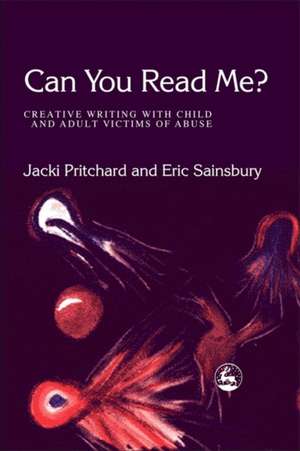
Can You Read Me?: Creative Writing With Child and Adult Victims of Abuse
Editat de Jacki Pritchard, Eric Sainsburyen Limba Engleză Paperback – 15 mar 2004
In addition to individual contributors, the book records the activities of groups developed by Barnardos for children and young people and by Beyond Existing for adults. Although not written as a training manual per se, the book offers photocopiable exercises and an appendix of writings for use in staff training.
Can You Read Me? illustrates the great potential for applying our creative imaginations and personal qualities like sensitivity in work with survivors of abuse and those with mental health and disability problems.
.
Preț: 181.19 lei
Preț vechi: 260.59 lei
-30%
Puncte Express: 272
Preț estimativ în valută:
32.05€ • 37.46$ • 27.86£
32.05€ • 37.46$ • 27.86£
Carte indisponibilă temporar
Doresc să fiu notificat când acest titlu va fi disponibil:
Se trimite...
Specificații
ISBN-13: 9781843101925
ISBN-10: 1843101920
Pagini: 238
Dimensiuni: 158 x 231 x 13 mm
Greutate: 0.36 kg
Editura: JESSICA KINGSLEY PUBLISHERS
Colecția Jessica Kingsley Publishers
Locul publicării:London, United Kingdom
ISBN-10: 1843101920
Pagini: 238
Dimensiuni: 158 x 231 x 13 mm
Greutate: 0.36 kg
Editura: JESSICA KINGSLEY PUBLISHERS
Colecția Jessica Kingsley Publishers
Locul publicării:London, United Kingdom
Recenzii
Occupational therapists will already be familiar with the principles of group work but the book demonstrates who the use of poetry can be used to order the chaos of the thoughts of the writers and describes the practical use of journals for workers in helping victims through the healing process. The book is also littered with useful snippets of advice. It is written in an economical, plain language sensitive to the subject matter and is deceptively quick to read as you are drawn in by the emotional raw poetry and writing it contains.
The first sixty-seven pages explore the creation of the book, understanding the origins of the work it presents and seeking to analyse it. These pages, in my opinion, concretise the book's real value. In my own experience as a counsellor with survivors of abuse, writing is frequently employed as a therapeutic tool but is less frequently well-understood. The book is clear and understandable. Various exercises are handily summarised in a series of readymade handouts, which may be photocopied and reused. This would be a valuable addition to the library of anyone working, or considering work, with survivors of abuse.
The editors have succeeded in giving health care workers both the opportunity to increase their sensitivity and to develop responses that are caring and support emotional healing. This book is highly recommended for all health care professionals who provide therapeutic care to child and adult survivors of abuse and those who would like to experience an uplifting look into the resilience of the human spirit.
The book is a guide to ways in which creative writing and personal disclosure help sufferers to express themselves and cope. There are a range of case studies, practical writing exercises and guidelines for facilitating groups and encouraging participants to develop self-esteem. The book is aimed at health and social care workers, but aids understanding and contains guidelines for those working with any writing group, in which a member may include a victim of abuse.
The first sixty-seven pages explore the creation of the book, understanding the origins of the work it presents and seeking to analyse it. These pages, in my opinion, concretise the book's real value. In my own experience as a counsellor with survivors of abuse, writing is frequently employed as a therapeutic tool but is less frequently well-understood. The book is clear and understandable. Various exercises are handily summarised in a series of readymade handouts, which may be photocopied and reused. This would be a valuable addition to the library of anyone working, or considering work, with survivors of abuse.
The editors have succeeded in giving health care workers both the opportunity to increase their sensitivity and to develop responses that are caring and support emotional healing. This book is highly recommended for all health care professionals who provide therapeutic care to child and adult survivors of abuse and those who would like to experience an uplifting look into the resilience of the human spirit.
The book is a guide to ways in which creative writing and personal disclosure help sufferers to express themselves and cope. There are a range of case studies, practical writing exercises and guidelines for facilitating groups and encouraging participants to develop self-esteem. The book is aimed at health and social care workers, but aids understanding and contains guidelines for those working with any writing group, in which a member may include a victim of abuse.
Cuprins
Acknowledgements. Glossary of Terms. 1. What It's All About 2. Issues and Practicalities in Preparing the Book. 3. The Projects. 4. Themes from the Interviews with the Writers. 5. Using Poetry 1: Poems Presented by the Younger Adults. 6. Using Poetry 2: Poems Presented by the Other Adults. 7. Using Journals. 8. Using Stories 1: Adults. 9. Using Stories 2: Children. 10. Endings and Beginnings. 11. Exercises for Adult Victims. References. Index