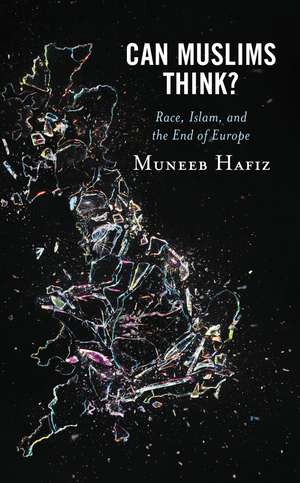
Can Muslims Think?: Race, Islam, and the End of Europe
Autor Muneeb Hafizen Limba Engleză Hardback – 21 iun 2022
Preț: 606.04 lei
Preț vechi: 917.08 lei
-34%
Puncte Express: 909
Carte tipărită la comandă
Livrare economică 18 noiembrie-02 decembrie
Livrare prin curier în România Termenul estimat este afișat lângă disponibilitate.
Transport gratuit pentru acest produs Plată online sau ramburs, în funcție de opțiunile comenzii.
Retur gratuit în 14 zile Comandă securizată și suport în română.
Specificații
ISBN-13: 9781538165072
ISBN-10: 1538165074
Pagini: 384
Ilustrații: 2 b/w illustrations; 4 b/w photos
Dimensiuni: 154 x 230 x 28 mm
Greutate: 0.72 kg
Editura: Bloomsbury Publishing
Colecția Rowman & Littlefield
Locul publicării:New York, United States
ISBN-10: 1538165074
Pagini: 384
Ilustrații: 2 b/w illustrations; 4 b/w photos
Dimensiuni: 154 x 230 x 28 mm
Greutate: 0.72 kg
Editura: Bloomsbury Publishing
Colecția Rowman & Littlefield
Locul publicării:New York, United States
Cuprins
What's in a Question?
Part 1: The Muslim Questioned
Chapter 1: Distance
Chapter 2: Disclosure
Chapter 3: Secrecy
Part 2: The Muslim Question
Chapter 4: Proximity
Chapter 5: Affirmation
Chapter 6: Publicity
Part 3: The Muslim Questioner
Chapter 7: Refusal
Chapter 8: Transparency
Chapter 9: Otherwise. Or, coordinates for an Other world
Bibliography
Part 1: The Muslim Questioned
Chapter 1: Distance
Chapter 2: Disclosure
Chapter 3: Secrecy
Part 2: The Muslim Question
Chapter 4: Proximity
Chapter 5: Affirmation
Chapter 6: Publicity
Part 3: The Muslim Questioner
Chapter 7: Refusal
Chapter 8: Transparency
Chapter 9: Otherwise. Or, coordinates for an Other world
Bibliography
Recenzii
Muneeb Hafiz has written a necessary book on Islamophobia, making sense of it in its proper time and place. That is, British Islamophobia is not just about Muslims per se, but about Britain coming to terms with its troubled past and uncertain future.
Can Muslims Think? is a deeply illuminating account of why Muslim identity has become so significant to the post-empire British imagination about self and other. In the process, Hafiz displays a mastery of philosophical and historical sources and teases out in compelling detail continuities and disjunctures in racial formation. The result is an essential guide for making sense of Islamophobia today as well as for confronting persistent and intertwined logics of racism and colonialism.
Both refreshing and daring in its command of rich but often neglected theoretical repertoires, Can Muslims Think brings a striking freshness to the critique of Islamophobia's rotten hold on Europe's melancholic psyche. With timely originality, Hafiz places today's all-consuming Islamophobia squarely within the wider conditions of Europe's general decline. Hafiz poignantly shows that Europe's refusal to reconcile itself to a humbled sense of its place in the world not only renders Muslims a fetichised and brutalised object of revanchist fear and alarm, but also stunts the very ability of Europeans who believe themselves to be natives to realise an affirmative, humanist future. At stake in Can Muslims Think is nothing less than our collective ability to live humane lives once spared the violent and now anachronistic delusions of European grandeur, civilisation and cohesiveness.
Islamophobia, a pervasive and escalating phenomenon in Western Europe, is fueling a surge of nativist and anti-internationalist sentiment. This sentiment, deeply rooted in fear and misunderstanding, has profound implications for Muslim minorities, who often find themselves at the receiving end of systemic marginalization and exclusion. The rise of populist, anti-immigrant sentiment has been a significant driver of these developments. Populist movements, often characterized by their simplistic and reductionist narratives, have capitalized on economic insecurities and cultural anxieties to scapegoat Muslim minorities and other immigrant groups. This scapegoating serves to consolidate their political base and legitimize their exclusionary policies. The resulting marginalization of Muslim minorities, in turn, exacerbates social divisions and perpetuates a cycle of fear, mistrust, and hostility. Hafiz's work is both a call for a more inclusive and empathetic future and a critical examination of the structural and historical roots of Islamophobia. It is an indispensable read for anyone interested in race, religion, or identity in contemporary Europe, making a substantial contribution to the discourse on these topics.
Can Muslims Think? is a deeply illuminating account of why Muslim identity has become so significant to the post-empire British imagination about self and other. In the process, Hafiz displays a mastery of philosophical and historical sources and teases out in compelling detail continuities and disjunctures in racial formation. The result is an essential guide for making sense of Islamophobia today as well as for confronting persistent and intertwined logics of racism and colonialism.
Both refreshing and daring in its command of rich but often neglected theoretical repertoires, Can Muslims Think brings a striking freshness to the critique of Islamophobia's rotten hold on Europe's melancholic psyche. With timely originality, Hafiz places today's all-consuming Islamophobia squarely within the wider conditions of Europe's general decline. Hafiz poignantly shows that Europe's refusal to reconcile itself to a humbled sense of its place in the world not only renders Muslims a fetichised and brutalised object of revanchist fear and alarm, but also stunts the very ability of Europeans who believe themselves to be natives to realise an affirmative, humanist future. At stake in Can Muslims Think is nothing less than our collective ability to live humane lives once spared the violent and now anachronistic delusions of European grandeur, civilisation and cohesiveness.
Islamophobia, a pervasive and escalating phenomenon in Western Europe, is fueling a surge of nativist and anti-internationalist sentiment. This sentiment, deeply rooted in fear and misunderstanding, has profound implications for Muslim minorities, who often find themselves at the receiving end of systemic marginalization and exclusion. The rise of populist, anti-immigrant sentiment has been a significant driver of these developments. Populist movements, often characterized by their simplistic and reductionist narratives, have capitalized on economic insecurities and cultural anxieties to scapegoat Muslim minorities and other immigrant groups. This scapegoating serves to consolidate their political base and legitimize their exclusionary policies. The resulting marginalization of Muslim minorities, in turn, exacerbates social divisions and perpetuates a cycle of fear, mistrust, and hostility. Hafiz's work is both a call for a more inclusive and empathetic future and a critical examination of the structural and historical roots of Islamophobia. It is an indispensable read for anyone interested in race, religion, or identity in contemporary Europe, making a substantial contribution to the discourse on these topics.