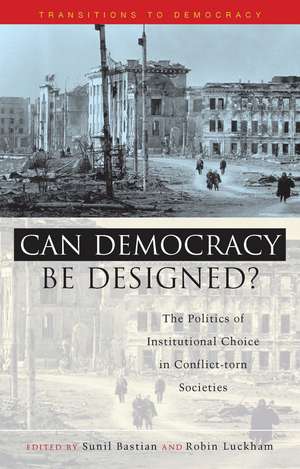
Can Democracy be Designed?: The Politics of Institutional Choice in Conflict-Torn Societies: Transitions to Democracy
Editat de Robin Luckham, Sunil Bastianen Limba Engleză Paperback – iun 2003
The authors, while regarding democracy as a general entitlement, refuse to subscribe to a triumphalist view which sees it as a universal panacea. Instead they seek to understand how democratic institutions actually facilitate (or sometimes fail to facilitate) improved governance and the management of conflict in a variety of national settings.
This thoughtful and empirical set of explorations is highly relevant to other societies wrestling with similar problems of institutional design in situations of democratic transition and/or deep-seated social conflict.

Preț: 219.74 lei
Preț vechi: 262.09 lei
-16%
Puncte Express: 330
Carte tipărită la comandă
Livrare economică 01-15 decembrie
Livrare prin curier în România Termenul estimat este afișat lângă disponibilitate.
Transport gratuit de la 400.00 lei Plată online sau ramburs, în funcție de opțiunile comenzii.
Retur gratuit în 14 zile Comandă securizată și suport în română.
Specificații
ISBN-13: 9781842771518
ISBN-10: 1842771515
Pagini: 352
Ilustrații: notes, bibliography, index
Dimensiuni: 136 x 214 x 24 mm
Greutate: 0.46 kg
Editura: Bloomsbury Publishing
Colecția Zed Books
Seria Transitions to Democracy
Locul publicării:London, United Kingdom
ISBN-10: 1842771515
Pagini: 352
Ilustrații: notes, bibliography, index
Dimensiuni: 136 x 214 x 24 mm
Greutate: 0.46 kg
Editura: Bloomsbury Publishing
Colecția Zed Books
Seria Transitions to Democracy
Locul publicării:London, United Kingdom
V-ar putea interesa
-
 The Oxford Handbook of Law and PoliticsKeith E. Whittington-19%Preț: 318.06 lei391.70 lei
 -
 -31%Preț: 826.04 lei1191.14 lei
 -
 -33%Preț: 854.69 lei1268.34 lei
 -
 -31%Preț: 626.45 lei909.30 lei
 -
 Preț: 251.60 lei
 -
 Constructing Sovereignty between Politics and LawTanja Aalberts-18%Preț: 1431.87 lei1746.17 lei
 -
 Ordinary InjusticeAmy BachPreț: 134.31 lei
 -
 Lost American PrinciplesSteven L HallPreț: 115.13 lei
 -
 Preț: 281.63 lei
 -
 The Constitution of Australia: A Contextual AnalysisProfessor Cheryl Saunders-16%Preț: 201.56 lei240.59 lei
 -
 The Constitution of France: A Contextual AnalysisSophie Boyron-20%Preț: 199.72 lei250.89 lei
 -
 -18%Preț: 191.44 lei232.70 lei
 -
 -17%Preț: 193.03 lei231.25 lei
Cuprins
Introduction: Can Democracy be Designed? - Sunil Bastian and Robin Luckham
1. Democratic Institutions and Democratic Politics and Political Violence - Robin Luckham, Anne Marie Goetz and Mary Kaldor
2. The Politics of Institutional Design in the South African Transition - David Pottie and Shireen Hassim
3. The Reformulation of Ugandan Democracy - James Katalikawe and Aaron Griffiths
4. Ghana: The Political Economy of 'Successful' Ethno-Regional Conflict Management - E. Gyimah-Boadi
5. The Politics of Institutional Design: An Overview of the Case of Sri Lanka - Radhika Coomaraswamy
6. Proportional Representation, Political Violence and the Participation of Women in the Political Process in Sri Lanka - Kishali Pinto Jayawardena
7. The Political Economy of Electoral Reform: Proportional Representation in Sri Lanka - Sunil Bastian
8. Electoral Engineering and the Politicization of Ethnic Frictions in Fiji - Jon Fraenkel
9. Building Democracy from the Outside: The Dayton Agreement in Bosnia and Herzegovina - Marcus Fox
10. Managing Ethnic Conflicts: Democratic Decentralization in Bosnia-Hercegovina - Vesna Bojicic
11. Conclusion: The Politics of Institutional Choice - Sunil Bastian and Robin Luckham
1. Democratic Institutions and Democratic Politics and Political Violence - Robin Luckham, Anne Marie Goetz and Mary Kaldor
2. The Politics of Institutional Design in the South African Transition - David Pottie and Shireen Hassim
3. The Reformulation of Ugandan Democracy - James Katalikawe and Aaron Griffiths
4. Ghana: The Political Economy of 'Successful' Ethno-Regional Conflict Management - E. Gyimah-Boadi
5. The Politics of Institutional Design: An Overview of the Case of Sri Lanka - Radhika Coomaraswamy
6. Proportional Representation, Political Violence and the Participation of Women in the Political Process in Sri Lanka - Kishali Pinto Jayawardena
7. The Political Economy of Electoral Reform: Proportional Representation in Sri Lanka - Sunil Bastian
8. Electoral Engineering and the Politicization of Ethnic Frictions in Fiji - Jon Fraenkel
9. Building Democracy from the Outside: The Dayton Agreement in Bosnia and Herzegovina - Marcus Fox
10. Managing Ethnic Conflicts: Democratic Decentralization in Bosnia-Hercegovina - Vesna Bojicic
11. Conclusion: The Politics of Institutional Choice - Sunil Bastian and Robin Luckham
Recenzii
These highly informed original contributions on the politics of institutional design offer a wealth of insights.
The book reinforces a message that cannot be repeated too often, it seems, which is the need to relate institutions and institutional innovation to its specific political context.
The book reinforces a message that cannot be repeated too often, it seems, which is the need to relate institutions and institutional innovation to its specific political context.