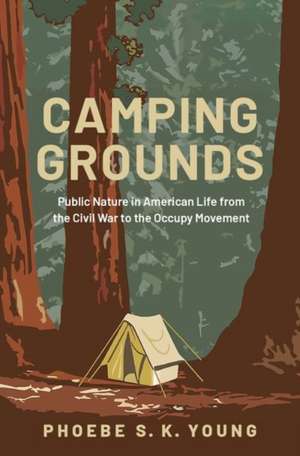
Camping Grounds: Public Nature in American Life from the Civil War to the Occupy Movement
Autor Phoebe S.K. Youngen Limba Engleză Hardback – 30 sep 2021
Preț: 227.78 lei
Preț vechi: 265.66 lei
-14%
Puncte Express: 342
Carte tipărită la comandă
Livrare economică 10-16 decembrie
Livrare express 31 octombrie-06 noiembrie pentru 79.60 lei
Livrare prin curier în România Termenul estimat este afișat lângă disponibilitate.
Transport gratuit de la 400.00 lei Plată online sau ramburs, în funcție de opțiunile comenzii.
Retur gratuit în 14 zile Comandă securizată și suport în română.
Specificații
ISBN-13: 9780195372410
ISBN-10: 0195372417
Pagini: 432
Ilustrații: 65 halftones
Dimensiuni: 236 x 157 x 41 mm
Greutate: 0.73 kg
Editura: Oxford University Press
Colecția OUP USA
Locul publicării:New York, United States
ISBN-10: 0195372417
Pagini: 432
Ilustrații: 65 halftones
Dimensiuni: 236 x 157 x 41 mm
Greutate: 0.73 kg
Editura: Oxford University Press
Colecția OUP USA
Locul publicării:New York, United States
Recenzii
Young deserves praise for creating fertile ground for historians of the environment, race, class, and gender to further complicate the narrative of camping in North America, as well as demonstrating how others can critically engage with conceptions of government responsibility and public nature.
A rich and compelling book that follows two intersecting paths through the history of camping. The most obvious path is that of recreational camping....The second path is the history of protest camping, from Civil War veterans to Occupy protesters.... While Camping Grounds centers on the practices of camping, as recreation and protest, it situates this analysis in the broader overarching concept of 'public nature.'...[Its] concern, one with implications for the future, is that other forms of camping-such as a mode of protest or as a matter of necessity-are delegitimized, as a market-based recreational ethos crowds out the potential for camping to yield broader public goods....This concept of public nature will serve historians well as they wrestle with how we use, govern, and consume nature to reflect, shore up, and challenge hierarchies of power in the United States.
Recreational camping and political camping, two voluntary but contrasting activities, and functional camping, an involuntary activity, are the three forms of American camping explored in this excellent, well-researched book. Most camping scholarship...concentrates on the first of the three forms while neglecting the other two. Young's...demonstration of the interrelatedness of and shaping interactions between the three forms makes it exceptionally revealing and valuable....Young convincingly demonstrates that camping today is complicated, contains multiple meanings, and can be both a highly popular form of leisure and the justification for an arrest by law enforcement. In addition to being a revealing analysis, Camping Grounds is an engaging narrative....I strongly recommend Camping Grounds to readers who wish to better understand how America came to include an everyday activity that is both praised and condemned, often by the same people.
This is a magnificent study of camping in the US, from the mid-19th century to 2019. Camping has had significantly different meanings at different times in US history, and Young explores three different eras. Early camping was primarily a way of sheltering while traveling, or while in a state of military transition, with emphasis on organizing people....Camping as a choice and pastime emerged later and played a role in changing views of class and race in the US....In the late 19th century, camping became an alternative to resort vacations, taking on social and economic implications. The camping equipment industry and planned campgrounds emerged. The popularity of camping in the second half of the 20th century created environmental and institutional problems, resulting in a wilderness ethic and economic opportunities....Relevant to social and environmental studies and law....Recommended. Lower-division undergraduates through professionals.
A varied and comprehensive overview of modern camping with ample detail and sociological perspective on the origins of camping and its roles in war, protest, consumerism, and class discrimination.
Young, an environmental historian, traces "camping" back to the Civil War and explores its implications for social justice and political discourse—beyond its more obvious role as a mere diversional outdoor activity.
In Camping Grounds, Phoebe Young presents the surprisingly political history of sleeping outside, in which veterans, vagrants, migrants, recreationists, protestors, bureaucrats, officials, police, and others have fought over the meaning of public nature, with profound implications for American life and the American social compact. Artfully written, creatively researched, a tour de force that will change the way you see your country.
In this brilliant new book, Phoebe Young asks a seemingly simple question: 'What does it mean to camp and why does it matter?' The answer is strikingly complex and in its pursuit Camping Grounds offers a radically inclusive vision of America's public nature and environmental culture.
Phoebe Young strips the innocence from sleeping under the stars, revealing this quintessential American pastime as a precarious practice — one long bedeviled by class tensions, legal wrangling over the definition of camping, and ever-shifting claims on public nature.
My recommendation?: gather 'round the campfire with a s'more, and read this smart, engaging book. Young exposes the 'simple life' of camping as a complex set of negotiations historically about your environments, your government, your fellow citizens...and yourself.
Young uses a broad-minded version of cultural history to offer a sweeping view of the politics of camping out in the United States over the last 160 years. Her history's origin story constitutes a fresh take on the significance of soldiers' experience in the Civil War. While the men in blue and gray may have ravaged any number of forests, they also imprinted on comradely campfires under the forest canopy. The nature of encampment in American history turns out to be thought-provokingly complex... Young's book demonstrates that, ever since the Civil War, to camp in the United States has been to raise crucial questions about who gets to feel 'at home' in this particular homeland.
A fascinating look at the role of camping in U.S. history that will prove insightful not only for readers interested in recreation and environmental history, but also those seeking nuanced histories of capitalism, political protest, environmental justice, labor, and more... Young elegantly incorporates complicated, interwoven histories into a clear narrative. She includes analyses of the complicated relationships between race and camping, especially for African Americans for whom, over time, camping has served variously as a means of self-emancipation, a site of exclusion from explicitly or implicitly segregated spaces, a tool for protest, and a form of recreation. Likewise, she demonstrates that the development of recreational camping depended on the removal and exclusion of Indigenous peoples from land.
A rich and compelling book that follows two intersecting paths through the history of camping. The most obvious path is that of recreational camping....The second path is the history of protest camping, from Civil War veterans to Occupy protesters.... While Camping Grounds centers on the practices of camping, as recreation and protest, it situates this analysis in the broader overarching concept of 'public nature.'...[Its] concern, one with implications for the future, is that other forms of camping-such as a mode of protest or as a matter of necessity-are delegitimized, as a market-based recreational ethos crowds out the potential for camping to yield broader public goods....This concept of public nature will serve historians well as they wrestle with how we use, govern, and consume nature to reflect, shore up, and challenge hierarchies of power in the United States.
Recreational camping and political camping, two voluntary but contrasting activities, and functional camping, an involuntary activity, are the three forms of American camping explored in this excellent, well-researched book. Most camping scholarship...concentrates on the first of the three forms while neglecting the other two. Young's...demonstration of the interrelatedness of and shaping interactions between the three forms makes it exceptionally revealing and valuable....Young convincingly demonstrates that camping today is complicated, contains multiple meanings, and can be both a highly popular form of leisure and the justification for an arrest by law enforcement. In addition to being a revealing analysis, Camping Grounds is an engaging narrative....I strongly recommend Camping Grounds to readers who wish to better understand how America came to include an everyday activity that is both praised and condemned, often by the same people.
This is a magnificent study of camping in the US, from the mid-19th century to 2019. Camping has had significantly different meanings at different times in US history, and Young explores three different eras. Early camping was primarily a way of sheltering while traveling, or while in a state of military transition, with emphasis on organizing people....Camping as a choice and pastime emerged later and played a role in changing views of class and race in the US....In the late 19th century, camping became an alternative to resort vacations, taking on social and economic implications. The camping equipment industry and planned campgrounds emerged. The popularity of camping in the second half of the 20th century created environmental and institutional problems, resulting in a wilderness ethic and economic opportunities....Relevant to social and environmental studies and law....Recommended. Lower-division undergraduates through professionals.
A varied and comprehensive overview of modern camping with ample detail and sociological perspective on the origins of camping and its roles in war, protest, consumerism, and class discrimination.
Young, an environmental historian, traces "camping" back to the Civil War and explores its implications for social justice and political discourse—beyond its more obvious role as a mere diversional outdoor activity.
In Camping Grounds, Phoebe Young presents the surprisingly political history of sleeping outside, in which veterans, vagrants, migrants, recreationists, protestors, bureaucrats, officials, police, and others have fought over the meaning of public nature, with profound implications for American life and the American social compact. Artfully written, creatively researched, a tour de force that will change the way you see your country.
In this brilliant new book, Phoebe Young asks a seemingly simple question: 'What does it mean to camp and why does it matter?' The answer is strikingly complex and in its pursuit Camping Grounds offers a radically inclusive vision of America's public nature and environmental culture.
Phoebe Young strips the innocence from sleeping under the stars, revealing this quintessential American pastime as a precarious practice — one long bedeviled by class tensions, legal wrangling over the definition of camping, and ever-shifting claims on public nature.
My recommendation?: gather 'round the campfire with a s'more, and read this smart, engaging book. Young exposes the 'simple life' of camping as a complex set of negotiations historically about your environments, your government, your fellow citizens...and yourself.
Young uses a broad-minded version of cultural history to offer a sweeping view of the politics of camping out in the United States over the last 160 years. Her history's origin story constitutes a fresh take on the significance of soldiers' experience in the Civil War. While the men in blue and gray may have ravaged any number of forests, they also imprinted on comradely campfires under the forest canopy. The nature of encampment in American history turns out to be thought-provokingly complex... Young's book demonstrates that, ever since the Civil War, to camp in the United States has been to raise crucial questions about who gets to feel 'at home' in this particular homeland.
A fascinating look at the role of camping in U.S. history that will prove insightful not only for readers interested in recreation and environmental history, but also those seeking nuanced histories of capitalism, political protest, environmental justice, labor, and more... Young elegantly incorporates complicated, interwoven histories into a clear narrative. She includes analyses of the complicated relationships between race and camping, especially for African Americans for whom, over time, camping has served variously as a means of self-emancipation, a site of exclusion from explicitly or implicitly segregated spaces, a tool for protest, and a form of recreation. Likewise, she demonstrates that the development of recreational camping depended on the removal and exclusion of Indigenous peoples from land.
Notă biografică
Phoebe S.K. Young is an associate professor of history at the University of Colorado Boulder. She is the author of California Vieja: Culture and Memory in a Modern American Place.
Cuprins
- Acknowledgments
- Introduction: Public Nature
- Part One: 1850s-1880s
- Ch. 1. Saving the Union
- Ch. 2. Seeing the Country
- Part Two: 1890s-1940s
- Ch. 3. Tramp Style
- Ch. 4. Campers' Republic
- Part Three: 1950s-2010s
- Ch. 5. The Back to Nature Crowd
- ch. 6. Tents and Public Statements
- Epilogue: "We MUST Camp"
- Notes
- Index